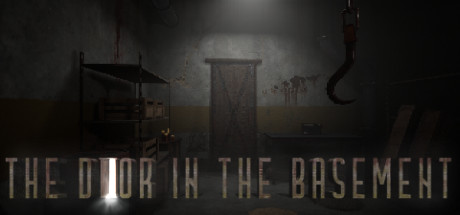
The Door in the Basement, developed and published by Aegon Games, is a compact first-person horror title that builds its identity around atmosphere and unease rather than complex systems or traditional gameplay loops. It begins with a simple, almost mundane setup—an ordinary basement concealing something unnatural—but quickly shifts into a surreal descent once the player steps through the titular door. From that moment on, the game abandons conventional logic and embraces a dreamlike structure, placing the player in a series of interconnected underground spaces that feel more psychological than physical.
The experience is primarily driven by exploration. Players move through narrow tunnels, cavernous rooms, and abstract environments that rarely follow a clear architectural logic. There are occasional interactions—simple puzzles, environmental triggers, and moments where timing or awareness matters—but these elements remain intentionally minimal. The focus is less on solving challenges and more on navigating the unknown. This design keeps the experience accessible, but it also places a heavy burden on the game’s atmosphere to sustain engagement, as there are few mechanical systems to fall back on.
Where the game succeeds most clearly is in its ability to create tension through restraint. Long stretches of quiet exploration are punctuated by subtle audio cues and environmental shifts that gradually build unease. The absence of constant threats allows the player’s imagination to fill in the gaps, making the world feel more oppressive than overtly dangerous. When hostile encounters do occur, they are used sparingly, often relying on simple avoidance rather than direct confrontation. These moments can be effective in breaking the rhythm of exploration, though they rarely evolve beyond their initial impact and can feel predictable after repeated exposure.
Visually, the game adopts a deliberately low-resolution, retro-inspired aesthetic that works in its favor. The pixelated presentation obscures detail just enough to make environments feel uncertain and unstable, reinforcing the sense that the player is navigating something unnatural. Rather than striving for realism, the visuals lean into abstraction, allowing shapes, shadows, and movement to suggest more than they explicitly show. This approach enhances the psychological aspect of the horror, making the environment itself feel like an extension of the game’s underlying themes.
Narrative elements are present but intentionally fragmented. There is no clear storyline guiding the player, and exposition is kept to a minimum. Instead, meaning is conveyed through scattered notes, environmental details, and the overall tone of the world. The result is an experience that invites interpretation rather than providing answers. Some players may find this ambiguity compelling, as it encourages them to piece together their own understanding of what is happening. Others may find it too vague, lacking the structure needed to create a strong narrative payoff.
One of the more noticeable aspects of The Door in the Basement is its brevity. The game can be completed in a relatively short time, often within a single sitting. This works to its advantage in maintaining a consistent level of tension, as the experience does not overextend itself or dilute its core ideas. At the same time, the limited runtime means that there is little room for mechanics or themes to develop further. Once the initial concept has been explored, the game reaches its conclusion without significantly expanding on it.
Despite its simplicity, the game manages to leave a lasting impression through its cohesive atmosphere and focused design. It understands the kind of experience it wants to deliver and avoids unnecessary complexity, instead relying on mood, pacing, and environmental storytelling to carry the player forward. While it does not offer the depth or variety of larger horror titles, it compensates with a consistent sense of unease that persists throughout its runtime.
Ultimately, The Door in the Basement is best approached as a short, atmospheric horror vignette rather than a fully fleshed-out adventure. It excels at creating tension and immersing the player in a strange, unsettling world, but it remains limited in scope and mechanical depth. For players who appreciate subtle, exploration-driven horror, it provides a memorable, if brief, experience. For those looking for more complex gameplay or a clearly defined narrative, it may feel too minimal to fully satisfy.
Rating: 8/10