[h1]Where Meaning Hesitates — To Linger Without Answer[/h1]
I found myself staring at the ceiling of what appeared to be a railway station. There were benches, and clock faces without hands. I could let the place cradle me, allow myself to be carried from one side to another; I could linger there, simply to observe—as though an echo were resonating within me. Perhaps it was only the sound of my own footsteps, and yet, at last, I could hear myself.
So I walked a little further.
When I heard myself name it—a railway station—I did not forget what had already begun to echo inside me. Could it be that this place is precisely that, for me? Do I truly wish to name everything, to press meaning upon whatever I see, wherever I stand? Though it is true that I can breathe more freely now—having passed through other worlds—only a rare few have allowed me to linger, not to arrive, but to quiet my words just as they begin searching for a name.
I remember a lecture at university.
The professor asked us—whether in jest or something sharper, I could not tell—about the meaning of the very first word in the opening paragraph of a book we were reading. A classmate dismissed it lightly. Yet now I find myself wondering: why did I begin with the act of staring? And why that opening letter—why not a direct, unguarded “I”?
I once watched a video about the “lore” of a game. The player was desperate, searching for connections, for meaning in every corner. It overwhelmed me, and, in a quieter way, it frightened me. It felt like searching for someone you love while suspecting they may never have existed at all—or that they have already gone, irretrievably. And each time you think you are close, they recede further into the distance.
At times, I come across teddy bears, or fragments of food left behind in these spaces. I do not search for them as symbols. I notice them because I understand that if I move too quickly—if I fail to attend to the smallest details—I will miss the essence of the work itself. It is as though something whispers: stop.
And still, I am left with two questions: how can I hear myself within a work without forcing it to reflect me? And how might I quiet that inner voice, so that I may receive the work as gently as it receives me?
Then I met Davey.
He reminded me of those visitors who walk through galleries with an almost intrusive certainty. He drew urgent, personal meanings from each of Coda’s creations, as though every piece concealed a single truth waiting to be uncovered. He wanted to guide me towards one definitive thread—the least ambiguous one—that could bind each game to the next. And yet, in doing so, it felt as though he risked suffocating the very thing he sought to reveal.
When I pause—as I often do, to gather myself, to feel and to think—it is simply to acknowledge that I have encountered the work. But I know how easily I might overwhelm it, if I saturate it with myself: with explanations, with assumptions disguised as insight, with interpretations that insist too loudly. To do so would be to deny it air—to prevent it from being what it is, here and now.
To enter a work is to resonate with it, even when it appears, at first, to offer no clear meaning. I cannot place hands upon a clock that has none. Nor can I grant it purpose by fastening it to Coda’s life, to what it might have meant for him. Everything would dissolve into conjecture: perhaps this, perhaps that—a fragile web of imagined intentions.
And yet, there is something Coda himself may not fully see: once his work comes to dwell with us, it must also learn to receive those who encounter it. Those of us who understand that we are not here to alter it—as Davey tried, so insistently—but to preserve it, to let it remain as it is.
I arrived at a place called Notes. It was filled with floating bubbles that released messages as I approached—fragments left behind by other players. Davey, ever the guide, framed it as a kind of performance on social anxiety, on the longing for connection. For him, it was a diagnosis.
But I found myself wondering: what if it was simply an exploration of interaction—nothing more, nothing less? And even that thought felt like an imposition. Perhaps what is required is quieter than that—the softening of the voices within us that demand a single, final meaning.
The true revelation lay further below.
A path led towards an immense abstract painting. The bubbles had gathered before it, like a silent congregation. Each message was a trace: an attempt to understand, a passing thought, a feeling suspended in place.
What does it mean to me? I could say it reflects the very bubbles that surround it. I could say many things. But if I quiet that impulse—if I remain grateful simply to have been welcomed—then I find I would rather observe what others have left behind. Davey included.
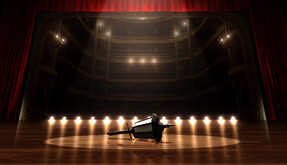
If I am to care for this place, I must speak first of how I lived it, not what I think it means. I must resist the urge to pin it down—to extract something clinical from an infinite staircase, or from a theatre with no audience.
The work must be allowed to be.
Only then can it remain within its own nature—perhaps as something the creator never intended to resolve, only to be inhabited. Art is not a riddle to be solved, but a space that does not turn us away as we dwell inside it.
I feel like a beginner again.
Not in the act of critique, but in the desire to see—to encounter the work once more, exactly as it is.
The finale—a vast labyrinth—may or may not hold a deeper meaning. But what remains true is how it moved me. As I watched it unfold, I felt myself lost among ideas, only to return the moment I stopped searching for them. I felt the weight of its brutalist architecture pressing in on me—a deeply personal sensation, not a theory, simply something I experienced by staying within it.
There is a story, yes. But there is also a mystery that asks to be lived.
A journey that, even retraced, feels new. Not a void to linger in, but a space that asks us to be responsible for what we say—without violating what is there.
Coda and Davey alike must accept that once a work is released into the world, it will gather voices. We are, after all, creatures that generate meaning.
And yet, only a few will know how to listen—how to respect the work for what it is, and to protect its quiet right to remain exactly as it stands.
Although there are works that carry meaning and intention, these can only truly be found within their own worlds.
I remain for a while, walking through Down and Theatre.
The first, for its white expanse, where I feel myself become small within the infinite.
The second, like an actor without an audience—
and yet, I can still imagine that someone is there.