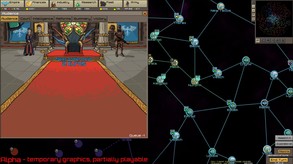
Asymmetric space empire builder where you feel like the Emperor, not a logistics officer. No micromanagement, grand scale, fast paced, audiences, assassins, imperial court, disloyal admirals.
Modeled estimate, not a reported figure. How we estimate →
Prices
The United States storefront in every case, so this compares stores and not countries.
Discounts
Every price cut of more than 20% we have observed, in each market that quoted one, with this game's chart position on either side of it. These are episodes, not a model: a sale is one event, and one event cannot tell you what the next one will do.
Reviews, worldwide (the counter carries no country): 0/day in the week to Aug 25 → 0/day in the week after.
Reviews, worldwide (the counter carries no country): 4.4/day in the week to Jul 16 → 0/day in the week after.
For scale, across Steam · Top Sellers · Brazil over the last 30 days: the 25 chart moves that followed a price cut of more than 20% went a median of 10 places towards #1, and the 2,413 moves with no price cut behind them went 2 away. One store, one chart, one country — it is the only place we have enough observations to say even that.
Prices outside the United States have been collected since 6 August 2026 and chart positions since 19 July 2026, so a cut older than that has no market to compare and a market that joined later has no history yet. Nothing here is converted between currencies.
About
Genres
Add-ons
Each DLC is estimated with the same model as a game, then summed — a modeled figure, not reported DLC sales.
Sums Steam only; GOG publishes no volume signal, so the true total is higher by an unknown amount.
| Store | Price | Audience | Score | Chart | Est. revenue |
|---|---|---|---|---|---|
SteamYou are here | $14.99 | 206reviews | 78% | — | $110K |
| $7.49−50% | 8ratings | 78% | — | not modelled |
Matched by title — a reused name can pair the wrong games. * is a critic aggregate. Prices and positions are each store's United States storefront; Epic charts worldwide. Audience and Score too, except Steam's, which is worldwide.
Engagement
Reviews
Themes across 41 recent reviews and how positive each mention is. A keyword signal, not full sentiment analysis.
Reviews
Really makes you FEEL like an intergalactic God-Emperor, 9/10 - IGN
IMHO A cool and different way to rule a Space Empire. The better you imagine how the game go , the better imersion. I like it alot. Especially with different Empire size start and the way you build your Emperor clone. High replayabilty.
Solid little strategy game. Very chill gameplay which is unusual, and nice, for this sort of game.
Media

Related
Related
Price dynamics, follower growth, revenue and sales trajectories with interactive tooltips
This and every other Pro feature is free until October 20, 2026. A free account is all it takes.
Stats
All-time low is the lowest price we've recorded for this game since we started tracking it.
Languages: English**languages with full audio support
Hours played at review time, across 41 reviews with recorded playtime.
positive critical· bar length = how often the theme comes up
i am very pleased with this game. It plays like you really are the emperor, dealing only with high level decisions, and the AI is good enough to allow this to happen. The game is different from others, so it takes a couple of tries to get the AI to work for you. Start at the easiest difficulty. I keep Fleet #1 at Terra, manually controlled and set the fleet to about 10 squadrons. Fleets 3,4,5,6 are defensive Autonomous fleets for each of the directions, N E S W, with 8 squadrons each. Fleets 2, 7 ,8, 9 are Autonomous offensive fleets, able to attack in all directions, 8 squadrons each. Be sure to check the box allowing the fleets to retake lost planets. In the Budget section, set the Defense to 4. In the Court, try hard to maintain balance, but also, in general, you want your highest Competence people shifted to the left (Defense and Treasury). I colonize as quickly as I can, always leaving a reserve of 10,000 in case a bad event occurs. Early on, I review Loyalty of admirals and governors more than other choices to delay the rebellions somewhat. To shorten the rebellion, mark the rebellious planets for conquest when you get to that part of the game. In this game, you must plan on expansion through conquest, because the aliens seem to get stronger as the game goes on. You can handle this any way that you like. But a peaceful and diplomatic game does not seem possible to me. There is much more to tell, but I won't spoil it for everybody. Hopefully, this helps some new players get started.
good
Stellar Monarch, developed and published by Silver Lemur Games, is a grand-strategy experience designed for players who want the scale and drama of ruling a vast interstellar empire without the exhausting micromanagement that often dominates the 4X genre. Instead of placing you in the role of a planetary administrator or logistics manager, the game crowns you as Emperor — a figure who issues directives, sets priorities, navigates political tensions, and shapes the destiny of a sprawling galactic civilization from a high vantage point. This shift in perspective defines the entire experience: Stellar Monarch is less about fine-tuned optimization and more about big decisions, power struggles, and the unpredictable forces within and beyond your empire. The game immediately distinguishes itself by abstracting away the granular details most 4X titles treat as mandatory. You don't spend time queueing buildings, adjusting resource sliders, or manually maneuvering every ship. Instead, colonies run largely on their own, admirals control fleets according to your strategic guidelines, and ministers attempt to execute your policies. Your role is to set direction — issuing edicts, replacing underperforming officials, deciding how aggressively to expand, determining which border conflicts matter, and managing stability across your worlds. This approach gives you the sensation of commanding something truly enormous, where the machinery of empire never stops moving, yet still reacts to your influence. It’s a refreshing change of pace for players who find late-game micromanagement in other 4X games tedious or overwhelming. Political dynamics play a major role in the experience. Noble houses, influential court figures, and internal factions all vie for position and influence. Their loyalty — or resentment — shapes the overall stability of your empire. Make too many harsh decisions and the nobility may revolt; favor one faction too openly and others may sabotage you. These political considerations give the game an undercurrent of tension. You are not an unquestioned god-emperor; you are a ruler constantly negotiating with power blocs, opportunists, and hidden agendas. Many of the most memorable moments arise not from alien invasions or border conflicts but from internal crises: uprisings, intrigue, strategic betrayals, or discovering corruption embedded deep in your government. Alien civilizations also add unpredictability to the galaxy. Unlike the symmetrical opponents of many strategy games, Stellar Monarch’s aliens vary widely in threat, behavior, and complexity. Some can be reasoned with, others are fanatical or biologically incompatible with diplomacy, and still others behave more like dangerous environmental forces than political actors. Because your empire spans hundreds of worlds and encounters numerous alien threats simultaneously, you must decide where to commit military strength and where to retreat or fortify. Warfare follows the same high-level philosophy as the rest of the game: you don’t command individual ships but instead set priorities for your admirals. This can feel liberating or frustrating depending on your taste — liberating because you never need to choreograph massive fleets, frustrating because sometimes you want more direct control when the stakes are high. The overall abstraction does create a clean, relatively fast-moving strategy experience, but it also introduces limitations. Players who enjoy customizing ship designs, optimizing planetary grids, or micro-adjusting resource chains may find Stellar Monarch too hands-off. The empire often feels like a living organism with a momentum of its own, which is thematically appropriate but occasionally reduces your sense of agency in specific interactions. The learning curve is also steeper than expected, not because the mechanics are complicated but because they break away from genre conventions. You must rewire your expectations: success comes not from managing everything but from knowing what *not* to manage and where to intervene decisively. Another point of criticism concerns pacing. The early-to-mid game is filled with dramatic developments: rebellions, alien incursions, political upheavals, surprise events, and fluctuating loyalties. But once your empire stabilizes and powerful reforms are in place, the late game can become quieter. With most threats neutralized and internal systems aligned, some players may feel that the strategic tension gradually diminishes, leading to a more static “clean-up” phase before final victory conditions are met. That said, for others this calmer stage represents the satisfaction of having built a stable galactic dominion after surviving earlier chaos. Despite its imperfections, Stellar Monarch succeeds admirably in delivering something that many strategy players crave but rarely find: the fantasy of ruling a star empire at the imperial level, not as a bureaucrat but as a sovereign. It offers a distinctive blend of political drama, military oversight, unpredictable galactic threats, and strategic abstraction that keeps the focus on decision-making rather than repetitive tasks. Its design philosophy won’t appeal to everyone — especially those who love intricate colony management — but for players who prefer a cerebral, directive style of leadership, it offers a compelling and often refreshing alternative to traditional 4X games. In the end, Stellar Monarch stands as a unique entry in the strategy landscape. It is elegant in its abstraction, surprising in its internal political depth, and memorable in the emergent narratives that arise from governing a massive, imperfect empire. Those who embrace its high-level approach will find a rich, replayable experience full of crisis, triumph, and imperial character. Rating: 7/10

Fun game. I would like a little more in the way of fleet combat.
Takes getting used to it all. Learning curve. Micromanage your galaxy to the glory of Sparta!! https://youtu.be/DTPN9N6ntq0
Awesome strategy game
A refreshing take on the 4x genre, made by a tiny but dedicated indy dev. This game is genuine good fun. My first play through with default settings was nearly 30 hours to 100% the game, and I am looking forward to a replay on max difficulty to have a nice evolving game that I can play when I only have time for a couple turns in a sitting.
Selling now
See how fast this game is selling right now — estimated copies and revenue per day from recent review growth.
Players by region
Where this game's players are, estimated from review languages.
Related
| Game | Estimated lifetime revenue | Reviews | Review score | Price |
|---|---|---|---|---|
| $2.6M | 9.6K | 81% | $9.99 | |
| $97.2K | 113 | 69% | $19.99 | |
| $361.9K | 508 | 75% | $19.99 | |
| $332.5K | 427 | 69% | $29.99 | |
| $171.8K | 242 | 69% | $19.99 | |
| $42.3K | 306 | 50% | $4.99 |
Related
| Game | Estimated lifetime revenue | Reviews | Review score | Price |
|---|---|---|---|---|
| $110K | 206 | 74% | $14.99 | |
| $110K | 382 | 68% | $15.99 | |
| $110K | 408 | 89% | $6.99 | |
| $110K | 535 | 99% | $9.99 | |
| $110.1K | 282 | 76% | $19.99 | |
| $110K | 309 | 73% | $9.99 |