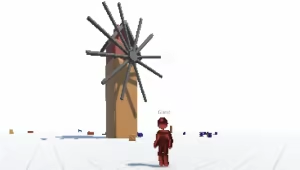
Snap Game is a physics-focused construction sandbox that embraces creativity, experimentation, and the unpredictable results that come from combining simple objects. Developed by Begula and Flops and published by IQ GROUP, it avoids relying on a conventional campaign or tightly controlled progression system. Instead, the game gives players a collection of building pieces and encourages them to invent their own entertainment. Whether the goal is creating something functional, assembling a strange structure, or simply discovering how badly an ambitious design can collapse, the freedom to experiment is the central attraction.
Construction revolves around combining relatively straightforward objects such as crates, bricks, columns, and other components. Individually, these pieces may not seem particularly exciting, but their usefulness becomes clearer once they are connected into larger creations. Physics properties can influence how objects behave, while motors introduce movement and make mechanical designs possible. A static collection of blocks can consequently become a rotating machine or another improvised contraption. The mechanics appear intentionally approachable, making experimentation more important than understanding complicated engineering concepts.
The physics system gives these creations their personality. Building something is only part of the process because players also get to see whether it functions once movement and physical interactions are involved. This creates opportunities for both genuine problem solving and accidental comedy. A carefully constructed mechanism can perform exactly as intended, while another might collapse spectacularly because of an overlooked connection. That unpredictability is valuable in a sandbox because failures can be nearly as entertaining as successful designs.
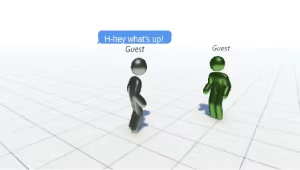
Multiplayer significantly expands the concept. Players can build alongside friends, cooperate on larger projects, or simply create chaotic situations using the available tools. Integrated communication supports this collaborative approach, while character customization provides some individuality when several players occupy the same environment. Walking around the sandbox and interacting with constructions from a character's perspective also makes creations feel more tangible than they would through a purely detached building interface. Multiplayer has the potential to produce some of the game's funniest moments because human experimentation naturally adds unpredictability to the physics simulation.
Solo play remains possible for anyone who prefers quietly experimenting with designs. Without other players, the experience becomes closer to a personal construction workshop where the objective is whatever challenge the player decides to pursue. This freedom can be relaxing, particularly for people who enjoy testing ideas without timers, enemies, or demanding objectives. However, the absence of extensive structured goals also means that long-term enjoyment depends heavily on personal creativity. Players who need missions, progression rewards, or a story constantly providing direction may find the sandbox comparatively sparse.
The amount of available content is therefore one of the most important considerations. A physics sandbox can only remain fresh for so long if its selection of components is narrow. Additional building materials, connectors, mechanical devices, motors, interactive objects, and specialized tools would greatly increase the number of possible creations. The underlying concept has considerable room for expansion because even a single new mechanical component could enable numerous designs when combined with existing pieces. The strength of future development will largely depend on how much the construction toolbox grows.
Visually, Snap Game adopts a straightforward style that suits its purpose. Detailed realism is unnecessary when the important information is the shape, position, and physical behavior of objects. The uncomplicated presentation keeps attention focused on building and interaction rather than graphical spectacle. There is also an appropriately playful tone surrounding the experience, which fits a game where elaborate engineering and ridiculous physics accidents can exist side by side. It understands that creativity does not always need to produce something sensible.
Hardware demands are modest, which complements the accessible nature of the game. Its lightweight presentation means players do not need particularly powerful computers simply to participate in the sandbox. This is especially useful for multiplayer groups where friends may have significantly different PC configurations. The small storage requirement also makes it easy to keep installed as a casual game that can be launched whenever a group wants a quick creative session.
Steam Deck compatibility is officially categorized as Playable rather than fully Verified. Performance with the default graphics configuration is considered suitable, and the game can run successfully on SteamOS. However, handheld players should expect compromises. Some functionality is not fully accessible through the default controller configuration, touchscreen interaction or a community controller layout may occasionally be useful, and text entry can require manually opening the virtual keyboard. Some interface text may also appear small, while certain prompts can display keyboard, mouse, or non-Steam Deck controller icons. It is therefore functional on the Deck, but the experience is less seamless than a fully optimized handheld release.
Snap Game succeeds most clearly as a simple foundation for player-created entertainment. The combination of construction, motors, adjustable physics, multiplayer interaction, character customization, and free-form experimentation gives it plenty of potential despite its comparatively limited collection of objects. It is unlikely to satisfy someone looking for a deep narrative or heavily structured progression, but those who enjoy making strange machines and sharing unpredictable sandbox moments with friends may find considerable charm here. Expanding the building library will be crucial to its longevity, yet the fundamental idea is accessible and flexible enough to support a much larger experience.
Rating: 7/10