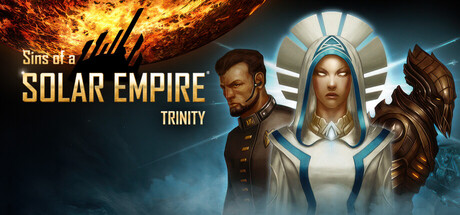
Sins of a Solar Empire: Trinity delivers a distinctive form of space strategy by combining the large-scale empire building of a 4X game with battles that unfold entirely in real time. Instead of dividing exploration, economics, diplomacy, and warfare into separate turns, everything happens continuously across a sprawling network of planets and star systems. Developed by Ironclad Games Corporation and Stardock Entertainment and published by Stardock Entertainment, Trinity packages the original game together with the Entrenchment and Diplomacy expansions, creating a much broader strategic experience than the base release alone.
The heart of the experience is building an interstellar civilization while simultaneously preparing it for war. Colonizing new planets expands territory and increases access to resources, but every additional world creates another location that may require infrastructure and protection. Economic development, research, fleet construction, trade, and planetary improvements constantly compete for available resources. Expanding too aggressively can produce a large but fragile empire, while remaining defensive for too long can allow rival factions to claim valuable systems. This balance makes even relatively peaceful periods important because the strength of a future fleet often depends on decisions made much earlier.
Its seamless strategic camera remains one of the game's most impressive features. The player can zoom outward to examine the overall shape of an empire before descending toward an individual planet or ship without transitioning to a separate battle screen. This provides an excellent sense of scale. One moment can involve managing research and production across multiple worlds, while the next involves watching capital ships exchange enormous volleys of fire above a contested planet. The interface therefore connects high-level strategy and tactical warfare in a particularly satisfying way.
Fleet combat is visually dramatic but also requires thoughtful preparation. Capital ships serve as major battlefield assets, while smaller vessels, support ships, fighters, and specialized units contribute different capabilities. Simply assembling a huge collection of ships does not guarantee victory. Fleet composition, upgrades, abilities, reinforcement routes, and the economic capacity to replace losses all matter. Large engagements can become spectacular, particularly when multiple capital ships and swarms of smaller craft are involved, yet the strategic consequences of losing such a battle can be even more important than the spectacle itself.
Entrenchment adds considerable depth to defensive play. Starbases, mines, and expanded defensive options allow strategically valuable systems to become genuine fortresses. This makes invading established territory much more demanding because a fleet may have to overcome layers of defenses rather than simply defeat the ships stationed there. Fortified chokepoints can delay a stronger opponent and give the defender valuable time to gather reinforcements. As a result, territorial control feels more meaningful, and players have additional ways to survive besides matching an enemy's fleet strength directly.
The Diplomacy expansion strengthens another part of the experience by making relationships between civilizations more strategically useful. Trade agreements, diplomatic pacts, missions, and other interactions provide alternatives to unrestricted conquest. A well-managed relationship can produce economic or technological advantages, while diplomatic maneuvering can help prevent an empire from fighting on several fronts simultaneously. Pirates introduce additional unpredictability because they can become an indirect weapon against opponents. Together, these mechanics make the galaxy feel less like a collection of isolated armies and more like a shifting political environment.
Research and economic management provide substantial long-term depth. Technology can improve military capabilities, resource production, defenses, infrastructure, and other aspects of an empire. Choosing when to invest in research instead of immediate military production becomes especially important during competitive matches. An economy focused entirely on short-term warfare may struggle later, while excessive investment in development can leave valuable territory vulnerable. The strongest campaigns frequently involve adapting priorities as alliances change, borders expand, and enemy fleets become more dangerous.
The game's age is more apparent in its presentation and accessibility. Some interface elements and visual details feel dated compared with newer space strategy games, and newcomers may initially find the number of interconnected systems intimidating. Matches can also become extremely long, particularly on larger maps with several factions. Players looking for quick RTS rounds may find the pacing demanding, but those who enjoy campaigns that gradually evolve from modest planetary settlements into enormous interstellar wars may consider that length a major advantage. The discontinuation of the original Ironclad Online service also reduces the convenience of traditional internet multiplayer, although LAN, DirectIP, single-player, and supported local-network multiplayer options preserve several ways to experience the game.
Steam Deck compatibility is officially categorized as Playable rather than fully Verified. Performance with the default graphics configuration is considered suitable, and the game can run successfully on SteamOS. However, handheld players should expect compromises. Some functionality is not fully accessible through the default controller configuration, touchscreen interaction or a community controller layout may occasionally be useful, and text entry can require manually opening the virtual keyboard. Some interface text may also appear small, while certain prompts can display keyboard, mouse, or non-Steam Deck controller icons. It is therefore functional on the Deck, but the experience is less seamless than a fully optimized handheld release.
Even years after its original release, Trinity remains an engaging demonstration of how real-time warfare and 4X empire management can function together. Exploration, colonization, economics, technology, diplomacy, defensive construction, piracy, and huge fleet engagements all contribute to a strategic sandbox where victories are usually created through long-term planning rather than a single decisive mechanic. Its presentation has naturally aged and its multiplayer situation is less convenient today, but the underlying strategy remains deep and rewarding. For players who want to command both the economic machinery of an empire and the fleets defending it without leaving a continuous real-time galaxy, it remains an impressive classic.
Rating: 8/10