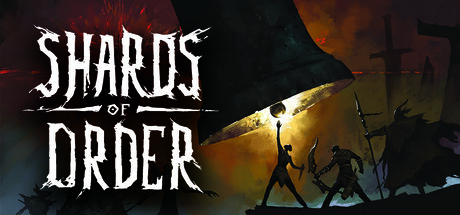
A grim RPG with card-based combat where nothing stays dead. Lead a party of survivors through a world undone by shattered Laws. Restore them and reshape the rules of the game, but be ready to face the consequences.
Modeled estimate, not a reported figure. How we estimate →
About

Shards of Order is a dark fantasy RPG that throws out the rulebook for deckbuilding & card-based combat. There are no turns and no mana points. Every enemy acts on a visible countdown, and every card you play winds those counters down, shifting the whole flow of the fight. Time is your most valuable resource. Misjudge, and your team is sure to crumble.
Master the art of shared deckbuilding; there are three heroes, but only one set of cards. Every card you add affects the drawing odds. Will you build around one main hero and stack the deck in their favor, or spread the strength across the whole party and keep everyone in the fight?
Reality is coming apart. The ancient Laws that once held life, death, and time in place have been stolen or shattered. What’s left is a world where identity fractures and the dead refuse to stay buried. A handful of survivors set out to put it back together, one broken Law at a time. You’re their leader, and restoring Order is up to you – If you find it worth saving.
Play as three distinct characters, each with multiple playstyles, their own skill trees, and a personal arc. This is a full RPG underneath the cards: level up, customize equipment, make dialogue choices, and pass skill checks. Weapons and armor aren't just stat sticks. They define each hero's playstyle and can even inject unique cards straight into your shared deck, so every gear decision is also a deckbuilding decision. Layer the right gear across all three and your party starts working like one organism.
The time counter system is the heart of combat in Shards of Order. Each enemy shows exactly when it will act next, and each card you play pushes those moments closer or further away. You're not reacting turn by turn, but rather managing a clock for your entire party at once. One mistimed card can unravel the whole fight, so every move is a calculation. Three unique regions and a roster of handcrafted boss fights will push your time mastery to the limit.
As you scavenge a dying world, you recover the lost Laws that once governed it. But restoration comes at a cost. Each Law you bring back draws the eye of the all-seeing God a little closer. In your darkest moments, they will offer a helping hand, and you're free to take it. But be warned: they are known for their mischief…
Now, embark on this journey through ruin, where every decision leaves a scar, and every scar becomes part of your story.
There is no more Order. Only what you are strong enough to bring back.
Genres
Stats
All-time low is the lowest price we've recorded for this game since we started tracking it.
Engagement
Reviews
Themes across 484 recent reviews and how positive each mention is. A keyword signal, not full sentiment analysis.
Reviews
I feel bad writing such a negative review, because there's a great game here, potentially, but this was not ready for release in this state. The art is beautiful and the sound is sometimes great -- otherwise It's a technical and mechanical mess, and some of the changes have made it worse since the demo. Not the absolute worst translation I've seen in a while, but certainly on the worse side -- frequently written in broken English. Some minor issues like the wrong character names or portraits shown during dialogue, and it's really not hiding where it is cribbing its notes and aesthetic from, but the major issue is the translation. Most areas are in some way bugged -- the game is sometimes bugged on a fight by fight basis, in fact. I've reported a couple but these would be hard to miss. It's hard to believe no one noticed that Ayla randomly targets static objects like rocks with her arrows -- or that she will cancel her own abilities if an enemy dies after she loads and shoots. Some enemies in the Breathless Sands don't display damage numbers correctly, some enemies don't seem to have accurate ability descriptions. I couldn't tell you what the Wine King does, because he doesn't appear to *do* anything. For me, at least, he floats there the whole fight taking damage with a big Zero above his head, does nothing, transitions to a second stage, attacks once, then dies. I have no idea what the floating numbers meant because they never did anything. This was the tipping point for me, in part because I'm not sure if this was bugged or if the mechanic was just terribly designed. Really baffling mechanical choices in general, including weird changes since the demo. I don't know why you've replaced the rationed healing system with checkpoints and what feels like a band-aid "heal my whole party for free but probably punish me narratively later" system? There's just a big floating eye in my fights that I'm not using, but might be punished for later because the tutorial told me to click it. It can't really be free, because otherwise the game would be far, far too easy with it. Very odd, not sure what happened to the bell healing system from before. I feel like anyone could understand how bad the respecs feel just from clicking through it once -- why can't I just reset a character fully with a single click, if you're going to make me slowly undo abilities down through the whole tree to change the earliest tiers anyway? Each area seems to have quite different requirements for the party, and there's even a couple fights, like the solo Lev fight in the Frozen Marina that will require some players to respec if they've built him as a full tank, so why is this so tedious? Entire card mechanics feel vestigial -- there are so many cards that discard, from both Ayla and Thade, but the 'Sacrifice' keyword barely exists, and trap seems extremely weak compared to other damage cards. Weakness feels vital from the second area onwards but only Ayla reliably applies it. Thade just has a single tree of poison/Rot and half of them seem really quite weak, relative to their cost. I'm not sure why I would spend 2 to rot 3 and hope that an enemy eventually dies from other sources of rot specifically, all to just...spread 5 rot to someone else at random. An upgraded Rot just applies 4 rot for 1 cost. And even then health pools are, for the most part, too large for that to really make sense. Lev can spend 5 to hit for 60, guys. Thade in particular feels awful to play with when so many of his cards dump all mana, rather than spending a fixed cost -- or on drawing cards in a game where card draw is readily accessible as part of its base mechanics. Why would I spend time *and* mana to draw cards -- when I already spend time to draw cards? Why would I spend time and/or mana to reduce a card's cost -- when I can just play the card? At this point I've just tried to minimise Thade's involvement in my party altogether. Lev and Ayla do so much more without the setup requirement. If you're really, really into card games and like the artwork then there's a game worth playing here, but I can't recommend it to anyone else. It's at a low price point, but so are so many other card games out right now.
Media

Related
Related
Price dynamics, follower growth, revenue and sales trajectories with interactive tooltips
This and every other Pro feature is free until October 20, 2026. A free account is all it takes.
Languages: English*, French, German, Simplified Chinese, Polish*languages with full audio support
Hours played at review time, across 486 reviews with recorded playtime.
positive critical· bar length = how often the theme comes up
NOT RECOMMENDED The fundamental problem is that the developers appear to have tested the game with advance knowledge of its systems. The player is not privy to any of it. You arrive at a boss with a deck that isn’t optimized for that particular fight, equipment that doesn’t help, wounded characters, and a hand selected by RNGesus who decided today is your turn to be nailed to the cross. You get your ass kicked, try again, and keep losing until you respec, pare your deck down to precisely what the encounter demands, and hope the cards arrive in the correct order. That's not good encounter design. It's an answer key disguised as character building. The Blacksmith encounter is a perfect example. The game allows you to attack the Fire Priest, which suggests that you might be able to defeat him and save the Blacksmith intact. The Priest has a comically inflated health pool, however, and the real objective is to decapitate the Blacksmith. Fighting the Priest is technically presented as an option, but the encounter makes that option functionally meaningless with the resources available at that point. You were never really meant to choose. You were meant to discover the action the developers had already selected for you. Later, you are expected to save a were-creature by applying a mixture to it three times during combat. What happens if the necessary card doesn’t appear when you need it? You can end up killing the creature because you didn’t know in advance how the encounter was scripted and hadn’t optimized your deck around repeatedly drawing that one card. The game is full of encounters like this. It frequently presents what looks like a tactical or moral choice when there is actually one intended solution enforced by card availability, inflated enemy statistics, or hidden encounter rules. Health persistence creates another problem. You often finish one fight with the party looking as though it went through a food processor, only to be thrown into another battle without meaningful healing or rest. The sensible move is sometimes to enter the next encounter, lose, respawn at full health, and then make a serious attempt. The game has turned death into the ultimate healing device. Attrition can produce excellent tension when players can manage supplies, choose when to rest, retreat, or decide whether to risk pressing onward. Here, victory can leave you in a worse strategic position than dying. Your punishment for surviving one battle is starting the next one half dead; your reward for losing is a fully restored party. Equipment balance is equally inconsistent. The Scholar obtains the Sun Attire early in the game. It restores his shields to maximum every time he plays a Scholar card. The armor initially provides only twelve shields, but it can be upgraded, and the Scholar possesses numerous zero-cost cards. With modest planning, he can repeatedly restore himself to full shields between enemy attacks while performing actions he already wanted to take. Why would I replace that? Later armor might offer higher numbers or conditional effects, but very little competes with automatically restoring your entire shield whenever you play one of the character’s abundant class cards. The game hands you what is effectively an early best-in-slot defensive engine and then continues dropping armor that is far less reliable. The Memory of the Materialist has the opposite balance problem. It damages every enemy according to the number of cards discarded during a redraw. That means discarding five or six cards can inflict five or six guaranteed damage on every enemy on the board, every round. Against the hordes the game throws at you, redrawing your entire hand can be considerably more efficient than using actions to attack individual enemies. The relic bypasses bad draws, card costs, targeting restrictions, and much of the ordinary combat system. It isn’t merely strong. It is an escape hatch from the game’s combat design. Sometimes the most effective way to play this card game is to refuse to play your cards. Then there is the Memory of a Trader, which may be the most useless trinket I found. It reduces the time cost of the wearer’s cards by one but only during the first round. You control three characters, and each draw randomly produces cards belonging to all three. Even if you load one character’s deck with one-cost cards, there is no guarantee that you will draw enough of them during the opening round to justify occupying an equipment slot. Perhaps you get lucky and receive some free attacks or buffs. Perhaps you draw one card whose discount barely matters. Either way, after that first round the trinket does absolutely nothing for the remainder of the battle. It is a high-variance relic occupying a permanent equipment slot in a game that already punishes variance. These are not isolated balance quirks. Weak equipment depends upon random conditions, while the strongest equipment works by insulating you from the randomness of the card system altogether. This is not much of an RPG. It is a railroad with a card game attached. The developers have now added the ability to refund skill points. That is better than the original system, which allowed players to become trapped by earlier choices and accumulate upgraded cards that were actively harmful to later decks. However, respecs address the symptom rather than the cause. The encounters still do not adequately support a broad range of reasonable builds. Now, when your deck cannot pass the next test, the game simply allows you to change your answers after seeing the question. Reach a boss, discover which cards it demands, refund your choices, reconstruct your deck, and try again. Experience and progression are tightly controlled. Areas remain locked until the game permits you to enter them, encounters are finite, and enemies do not randomly respawn for additional experience. You cannot grind a few levels to compensate for an unconventional build. The developers largely know what level you will be, what equipment you can possess, and which cards can be available when you reach a particular encounter. Despite controlling those variables, the game still needed a respec system and even a major area rebalance after release. That suggests the developers proved that their preferred builds could finish the game. They did not adequately test whether the range of builds encouraged by their own cards, skill trees, relics, and armor remained viable. The music also deserves a warning. Dzivia’s magnificent work helped lure me into the game, but his released album material is heavily front-loaded and reused. “Dead Deities” and “Vataha” appear under their proper names, while the eleven-minute “Imperivm” is reused under multiple incorrect cue names. “Ascension,” which appears in the trailer, isn’t even included in the in-game soundtrack. Much of the later music is comparatively generic. It isn’t bad, but it probably won’t stay with you after turning off the game the way Dzivia’s work does. Not everything here is terrible. The artwork is excellent, the world is dark and atmospheric, and there are some wonderfully grim jokes. The story remains interesting enough that I continue playing despite my frustration. The underlying card mechanics can also be satisfying when the game permits you to use them normally rather than demanding an encounter-specific solution. But that isn’t enough for me to recommend it. If you can tolerate dying because you brought the “wrong” reasonable deck, arriving at battles already mauled, rebuilding your character to counter individual bosses, and following a rigid sequence of objectives through areas that open only when the game permits, you may enjoy Shards of Order. It has style, atmosphere, and some genuinely compelling ideas. For everyone else, wait for a STEAM sale. You can always refund the game if you hate it—which, appropriately enough, may be its most functional respec system.
I really wish there was a middle/mixed option because this game has a lot of positives and the first 2 hours were a great experience but at a certain point in the second region the encounters become so sadistically hard that it feels just blatantly unfair and takes away all enjoyment from the game. The lack of difficulty options means there isn't anything to be done about this either.
사실 게임성은 좋아보인다. 그럼에도 불구하고(nevertheless), 영어를 잘 하지 못하는 한국인에게 한국어 번역이 안되어 있다는 이유로 구매를 취소한 사례가 너무 많기 때문에 너무 아쉽다고 생각한다. 나도 게임을 구매해서 약 15분간 플레이해보려고 노력했지만, 스토리 자체에 번역, 이해가 불가능해서 환불 신청했다. 이런 아트스타일, 그래픽이 정말 취향임에도 불구하고 언어의 장벽으로 인해 게임을 하지 못하는 상황이 너무 답답하고 짜증이 난다. 나의 언어 능력 부족도 있지만 개발사의 게임 판매 증가를 위해 조금더 노력해줬으면 하는 바람(wish) 이다.
Really good! Has a unique and engaging action economy and each character has fun mechanics to experiment with. Music is surprisingly good, and the aesthetics are cohesive and appealing. NOT A ROGUELIKE, but an expansion that adds a roguelike mode could be pretty cool!
Shards of Order is a Dark Fantasy Deckbuilder RPG (NOT A ROGUELIKE), divided by several areas that you will mostly have to explore linearly (sometimes deciding between two paths, where you can backtrack a bit if you want to prioritize one path instead of the other). In this game you don't use energy to play your cards, you use time, while every enemy will attack when a determined about of time has past. Gameplay is REALLY challenging, it requires you to think through your every action, sometimes playing cards, sometimes moving your units, sometimes redrawing. Same with the deckbuilding aspect. In this game, the deckbuilding is directly related to the RPG, where your units will get xp after every combat and the level ups will unlock new cards or upgrades (don't worry, unlocking a new card doesn't mean you immediately add it to the deck, you can still be customizing by adding and removing cards you unlocked), and you will have to be carefully choosing those points, while also maybe saving cards for later or just removing them if the build doesn't work. With that being said, be ready to get damage unavoidably... At times this game might feel unfair, where you will be getting damage over and over, fighting against multiple enemies without being able to heal. However, the game counts with strategically placed checkpoints that will automatically heal you the moment you get there, so, even when it might be impossible to beat without dying, it is pretty possible, sometimes you might have to prioritize to stay alive no matter if you will survive with 10 HP, because at some point the checkpoint will relieve your pain. The visual design is great, especially on bosses, emphasizing the grimdark atmosphere that this game wants to deliver. Same with story, it's pretty dark and pretty immersive. I am here for the gameplay, but I have been enjoying the story so far. About length, this game can be beaten in around 10 hours (I have 8 hours, and I think I'm only missing one area), which is short for an RPG, but the game counts with a slight amount of replayability. During your run, in several occasions you will have to face decisions that will somehow affect your gameplay (mostly regarding new items or new cards) and one will exclude the other one. The same way, like I mentioned, you have to be careful not to fill your deck with cards that might get in the way, reason why another aspect of replayability is other builds (meaning, a different focus on your skill tree) you might one to try, which is not HUGE, but I think it's enough if you care about trying different builds and replayability. So far, there are two aspects of the game that I don't like: Sometimes leveling up doesn't feel that worth it... Don't get me wrong, some cards are pretty useful, and the builds are pretty fun, but several times I feel like rewards and upgrades are not worth it (or the time cost for some cards doesn't feel worth the effect) and I end up just taking stuff just to take something (you can probably see bad reviews regarding people saying that the difficulty is too high and they don't feel like they are getting stronger... it's probably because of that, but it's not something that happens always). The other part that I don't like is the fire debuff... I feel like getting 6 damage everytime I play a card is a huge debuff. I managed to play around it, but the hardest fights in the game happen really early, when you need to fight at least 2 enemies applying fire. Anyways, so far a pretty good balance between challenging and enjoyable gameplay. You can check out some gameplay here if interested https://www.youtube.com/watch?v=Q2Gm80nfGkc
Slay the Spire + Darkest Dungeon + actual Story, at Times very difficult. Get it.
How is this game so well made and such an outstanding price? It's like reading a book but having to play a game like Slay the Spire while I do it. I also love the different choices you can make. I'm gonna keep this short and sweet, if you like card games/roguelike games like me then this is an auto purchase. When does Shards of Order 2 come out? lol
Demo and first zone loocked realy promissing. But as soon as you in second zone gameplay becomes total slog and not fun. Totaly feels like false advertising of actual gameplay. Refunded.
Shards of Order is an atmospheric RPG with deck‑building elements, created by Fardust and published by Awaken Realms in late July 2026. The game stands out thanks to its unusual combat system and dense, dark‑fantasy mood. It’s a turn‑based card game… without turns. In Shards of Order there is no mana - the most important resource is time. At the start of each encounter you draw five cards, and every action you take - whether it’s an attack, a spell, or raising a shield - pushes enemies closer to performing their own moves. Above each foe you’ll see a timer counting down to their strike or spell, and your cards let you manipulate that clock, slowing it down or speeding it up. Once you play all your cards, you draw a new hand - but refreshing your cards costs time, and that time shrinks with every action you take. This gives the game a highly deterministic feel and forces players into unusual tactical dilemmas: is it worth using a powerful card that accelerates the enemy’s attack, or is it safer to prepare with “cheaper” moves? The immortal heroes share a single deck, further emphasizing the strategic nature of combat. Shards of Order is incredibly engaging, features an excellent soundtrack, and can be genuinely challenging - but that’s exactly why winning battles feels so satisfying. ************ Shards of Order to klimatyczna gra RPG z elementami karcianki (deckbuilder), stworzona przez studio Fardust i wydana przez Awaken Realms pod koniec lipca 2026 roku. Tytuł wyróżnia się nietypowym systemem walki oraz gęstym, mrocznym klimatem dark fantasy. To turowa gra karciana… pozbawiona tur. W Shards of Order nie używamy many, ponieważ najważniejszą walutą jest czas. Na początku potyczki dobieramy pięć kart z talii, a każde zagranie - czy to atak, czar, czy postawienie tarczy - przesuwa przeciwników bliżej ich własnej akcji. Nad wrogami widnieje licznik odmierzający moment wykonania ciosu lub zaklęcia, a my manipulujemy tym zegarem, spowalniając go lub przyspieszając za pomocą dostępnych kart. Po zagraniu wszystkich kart dobieramy kolejne, jednak wymiana kosztuje czas, który skraca się wraz z kolejnymi akcjami. To sprawia, że gra ma bardzo deterministyczny charakter i stawia przed graczem nowe, nietypowe dylematy: czy warto rzucić potężną kartę, która przyspieszy atak przeciwnika, czy lepiej przygotować się „tańszymi” zagraniami? Nieśmiertelni bohaterowie dzielą jedną talię, co dodatkowo podkreśla taktyczny aspekt rozgrywki. Shards of Order jest niezwykle wciągające, oferuje świetną ścieżkę dźwiękową i potrafi dać w kość - ale właśnie dzięki temu satysfakcja z wygranych starć jest ogromna.
Selling now
See how fast this game is selling right now — estimated copies and revenue per day from recent review growth.
Active players
Estimated daily and monthly active players (DAU/MAU) modeled from peak concurrency.
Players by region
Where this game's players are, estimated from review languages.
Players also reviewed
The games this title's players most often review too — audience affinity.
Related
| Game | Estimated lifetime revenue | Reviews | Review score | Price |
|---|---|---|---|---|
| $1.8M | 2.9K | 84% | $24.99 | |
| $9.4K | 17 | 82% | $19.99 | |
| $142 | 1 | 0% | $4.99 | |
| — | 0 | — | — | |
| $2.4M | 6.7K | 92% | $24.99 | |
| $384.5K | 3.5K | 74% | $4.99 |
Related
| Game | Estimated lifetime revenue | Reviews | Review score | Price |
|---|---|---|---|---|
| $168.5K | 372 | 89% | $19.99 | |
| $168.5K | 356 | 95% | $11.99 | |
| $168.5K | 411 | 96% | $29.99 | |
| $168.5K | 1.3K | 59% | $5.99 | |
| $168.6K | 598 | 88% | $9.99 | |
| $168.3K | 280 | 65% | $29.99 |