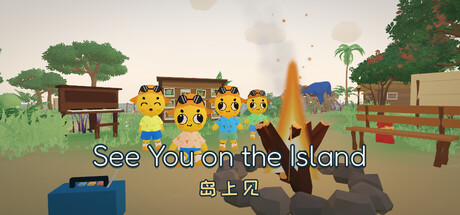
See You on the Island
Hang out on a small island with a few friends and talk — voice fades with distance, so walk closer to hear. Gomoku, coconut football, draw-and-guess, fireworks after dark, and a photo wall for your snapshots. No quests, no levels.
Estimated lifetime revenueLow confidence
—gross
—
Modeled estimate, not a reported figure. How we estimate →
Est. copies sold
0
mid estimate
Reviews
0
Review score
—
Concurrent players
About
About the game
You mostly want to talk. You just need somewhere to be.
See You on the Island is a small co-op island for two to four friends. Voice chat is not a feature bolted onto the side — it is the thing the whole island is built around. Everything you can do here is something you can do while talking, which is more than most co-op games can say.
Voice that works like standing next to someone
Voice is built in and fades with distance. Walk over and you hear them clearly; wander down the beach and they trail off into the surf. Two people can drift away for their own conversation without leaving the group — exactly how it works when you are actually standing on a beach together. Text chat is there too, for when you would rather not talk.The clearest proof that this is real gameplay and not a gimmick: the drawing board. Whoever picks up the brush writes their own word — nobody else sees it. Everyone else stands around the board shouting guesses out loud. That game simply cannot exist without voice in the world.
Things to do together
- Draw and guess at the camp board — only the drawer knows the word.
- Coconut football on the east beach, with a real goal, floodlights at night and a scoreboard that remembers every goal.
- Race a lap of the island — six flags, a start arch, and a board that remembers who was fastest.
- Gomoku at the village gate — open by day, closed at night, and the board survives until morning.
- Fireworks after dark. One barrel, one rocket, one burst the whole island looks up at.
- Shove each other. On the end of the pier this becomes sumo.
Or do nothing at all
- A piano on the camp meadow — seventeen keys, real piano samples.
- A portable speaker you can carry anywhere. Wherever you set it down, there is music.
- A two-seat swing at the lookout, a bench by the fire, a lounger under the beach umbrella.
- Swim out into the sea. Sometimes the dolphins jump.
Take a photo, pin it on the wall
You carry a camera. Frame the shot, press the shutter, or turn it around for a selfie — a print slides out and slowly develops. Photos are real image files saved to your Pictures folder, ready to send to friends the moment you quit. Next to the camp there is a photo wall with twelve pegs. Anything you pin there is visible to everyone on the island — and stays up after your friends log off.An island that keeps its own hours
Forty minutes to a day: bright noon, a long gold dusk, a pink-violet hour, deep night with stars and fireflies, then morning. Some things only happen at certain times; the clock and the notice board at camp tell you what time it is and what is open. Meteors cross the night sky — everyone on the island sees the same one.How you get in
One person opens an island; everyone else joins from the Steam friends list. No servers, no accounts, no room codes. Three save slots are three islands — scores, the gomoku board, the drawing and the photo wall all stay with the island. Your name and your shirt stay with you, whichever island you visit. The interface is available in thirteen languages.What it is not
No combat. No hunger bars. No building requirements. Nothing you can fail at, nothing that decays while you are offline, and no reason to log in daily. Come back when you feel like it.[hr][/hr]
Music: "Carefree" and "Bossa Antigua" by Kevin MacLeod , licensed under Creative Commons: By Attribution 4.0 —
Sound: "Footsteps on different surfaces" by congusbongus (CC BY 3.0) and "Wind Loop" by AntumDeluge (CC BY 3.0), both via OpenGameArt; water sounds by rubberduck (CC0, OpenGameArt); piano sample by HugeKC and firework whistles by el_boss (CC0, Freesound).
Models: character skeleton, animations and prop models by KayKit / Kay Lousberg (CC0); ocean animals by Quaternius (CC0); environment assets from Synty Studios POLYGON Tropical Jungle (licensed).
Fonts: Fredoka, ZCOOL KuaiLe, M PLUS Rounded 1c and Jua (SIL Open Font License).
Made with Godot Engine.