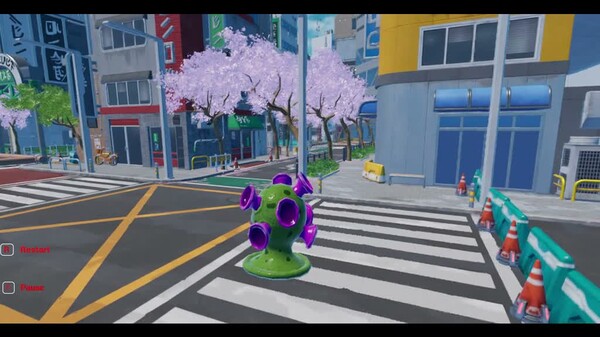
Sad Virus Tokyo is a compact indie adventure that builds its identity around straightforward exploration, collectible hunting, and environmental hazards. Developed and published by Valkeala Software, the game places players inside a Tokyo-themed urban environment where the primary objective involves traveling through the city, searching for beer bottles, and avoiding traps scattered across the route. It does not attempt to disguise its simplicity behind an elaborate story or complicated progression system. Instead, the experience concentrates on movement and observation, creating a casual journey in which reaching new areas and finding collectibles provide the main incentives to continue.
Although the game can broadly be described as a walking simulator, its design incorporates more interaction than the genre label might initially suggest. Movement is accompanied by platforming challenges, physics-based situations, collectible searching, and hazards that require some awareness of the surrounding environment. The presence of traps means players cannot simply hold forward and treat the setting as a passive sightseeing tour. They need to recognize dangerous areas, judge movement carefully, and occasionally approach obstacles with the precision expected from a lightweight 3D platformer. These elements help give the exploration a sense of purpose beyond simply reaching the end of the map.
The beer bottles serve as the game's most distinctive collectible and reinforce its deliberately eccentric personality. Their inclusion is amusingly mundane compared with the magical artifacts, treasures, or resources commonly found in adventure games. More importantly, they encourage players to examine the environment instead of following the most obvious route. Collectibles can make streets, corners, structures, and elevated locations worth investigating, particularly when their placement encourages players to leave the safest path. The effectiveness of this mechanic ultimately depends on how creatively the bottles are distributed, because searching becomes much more engaging when collectibles reward curiosity or require a small traversal challenge to obtain.
Traps provide a useful contrast to the otherwise relaxed exploration. Their presence creates uncertainty while traveling and gives players a reason to pay attention to environmental details. Combined with platforming and physics mechanics, these obstacles can transform seemingly ordinary sections of the city into small navigation challenges. This creates a simple gameplay rhythm of exploring, spotting something useful, figuring out how to reach it, avoiding nearby dangers, and moving toward the next area. There is little indication that the game is interested in deep combat or complicated character abilities, so the quality of these environmental encounters is especially important to keeping the journey entertaining.
The Tokyo-inspired setting gives the project an appealing visual theme even though it should not be mistaken for a realistic recreation of Tokyo. The city functions primarily as an adventure playground rather than a detailed geographical simulation. Urban structures, streets, obstacles, elevated sections, and assorted environmental objects provide spaces through which the player can navigate and search. This approach suits the modest scale of the project because it allows the environment itself to support the mechanics. Rather than overwhelming the player with excessive detail, the presentation can focus attention on pathways, collectibles, hazards, and locations that might be worth exploring.
Sad Virus Tokyo also occupies an interesting position between several genres. Its foundations are casual and simulation-oriented, but hidden-object searching, third-person movement, platforming, physics, and precision-based navigation contribute additional layers. None of these individual systems appears intended to become particularly complicated. Instead, they work together to prevent the experience from becoming nothing more than an uneventful walk. This hybrid structure should appeal most strongly to players who enjoy unusual independent games that establish a simple objective and allow the environment to generate most of the entertainment.
The third-person perspective is particularly appropriate for this style of play. Being able to see the character and nearby surroundings should make platforming distances and environmental hazards easier to understand. It also allows the city itself to occupy more of the player's attention, which matters when locating bottles and identifying potential traps are central activities. Physics can further introduce unpredictable moments into traversal, potentially giving the game some humor when movement or environmental interactions do not unfold exactly as expected. That slightly awkward unpredictability can work well in a deliberately quirky casual game.
However, the same simplicity that makes Sad Virus Tokyo accessible also represents its greatest potential weakness. Walking, collecting bottles, and avoiding traps can become repetitive if the environment does not continually introduce interesting arrangements or variations. Without substantial narrative development, combat, character progression, or complex puzzles to provide alternative forms of engagement, the game depends heavily on level design. Players expecting a sophisticated simulation of Tokyo or a story-driven adventure may therefore find the concept too limited. Its intended audience is more likely to consist of players comfortable with small experimental games where completing straightforward objectives is the main attraction.
Replay value could similarly depend on how much incentive exists to thoroughly explore the environment. Steam achievement support gives completion-focused players another reason to investigate the game beyond simply reaching its conclusion. If achievements encourage finding every bottle, surviving particular hazards, discovering less obvious locations, or completing challenges efficiently, they could extend the experience. Conversely, players interested only in reaching the end may have fewer reasons to return once they understand the map and its obstacles. The game's compact concept therefore seems better suited to a focused experience than an endlessly replayable one.
Another positive aspect is that the project communicates its intentions without pretending to offer something vastly larger. Valkeala Software appears to be presenting a deliberately uncomplicated game built around an unusual combination of sightseeing, bottle collecting, traps, and platforming. That clarity makes it easier to understand who will enjoy it. Players who appreciate unconventional indie projects may find charm in its odd premise, while those seeking polished cinematic storytelling, elaborate systems, or substantial mechanical depth will probably need to look elsewhere.
Overall, Sad Virus Tokyo is an eccentric exploration game whose personality comes from turning a Tokyo-themed environment into a casual obstacle course and collectible hunt. Its mixture of walking simulation, hidden-object searching, physics, third-person platforming, and trap avoidance gives the experience more activity than its simple premise initially implies. The concept is undeniably narrow, and its long-term appeal will depend greatly on environmental variety and collectible placement, but the straightforward design has a certain charm. With Valkeala Software handling both development and publishing, Sad Virus Tokyo feels like a deliberately small-scale project aimed at players who enjoy unusual, uncomplicated indie adventures. Based on its overall concept, gameplay structure, presentation, and intended scope,
Rating: 5/10