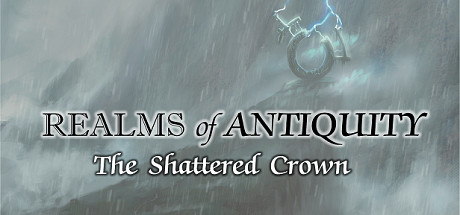
Realms of Antiquity: The Shattered Crown is a fascinating throwback to the formative years of computer role-playing games, embracing old hardware limitations and design traditions rather than simply copying their visual style. Developed by Adam Haase and published by Quixotic Software, the game was originally created around the capabilities of the TI-99/4A computer and reaches modern PCs through emulation. That unusual foundation gives it an authenticity rarely found in contemporary retro RPGs. Its limited color palette, straightforward interface, methodical exploration, and minimal hand-holding feel like genuine products of an earlier gaming era.
The adventure revolves around assembling a party and journeying through a large fantasy realm threatened by sinister forces. Instead of directing players through a rigid sequence of objectives, the game encourages independent exploration. Towns, villages, castles, wilderness regions, ruins, and underground areas are scattered throughout the world, with conversations and environmental discoveries gradually revealing where the party should travel. There is a strong sense that progress comes from understanding the world rather than simply following icons on a map.
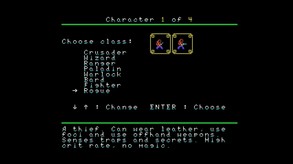
Party creation provides much of the game's strategic depth. Players can command up to four adventurers selected from nine character classes, allowing different combinations of physical fighters, magical specialists, and supporting roles. Building a party that can survive a wide variety of encounters becomes an important part of the experience. Character development is complemented by a substantial magic system containing 60 spells spread across seven schools. This gives spellcasting characters meaningful flexibility and makes party composition more interesting than the extremely simple presentation might initially suggest.
Combat uses a turn-based tactical format where preparation and intelligent use of the party's abilities are more important than fast reactions. Equipment, positioning, spells, character strengths, and available resources all influence survival. The large collection of monsters also helps keep encounters varied as the party moves into increasingly dangerous territory. Battles can occasionally feel slow because of the intentionally old-fashioned interface, but the underlying systems reward players who enjoy planning their moves instead of relying on reflexes.
Exploration is arguably the strongest aspect of the experience. The world includes different environments such as forests, mountains, deserts, frozen regions, oceans, rivers, settlements, and dangerous ruins. Boats can be used to navigate waterways and open seas, making transportation itself part of discovering the world. This variety helps create the feeling of participating in a genuine expedition. There are more than 250 distinctive powerful items to uncover as well, giving players a strong incentive to investigate locations that may not appear immediately essential to the main journey.
NPC interaction plays an equally important role. Conversations with inhabitants can provide clues, background information, directions, and knowledge necessary for understanding the broader adventure. The game expects players to pay attention to what people say rather than depending on an elaborate modern quest log. This approach can occasionally make the next objective unclear, particularly for players accustomed to contemporary RPG conveniences, but discovering a solution through observation can also be considerably more satisfying.
The presentation is intentionally primitive. Its 16-color graphics, compact environments, simple sprites, and functional menus will not impress anyone looking for modern visual spectacle. Within the technological framework being recreated, however, the artwork has considerable personality. The restrictions actually contribute to the atmosphere because imagination must fill in details that modern games normally illustrate directly. It feels less like a modern game wearing a retro costume and more like an ambitious lost computer RPG preserved for a contemporary audience.
The greatest challenge is adapting to the interface and pacing. Modern players may initially struggle with navigation, limited guidance, menu conventions, and the amount of information they are expected to remember themselves. There are few concessions to people accustomed to streamlined inventory systems, objective markers, elaborate tutorials, and constant navigation assistance. Patience is essential, particularly during the opening hours while learning how its systems communicate information.
Steam Deck compatibility is currently best considered unverified rather than officially supported. Because the PC release relies on the Classic99 emulation environment and was primarily designed around Windows operation, Steam Deck users may require manual configuration, compatibility-layer adjustments, or customized controls. It should therefore not be purchased specifically for handheld play with the expectation of a fully tested, seamless Steam Deck experience.
Despite its deliberately archaic appearance, there is an impressive amount of role-playing content underneath. Nine classes, a four-member party system, seven schools of magic, 60 spells, hundreds of monsters, more than 250 notable items, tactical encounters, NPC conversations, dungeon exploration, and extensive overworld travel create a remarkably substantial adventure. Its strongest achievement is that these elements feel connected rather than included merely to increase the feature count.
Realms of Antiquity: The Shattered Crown will appeal most strongly to players interested in traditional computer RPG design and gaming history. It demands patience and provides very little modern hand-holding, but those same characteristics give exploration and discovery greater significance. Anyone willing to accept its technological limitations can find an ambitious fantasy journey built around tactical decision-making, party development, conversation, exploration, and the satisfaction of uncovering secrets without being constantly directed toward them.
Rating: 8/10