[h1]QUICKERFLAK — 90 Seconds of Violence, Panic and Pure Arcade Focus[/h1]
[b]Recommended[/b]
QUICKERFLAK is the kind of game that looks tiny until you actually try to beat it. A successful run can technically be completed in less than 90 seconds, but that does not mean the game only contains 90 seconds of entertainment. I have played for 3.7 hours, and most of that time was spent dying, restarting immediately, learning enemy timing and trying to push slightly farther than before. My runs went from around 42%, to 53%, and eventually 77%, and every improvement felt earned.
[hr][/hr]
[h2]Gameplay and Difficulty[/h2]
The objective is extremely simple: enter a procedurally generated combat area, kill every enemy, reach the next section and complete the entire sequence before the timer expires. There are no health bars, character levels, upgrades, skill trees or grinding. Both you and most enemies die from a single bullet, so one bad movement or missed shot can end the entire run.
Movement is controlled with WASD while aiming and shooting are handled with the mouse. The controls are simple enough to understand immediately, but surviving with them is another matter. The restart is almost instant, which is essential for a game built around repeated failure. You die, click again and return directly to the action with almost no downtime between attempts.
QUICKERFLAK is brutally difficult, but the difficulty is not based entirely on player skill. The generated level layout has a major influence on every run. Sometimes you receive useful walls and clear firing angles, while other times you spawn almost directly in an enemy’s line of sight with very little protection. Cover can also be difficult to judge because of the isometric perspective. A wall may appear to protect you, but an enemy can occasionally fire across an angle that looked blocked, and it is also possible to get caught on corners while trying to escape.
This makes every attempt a combination of reflexes, accuracy, positioning, enemy timing, map awareness and luck. The randomness keeps repeated attempts from becoming identical, but it can also create runs that feel unfair from the moment they begin.
[hr][/hr]
[h2]Combat and Strategy[/h2]
Combat is fast, aggressive and unforgiving. You have a powerful weapon, but so does everyone else. Success is not about absorbing damage or slowly building a stronger character. It is about shooting first, using cover correctly and recognizing the small windows where enemies are vulnerable.
The best strategy is not always to rush forward. It is often better to move behind cover immediately, wait for an enemy to fire, attack during the brief pause afterward and remove enemies one at a time. The timer constantly pushes against careful play, so you cannot hide forever, but reckless movement usually results in instant death. That creates the central tension of the game: you must play carefully, but you must also play quickly.
When several enemies start firing at once, bullets, impact effects, characters and background details can blend together. It can become difficult to understand exactly what killed you, especially during the later sections. That visual confusion appears to be part of the intended pressure, but it will frustrate players who prefer perfectly clean competitive readability.
[hr][/hr]
[h2]Visuals and Sound[/h2]
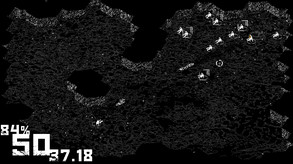
The visual presentation is dark, monochrome, industrial and deliberately hostile. The environments resemble distorted digital wastelands filled with hard edges, visual noise, broken geometry and flashes of white gunfire. It does not aim for conventional beauty. It looks more like an arcade machine trapped inside a damaged computer.
The style gives QUICKERFLAK a strong identity, but clarity is sacrificed for atmosphere. The player, enemies, projectiles and background can sometimes merge into one violent black-and-white mass. This fits the oppressive design, although it also means some deaths are difficult to read. Players who are sensitive to flashing effects, visual noise or extreme contrast should watch gameplay footage before buying it.
The soundtrack is one of the strongest parts of the game. The music is fast, mechanical and aggressive, and it matches the speed of the combat perfectly. Gunfire has a sharp and immediate impact, and together with the music it creates the feeling that the entire game is accelerating toward a violent system failure. The audio may be loud for some players, and the game offers very limited configuration, so you may need to adjust the volume through your desktop audio mixer.
[hr][/hr]
[h2]Content and Replay Value[/h2]
QUICKERFLAK is intentionally small. There is no campaign story, inventory system, weapon collection or long list of modes. The entire concept is focused on mastering one short sequence of increasingly dangerous encounters.
The replay value comes from completing the game, improving your completion percentage, finishing faster, earning the achievements, learning the procedural layouts and chasing the highest rank. Someone may complete everything relatively quickly, while another player may spend several hours trying to survive the final sections.
This is not a game for people who measure value only by campaign length. It is closer to an old arcade challenge where the same short experience is replayed until the player finally masters it.
[hr][/hr]
[h2]Linux Experience[/h2]
I played QUICKERFLAK as a Linux gamer. The store page only lists Windows in the system requirements, so this is not advertised as a native Linux release. However, it is Steam Deck Verified and works through Steam Play and Proton.
On my Linux setup, the game launched and was playable without requiring a complicated manual fix. Input, sound and the main gameplay worked correctly during my testing. This is especially important because QUICKERFLAK depends on extremely fast restarting. A game like this would become almost unbearable if every death resulted in a long loading screen or compatibility problem.
The game has very low storage requirements and should not require powerful modern hardware. Its visual complexity comes from the art direction rather than expensive graphical technology. Linux compatibility can still vary between distributions, drivers and Proton versions, but my experience was functional.
[hr][/hr]
[h2]The Good and the Bad[/h2]
[b]The good:[/b] Immediate arcade gameplay, almost instant restarting, simple controls with a high skill requirement, a strong industrial soundtrack, a distinctive visual identity, procedural layouts, no grinding or filler, a very low price, Steam achievements, trading cards and working Proton compatibility.
[b]The bad:[/b] The player, enemies and bullets can become difficult to distinguish, some generated layouts feel much less fair than others, cover is not always visually clear, a bad spawn can end a run immediately, the settings are extremely limited and the combination of random generation with instant death can become frustrating.
[hr][/hr]
[h2]Conclusion[/h2]
QUICKERFLAK is not pretending to be a large game. It gives you a weapon, a timer and a world that wants you dead, then asks one question: [b]How quickly can you become better?[/b]
It is short, violent, visually overwhelming and mechanically simple. It can also become extremely addictive because every failed run creates the feeling that the next attempt might finally be the one. The procedural generation occasionally makes the difficulty feel unfair, and the monochrome visual style can make combat harder to read than it should be, but the instant restart, aggressive soundtrack and constant pressure make it very easy to begin another run.
At its low price, I can recommend it to players who enjoy difficult arcade games, top-down shooters, speedrunning and repeated short challenges. Do not buy it expecting a traditional campaign. Buy it because you want 90 seconds of concentrated panic repeated until yo