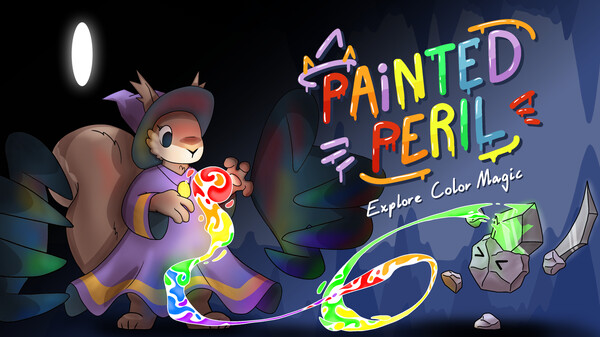
Take up the paintbrush and unleash the power of color with Sylvia the painter mage squirrel. Mix pigments, cast paint spells, and battle living rocks in a vibrant world of magic and adventure.
Modeled estimate, not a reported figure. How we estimate →
About
Embark on a perilous journey as Sylvia the Squirrel in this experimental roguelite adventure. One day a powerful color magician steals Sylvia's house and throws her into the vast cave system below. Help her climb back to her home tree by conquering randomly generated caves and overcoming various challenges.
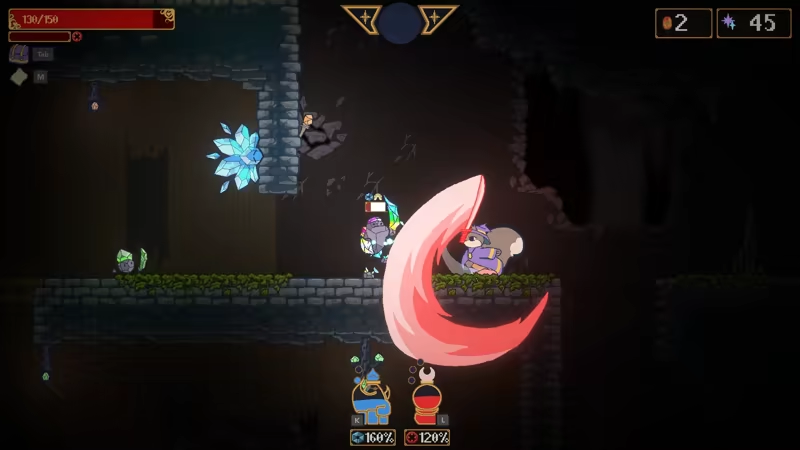
Use colors to tint your spells with unique effects such as creating yellow lightning chains or orange flames.

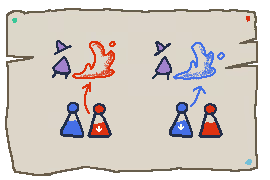
Shape the spells you cast using magical bottles. Each bottle comes with a different spell, such as creating a lingering trap, an explosive bomb or missiles that shoot out each time you get hurt.


Each color can be added to any bottle, combining the effect of the color with the behavior of the bottle.

Combine your own spells: Experiment with various combinations of colors, bottles and items to create spells with powerful synergies and behaviors.
Explore various different environments: Explore the vast cave systems below Sylvias tree-house that are filled with several secret paths, artifacts and structures. Each time you climb your experience will be different as the levels are randomly generated.
Interact with the critters of the caves: Get to know several critters that live in the caves. Help them out and get help from them.
Powerful Item Synergies: Discover and collect a wide variety of items that can be stacked to create powerful builds and synergies, enhancing your abilities and survival chances.
Tactical Decision-Making: Adapt on the fly as you strategically choose which colors to mix and which bottles to use to best face different enemies.
Challenging Roguelike Gameplay: Progress through levels, starting from the bottom of the cave system and ascend towards Sylvia's home. But be warned, defeat means starting over from square one. Can you overcome the odds and reach the surface?
Dive into an adventure, where quick thinking, strategic choices, and mastery of color magic are your keys to success. Can you guide Sylvia back to her beloved tree and escape the treacherous caves? The challenge awaits!
Genres
Stats
All-time low is the lowest price we've recorded for this game since we started tracking it.
Languages: English**languages with full audio support
Reviews
Painted Peril is a colorful action roguelite that builds its identity around experimentation rather than simply handing the player a collection of conventional weapons. Developed by Message Photon AB and published by Fennonauts, it follows Sylvia, a painter mage squirrel who is thrown into the enormous cave system beneath her tree home. Her journey back to the surface becomes the foundation for repeated runs through unpredictable environments filled with hostile creatures, strange inhabitants, hidden routes, useful artifacts, and opportunities to construct increasingly elaborate magical combinations. The defining mechanic is the ability to create spells through colors and magical bottles. Colors provide properties that alter what a spell actually does, with effects such as yellow producing chained lightning or orange introducing fire. Bottles determine how that magical power is delivered. One might create a persistent trap, another an explosive attack, while other configurations can launch projectiles under specific conditions. Because a color can be combined with different bottles, finding a pigment does not lock the player into one predetermined attack. Instead, the same ingredient can become part of several substantially different strategies. This modular design gives combat a satisfying sense of discovery. Experimentation becomes almost as important as mechanical skill because understanding how individual effects interact can transform an ordinary collection of components into an exceptionally effective build. Items further expand this concept through stacking and synergy. The interesting question is therefore not always which reward provides the biggest immediate improvement, but which one works best with everything Sylvia already possesses. Strong runs can gradually evolve into specialized builds where several effects reinforce one another. Randomly generated caves support that philosophy by ensuring that players cannot depend completely on memorizing a fixed sequence of encounters. The objective remains climbing from the depths toward Sylvia's home, but the journey can change between attempts. Different environments contain secret paths, structures, artifacts, enemies, and other discoveries, encouraging exploration instead of treating every area as a simple corridor between battles. The caves also contain various critters that Sylvia can interact with and assist, with some potentially returning the favor. These encounters help prevent the underground world from feeling like nothing more than a succession of combat rooms. There is a meaningful tactical element underneath the cheerful presentation. Players need to consider which pigments to use, which bottles should carry them, and how their current collection of items affects those choices. Improvisation is particularly important when the ideal components do not appear. Rather than waiting for one specific build every run, the systems encourage adapting to what is available. This gives successful experimentation a rewarding quality because unusual combinations can reveal strategies that might otherwise have been overlooked. The roguelike structure also provides the game's greatest potential source of frustration. Defeat sends Sylvia back to the beginning, making failure a genuine setback rather than a minor interruption. Players comfortable with repeated attempts will probably appreciate how this increases the importance of survival and decision-making, while those who prefer steady checkpoint-based progression may find the repetition demanding. Random generation can likewise create uneven runs, since the quality and usefulness of available combinations naturally vary. Still, this unpredictability complements a game centered on adapting spells rather than following a rigid upgrade sequence. Visually, the pixel-art presentation suits the playful concept well. A squirrel magician painting spells into existence gives the adventure an immediately recognizable personality, while the fantasy environments and living-rock enemies maintain a whimsical tone despite the potentially punishing progression. The colorful presentation is more than decoration because color is integrated directly into the combat mechanics. That connection between visual theme and gameplay gives the experience greater cohesion than it would have had if painting were merely an aesthetic gimmick. Movement and combat also benefit from full controller support. The combination of platforming, positioning, dodging, and spellcasting feels naturally suited to a gamepad, particularly when encounters become hectic. There are also movement-oriented magical possibilities that can encourage more aggressive approaches, reinforcing the idea that builds can influence not only damage output but also the way Sylvia moves and fights. Players who enjoy discovering unusual interactions should find this flexibility more appealing than a straightforward weapon progression system. Steam Deck compatibility requires a more cautious assessment. The Steam listing currently identifies Windows as the supported operating system and does not provide an official Steam Deck Verified or Playable classification. Full controller support is encouraging for handheld controls, and the 2D pixel-based presentation appears conceptually well suited to the Deck, but these qualities should not be mistaken for official verification. Anyone primarily intending to play on Steam Deck should therefore consider it an unverified experience and expect that Proton compatibility, interface behavior, or other issues may require testing rather than assuming completely seamless operation. Overall, this is a compact but inventive interpretation of the action roguelite formula. Its strongest idea is not simply fighting through randomized caves but constructing magic from interchangeable components and learning how pigments, bottles, items, movement, and situational effects can complement each other. The repetition inherent to its structure will not appeal to everyone, yet players who enjoy experimentation, build crafting, secrets, tactical improvisation, and the satisfaction of turning an uncertain collection of resources into a powerful setup have plenty of reasons to keep attempting the climb. Its charming presentation gives it personality, while the spell-combination system supplies the mechanical depth needed to make that personality meaningful. Rating: 7/10

Media

Related
Related
Price dynamics, follower growth, revenue and sales trajectories with interactive tooltips
This and every other Pro feature is free until October 20, 2026. A free account is all it takes.
Painted Peril is a nice 2D platformer. You play as an adorable squirrel. It has good controls and isn't frustrating like a lot of platformer can be. Fun game!
[b]I like Painted Peril. I recorded much of my progress in it, enjoying it, as well as offering some observations and thoughts. Please take a look if you prefer a more audio / visual format.[/b] https://youtu.be/uU91HfP5pMI Painted Peril is a 2D Action Roguelite Dungeon Crawler, a sidescroller with random dungeons where paints are your magic. [h1]Mix Paints to Mix Your Magic:[/h1] The magic in Painted Peril is very different. It’s all about the paint and potion mixing. The potion bottles you find change either your base, alt attack, or unlocked 3rd attack. The different colors of paint in the bottles give different effects to the attack Blue: slow and push Red: life-drain; seems to be temp hp Yellow: chaining attacks Each attack drains color, though you can still attack with an empty bottle; it is much less powerful. As you explore the caves, mushroom fields, and dungeons, you can mix different colors to create new effects. Blue + Yellow = Green Poison, weakens and spreads on death Red + Blue = Purple Sleep Red + Yellow = Orange Fire Rainbow = Big damage [h1]Alchemical Attack![/h1] Each of the different Bottle Shapes is a different kind of attack. Default is a melee attack Round bottle is a ranged attack Fist bottle is a longer ranged melee Star is a lobed bomb Ghost man drops 5 little bombs Each of these attacks has their own cooldown, so you can really toss out the damage by getting a good rotation going. [h1]An Agile Alchemist:[/h1] You are a squirrel thing here, so you can climb up vertical surfaces by default, which is very handy, especially for all the vertical caves here. Wall sliding is in as well; good, as is a default double jump, and a dash / air dash. As I said, a very agile squirrel alchemist indeed. Controller Support is present, though the controls are not rebindable. Mouse and Keyboard control is also present, but again, the controls are not rebindable. While I did enjoy my time with Painted Peril, I did find some areas where it could be even better. Please let me know if any of this is off-base, but I find directness works best here. I will try and keep this organized. [b]Tech / UI Suggestions:[/b] [h1]1: No Rebindable Controls?[/h1] As I mentioned above, the controls are not rebindable. Not off the title screen. Not off options. Not present period. Nor can you even view them off options. Concerning the controller: not being able to rebind the dodge feels particularly bad here, as all the rest of the attacks are locked to the face buttons, so dodge would fit much better on “B”, not way up on LT, opposite the map button (for some reason). These controls did not feel great to me. [h1]2: An Unskippable Lore Dump?[/h1] Adding the expected hold to skip button would be very helpful here for players who want to get right to the gameplay. For many players, any story investment must be earned, usually by good gameplay, thus, unskippable lore dumps plopped directly onto their faces are very often not appreciated. [h1]3: Have to Do the Tutorial Again?[/h1] Why? Is it because of the below crash? And, of course, I got to see the unskippable lore dump again. Sigh... This is why tutorials need to be optional, with at minimum, an off switch in options. To avoid this tedious, unpleasant waste of player time. [u]I strongly recommend just letting players who want to get right to the gameplay start at the cave hub, where the real game begins.[/u] [h1]4: Minor Bug: Pressing Map During the Death Falling Animation Crashes the Game?[/h1] Minor, because once you know not to do it, it is fine, still; bug. Also, a hold to skip is needed here as well. [b]Gameplay Suggestions:[/b] [h1]5: Boo![/h1] There is zero collision on the monsters here; you just walk right through them like a ghost. Am I fighting ghosts? It does not look good when walking right through your foes like they’re not even there… [h1]6: Skip Easy Intro Lvls[/h1] Would be nice to start at lvl 3 after clearing the 1st boss a few times. As there is such a big leap in difficulty after it. Think like in Spelunky, where you can unlock the fast path to the jungle. [u]After a few runs of the easy initial lvls, I really, really wanted to get to what felt like the intended difficulty, as having to wade through the initial two just to get enough power for players to have a real shot at the later lvls began to feel very tedious.[/u] Anyway, my critiques aside, Painted Peril is a fun 2D Action Roguelite Dungeon Crawler, a sidescroller with random dungeons where paints are your magic. Watch?
good style, good pacing, worth a look
A nifty cute game to pick up on the weekend. Pretty fun to try different combinations and more challenging than expected (in a good way!)
https://youtu.be/oSuWDbJRtV8 Smooth controls and a well realized visual style provides a light hearted rogue like with a lot a charm.
Selling now
See how fast this game is selling right now — estimated copies and revenue per day from recent review growth.
Related
| Game | Estimated lifetime revenue | Reviews | Review score | Price |
|---|---|---|---|---|
| — | 0 | — | — | |
| $1.4K | 16 | 94% | $3.99 | |
| — | 0 | — | — | |
| — | 0 | — | — | |
| $9.1M | 24.4K | 81% | $19.99 | |
| $355.8K | 976 | 89% | $14.99 |
Related
| Game | Estimated lifetime revenue | Reviews | Review score | Price |
|---|---|---|---|---|
| $1.2K | 64 | 84% | $0.99 | |
| $1.2K | 58 | 91% | $0.99 | |
| $1.2K | 82 | 68% | $0.99 | |
| $1.2K | 51 | 88% | $0.74 | |
| $1.2K | 138 | 91% | $0.71 | |
| $1.2K | 60 | 92% | $0.99 |