Napoleon's Eagles: Game of the Napoleonic Wars
Napoleon's Eagles is the classic board game War & Peace for computer. Be Napoleon – or stand against him – in a series of short scenarios that cover the epic battles of the age, or in a multiplayer-only grand campaign that may – or may not – end on the field of Waterloo.
Estimated lifetime revenueMedium confidence
$133.4Kgross
$60Klow → high range$293.5K
Net to developer$88.7K
Modeled estimate, not a reported figure. How we estimate →
Est. copies sold
4.2K
mid estimate
About
About the game
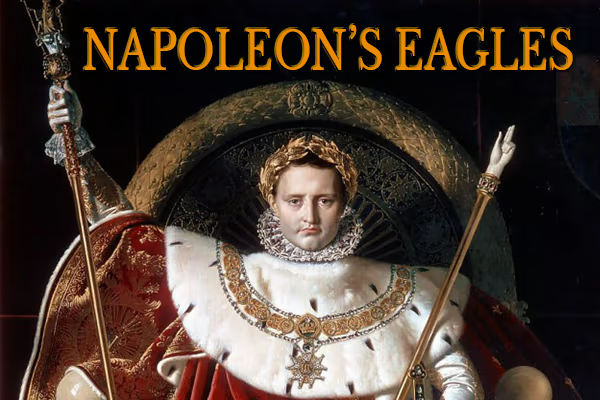
NAPOLEON'S EAGLES
The game is a grand strategic simulation of the Napoleonic Wars, derived from a masterpiece boardgame by Marc McLaughlin.AVALON DIGITAL has captured the look, feel, challenge, and excitement of the classic original board game War & Peace and brought it to life on your computer. Solo mode against the AI in some scenarios allows you to become Napoleon as you lead your armies from the fields of France to the steppes of Russia, and from the deserts of Egypt to the mountains of Spain. Or you stand against him as Blucher, Kutuzov, the Duke of Wellington, or any of a score of other famous generals as you plan your strategies to turn the tide of the Napoleonic Wars. And you can play all scenarios and campaigns in multiplayer (2 players).
Fight on land and at sea in short scenarios that cover every major strategic operation from 1796 to 1815, or do it all in a grand campaign that may – or may not – end on the field of Waterloo.
SCALE
Napoleon's Eagles is a monthly turn-based, hex-based (40 miles each), strategic game.
Dozens of individually named and rated generals lead armies composed of abstract strength points each representing roughly 5,000 men infantry or cavalry and their intrinsic artillery.
Every major – and minor – power of the Napoleonic Wars is represented with its own set of individual pieces, each of which is depicted by square counters illustrated with a soldier attired in the uniform unique to their nation and type.
The mix of forces includes everything from Spanish partisans and Prussian Landwehr on up to Russian Cossacks and Napoleon's Old Guard, and more.
The game also includes squadrons of ships of the line and transports with which players can wage both a global naval struggle – or recreate the situations that led to the epic clashes at the Nile, Copenhagen, and, of course, Trafalgar.
CONTENT
The game contains
- Different playing modes: solitaire play against the AI
- All the historical scenarios from the boardgame. Some have been thoroughly tested to be solo against AI (and can also be played in multiplayer mode), others are 2-players multiplayer-only for now (the Solo vs AI will come during the next months).

- THE ITALIAN CAMPAIGN OF 1796–97
- THE ARMY OF THE ORIENT, BONAPARTE IN EGYPT 1798–99
- MARENGO: 1800
- THE SUN OF AUSTERLITZ — 1805
- NAPOLEON’S APOGEE: 1806–1807
- WAGRAM — 1809
- THE CAMPAIGN IN RUSSIA — 1812
- NAPOLEON AT BAY — 1814
- THE WATERLOO CAMPAIGN — 1815

- STRUGGLE OF NATIONS — 1813
- THE PENINSULAR WAR: 1808–1814
- SPAIN: 1811–1814
- THE FINAL GLORY: 1812–1814
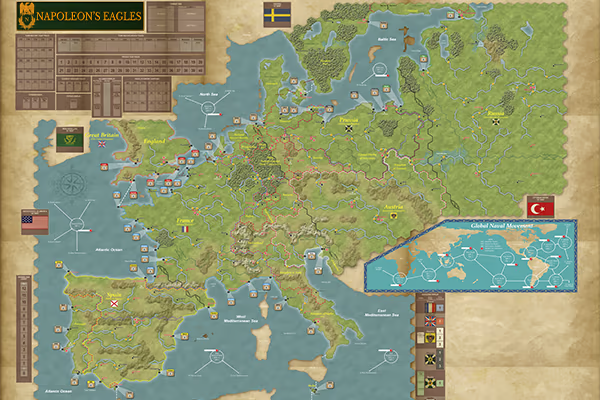
- Varied Hex maps with a scale of 40 miles per hex, weather zones, major cities for production and victory.
- 6 Major Powers, playable inside Pro or Anti-French Alliance, dozens of minor nations and powers.
- 5 different types of infantry, 3 of cavalry, all rated for their morale (i.e. quality) levels
- Warship or Transport naval squadrons
- All main historical leaders present
- March to the sounds of guns, conduct forced marches, fight pitched battles, entrench your armies, lay siege, and engage in amphibious, economic, and guerrilla warfare
- Production system for the grand campaign to create your own reinforcements
- Turn-based system, scale of one month per turn, with different phases: Attrition, Alliance, Reinforcements, Movement and Combat.
- An elegant, easy-to-understand on-screen guide that will walk you through every sequence of play and help you better understand the nuances and depth of choices and strategies available.
- Available in English and in French upon release, with Spanish, German, Russian and Chinese coming in a few months afterwards.
- No internet connection required to play against the AI
- THE GRAND CAMPAIGN GAME – WAR AND PEACE 1805-1815: a complete campaign covering the entire Napoleonic Wars, with production, diplomacy, foreign wars, land and naval warfare.
2 Players MP Only: this campaign is only playable in multiplayer mode for now, as the AI work on a project of this scope is daunting and will be made over time.
We prefer to have a playable 2-player multiplayer mode rather than an unfinished and unsatisfactory AI that would not render justice to the game.
PLAY DURATION
Estimated Playtime: 1 to Many Hours.
HISTORY
Although first published in 1980 by the Avalon Hill Company, the boardgame War & Peace has continued to evolve thanks to a dedicated fan base whose contributions have enhanced the game while retaining the original core set of basic rules. AVALON DIGITAL has taken the most recent of those versions, the 6th Edition which came out in 2021 and faithfully adapted it to the computer. Original designer Mark G. McLaughlin and his more recent co-designer, John Gant, have shepherded the board game through the latest of its six iterations.
The computer game was renamed Napoleon's Eagles in 2024 due to some other company having previously registered that brand on the computer games class (but our game remains the faithfull adaptation of the original boardgame which - as such - is the original 1980 IP of Mr Mark McLaughlin)
The original rules and scenarios remain intact, with additional scenarios set in Italy and the Levant to recreate Napoleon's early campaigns. Anyone who loved the board game will find the system familiar in every way.
John thoroughly revised and enhanced the original grand campaign for the 5th and 6th editions, with Mark's wholehearted approval and gratitude. In order to further ensure that they get every aspect of War & Peace correct, AVALON DIGITAL has retained Mark as one of the lead playtesters and consultants for the computer version of his classic and much-beloved design.
Napoleon's Eagles by AVALON DIGITAL is more than just a simple port of a board game to the computer; it is also a labor of love by an international team of historians and wargamers for whom this game is THE game on the Napoleonic Wars.
NB: The game name is a tribute to the well-know novel from Leon Tolstoï, "War and Peace", set in the Napoleonic era.

ONGOING AND FUTURE DEVELOPMENTS
As mentioned above, the biggest challenge for a development team in a game like Napoleon's Eagles is to create an AI that can prove to be challenging to players. We and the beta testers of the game (recruited from the Kickstarter campaign, see below) found a good balance and status in 6 of the game’s scenarios. For the other scenarios and campaign, the AI is still work in progress and we felt safer to keep the 2-players multiplayer version only for release.
Our development team, who has created the acclaimed Carrier Battles game is working hard and continuously on the AI and will provide regular free updates to it.
We conducted a survey last Spring to see with our testers and backers if they wanted the game to release now, or wait till everything was in place to do so. Most wanted the immediate release, as they feel the game is good enough to be a wonderful experience, and a current release will increase the number of potential players to join in multiplayer sessions.
WEBSITE
Visit the game's website here:
KICKSTARTER CAMPAIGN