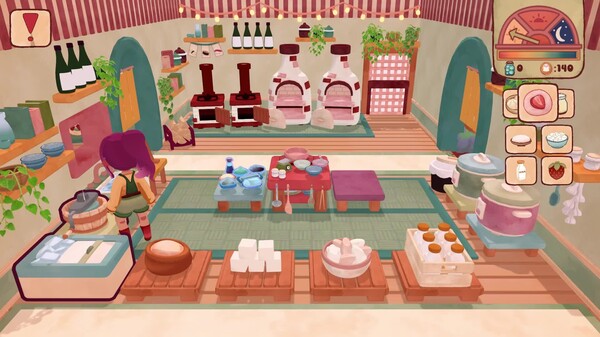
In this delightful farm-to-table cooking game, you’ll restore a cozy Japanese restaurant, cultivate a bountiful garden of fresh ingredients, and prepare mouth-watering Japanese dishes for hungry locals. Use your culinary skills to help bring a little life back to the spirit world!
Modeled estimate, not a reported figure. How we estimate →
About
Welcome to the spirit world! You might not remember how you got here, but don’t worry—Alan, the cutest (and grumpiest) poultry-geist, has a plan! In this farm-to-table cooking game help Alan restore a rundown Japanese restaurant, serve delicious meals, harvest fresh crops, and prepare special ingredients to meet all your customers’ needs.
Manage Your Restaurant:
Choose the menu that you want to serve each day. Experiment with new recipes and cater to what you think your customers will enjoy the most!
Balance your time and quality of each dish to keep your customers happy and earn money for future upgrades!
Prepare meals to put on your takeaway tables and meet the needs of customers on the go!
Farm-to-Table Cooking:
Water and harvest ingredients from your very own garden! Use these ingredients to create the freshest meals for your ghostly friends.
Make sure to take special care of your cows and chickens so that you can have fresh milk and eggs everyday!
Play mini-games to prepare certain ingredients for your recipes. Ferment soybeans to make your own soy sauce, dry green tea leaves to create your own matcha powder, and more!
Purchase Items & Upgrades:
Make sure to manage your finances so that you have enough funds to make purchases for your shop and yourself. Purchase new plants for your farm, decorations for your bedroom, and more!
Spend points to purchase upgrades to restore your shop, add extra elements to your kitchen, and activate other elements that make running your restaurant even easier!
Explore the NPCs:
Something has been missing from this restaurant for a long time. Learn about Alan’s history with the restaurant and help him find his missing piece!
According to Alan, this restaurant used to have some regulars. When they come into the restaurant, complete their challenge to learn more about the history of your store!
Genres
Stats
All-time low is the lowest price we've recorded for this game since we started tracking it.
Languages: English, Japanese, Simplified Chinese
Engagement
Reviews
Themes across 44 recent reviews and how positive each mention is. A keyword signal, not full sentiment analysis.
Reviews
In Kokoro Kitchen, you restore a rundown Japanese restaurant in the spirit world and serve delicious meals. I love cooking games, and Kokoro Kitchen is so cute! The game reminds me a bit of Lemon Cake, but I found myself enjoying Kokoro Kitchen more because it is not as grindy to unlock upgrades, new dishes, and even cows and plants for the farm. I also like the addition of the mini games. There is always something to do in the game, from cooking dishes for the spirits, restocking ingredients, cleaning up, and doing dishes, but the game does not feel overwhelming, which makes it a great cooking game.
I absolutely love this game its a very cozy and fun with just about right difficulty level to have to concentrate but not so much it isnt cozy anymore and the animation is adorable!
Media

Related
Related
Price dynamics, follower growth, revenue and sales trajectories with interactive tooltips
This and every other Pro feature is free until October 20, 2026. A free account is all it takes.
Hours played at review time, across 44 reviews with recorded playtime.
positive critical· bar length = how often the theme comes up
it stands by itself, but its way too easy for me personally. Doing a few days and finished the 3rd special customer, and I think I'm done with this. Everything you do does not change, which is a staple for cooking games of this kind, but there isnt enough presentation? or rewards that give you dopamine that you'd get from overcoming challenges. This game would be better for children and people who arent used to games. Personally I wouldnt recommend this to people who are used to cooking games that demand more on strategic challenge and rogue-like attributes, but as the game itself is fine so it earns a positive overall.
the joy
I played this game on the Steamdeck with no issues. Really fun and cute cooking game. I think the butcher shop door should be labeled a little better and the upgrade point count should include the up and down points, those were a little confusing. Would also be great if you could use money for more things once you unlock the recipes. Loved this though, thanks!
Kokoro Kitchen is a gentle, heartfelt simulation game that blends restaurant management, light farming, and time-management mechanics into a consistently cozy and emotionally warm experience. Developed and published by Mango Leaf Games, the game immediately distinguishes itself through tone rather than complexity, presenting a world where progress is measured less by efficiency and more by care, routine, and personal expression. Set in a spirit-filled realm inspired by Japanese aesthetics and folklore, the game frames its core loop around restoring a humble restaurant and nurturing both the space and the community that gathers within it. The structure of Kokoro Kitchen revolves around a calming daily rhythm that naturally guides the player without rigid enforcement. Each day begins with preparation, allowing you to decide which dishes to serve and how ambitious you want your workload to be. This sense of control is one of the game’s greatest strengths, as players are never forced into overwhelming scenarios unless they actively choose to expand their menu. Ingredient gathering forms the backbone of this preparation phase, with crops grown in your garden and produce collected from friendly farm animals like cows and chickens. The farm-to-table concept is not just thematic dressing; the quality and variety of ingredients directly influence your kitchen options, making even the simplest gardening tasks feel meaningful. Cooking and service introduce light time-management pressure, but the game intentionally avoids harsh punishment. Orders arrive steadily, and juggling preparation, plating, and delivery creates a satisfying sense of momentum, yet mistakes never result in failure or loss of progress. Burned dishes or missed customers simply pass without consequence, reinforcing the idea that Kokoro Kitchen is meant to be forgiving and approachable. This design philosophy makes experimentation feel safe, encouraging players to test new recipes, adjust menu complexity, and gradually refine their workflow without fear of setbacks. Beyond basic cooking, the game adds depth through ingredient processing mini-games that bring texture to the kitchen routine. Tasks such as fermenting soybeans, drying tea leaves, or preparing specialty components add a tactile layer to the experience, breaking up repetition and reinforcing the handmade feel of every dish. Progression is tied to both money and experience, with upgrades that improve efficiency, expand garden capacity, or unlock new cooking tools. These upgrades are paced thoughtfully, ensuring that growth feels earned rather than rushed and that the restaurant evolves organically alongside the player’s comfort level. Visually, Kokoro Kitchen leans heavily into a soft, inviting art style that complements its gameplay philosophy. Colors are warm, character designs are expressive, and environments feel intimate rather than expansive. The restaurant itself gradually transforms from a modest space into a lively, welcoming hub, which adds a strong sense of ownership and attachment. The animals are particularly charming, functioning as both resources and companions, and their presence reinforces the game’s nurturing atmosphere. Audio design remains subtle, relying on gentle music and ambient sound effects to create a soothing backdrop rather than demanding attention. Narrative elements are woven lightly into the experience, favoring emotional tone over plot complexity. As the restaurant gains popularity, spirit patrons return and share small pieces of history, hinting at past connections and personal stories tied to the space. Characters like Alan, the gruff but lovable poultry spirit, add personality and humor, grounding the supernatural setting with warmth and familiarity. These interactions never interrupt gameplay flow, instead acting as small rewards that deepen emotional investment without imposing narrative obligations. While Kokoro Kitchen is carefully designed to minimize stress, it does have moments where systems can feel slightly opaque, particularly early on. Some mechanics rely on experimentation rather than clear instruction, and as the restaurant becomes busier, multitasking can briefly feel overwhelming until upgrades are unlocked. However, the game’s forgiving structure ensures that these moments never escalate into frustration, and players are always free to slow down and simplify their approach. Ultimately, Kokoro Kitchen succeeds because it understands its purpose and audience. It is not a high-stakes management sim or a mechanically dense cooking challenge, but a comforting, player-driven experience built around routine, growth, and care. By emphasizing flexibility, warmth, and gradual progression, it creates a space where players can relax, express creativity, and enjoy the simple satisfaction of running a kitchen that feels alive. For fans of cozy simulations and gentle time-management games, Kokoro Kitchen offers a thoughtfully crafted experience that feels less like work and more like coming home. Rating: 7/10

Quite fun, but I wish the experience/skill system was explained better? I'm not understanding how the upgrades work, what do the blue bottles mean? Unless I missed something in the tutorial
Very cute and sweet game. I've just finished it and enjoyed the almost 11 hrs I spent playing it. The mini games are fairly easy with little drawback from failing. The same if a dish gets ruined, the consequences aren't anything further than having to remake the dish. It definitely left me wishing I could play more. Very fun and cute cooking game!
This is a cute little restaurant management game. It works well on both PC and steam deck, I actually think it plays better on the steam deck. It's pretty low stakes and relaxing. I would've liked it to be a little more challenging, after 10 hours I completed the game.
Maybe with some more polishing, the game would be a bit more fun to play but unfortunately at current, the game bugged out significantly in the tutorial. It was difficult to get through. I mistakenly thought that it would be kind of like an adorable Diner Dash and the mechanics of the game were more intensive than was enjoyable. Just wasn't for me.
Selling now
See how fast this game is selling right now — estimated copies and revenue per day from recent review growth.
Players by region
Where this game's players are, estimated from review languages.
Related
| Game | Estimated lifetime revenue | Reviews | Review score | Price |
|---|---|---|---|---|
| $969.8K | 2.1K | 84% | $14.99 | |
| $570.2K | 1.4K | 93% | $11.99 | |
| — | 0 | — | — | |
| $2.9M | 12.3K | 99% | $5.99 | |
| $854.4K | 1.7K | 76% | $24.99 | |
| $835.8K | 1.8K | 88% | $14.99 |
Related
| Game | Estimated lifetime revenue | Reviews | Review score | Price |
|---|---|---|---|---|
| $34.3K | 162 | 86% | $19.99 | |
| $34.3K | 321 | 88% | $5.99 | |
| $34.3K | 149 | 96% | $9.99 | |
| $34.2K | 351 | 85% | $4.99 | |
| $34.2K | 387 | 90% | $3.99 | |
| $34.2K | 385 | 56% | $4.99 |