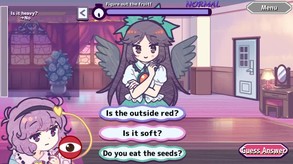
Satori's overworked herself into bed, but Okuu needs help remembering things! You can't use her heart-reading power, and will instead have to ask questions and use her power of recollection to correct wrong info, all while enduring visits from Orin and Koishi as you deduce what Okuu's forgotten!
Modeled estimate, not a reported figure. How we estimate →
About
Genres
Stats
All-time low is the lowest price we've recorded for this game since we started tracking it.
Languages: English, Japanese, Simplified Chinese, Korean
Engagement
Reviews
Themes across 44 recent reviews and how positive each mention is. A keyword signal, not full sentiment analysis.
Reviews
씨발년아 구라작작치라고 게년아
感觉比原神好玩
阿空你回答的問題有一半都記錯!!!!!!!!!! 現在你每次說話我都要用懷疑的眼神看你
Media

Related
Related
Price dynamics, follower growth, revenue and sales trajectories with interactive tooltips
This and every other Pro feature is free until October 20, 2026. A free account is all it takes.
Hours played at review time, across 44 reviews with recorded playtime.
positive critical· bar length = how often the theme comes up
Help Me Remember, Satori-sama! is a deceptively simple yet cleverly constructed deduction game that proves how engaging a strong idea can be when paired with charming presentation and thoughtful design. Developed and published by ISY, the game centers on conversation and logic rather than action, asking players to solve problems by asking the right questions instead of hunting for visual clues or executing precise inputs. What initially appears to be a lighthearted, cozy experience gradually reveals itself as a surprisingly sharp mental exercise built around uncertainty, inference, and the unreliable nature of information. The premise is immediately endearing and sets the tone for the entire experience. You play as Satori, who is exhausted to the point of being bedridden, yet still tries to help her scatterbrained companion Okuu recover lost memories. Normally gifted with the ability to read minds, Satori is forced to rely on conversation alone due to her weakened state. This narrative framing cleverly justifies the core mechanic: asking questions to narrow down what Okuu has forgotten. Each scenario revolves around deducing a missing object, concept, or memory by carefully choosing which questions to ask and interpreting the answers you receive. What truly defines the gameplay is the fact that answers are not always reliable. Okuu may give vague, misleading, or outright incorrect responses, forcing players to think critically rather than take every statement at face value. This design choice elevates the experience beyond a standard guessing game, as success depends on recognizing patterns, contradictions, and probabilities. Players must weigh how much trust to place in each answer and adapt their questioning strategy accordingly. The result is a satisfying loop of hypothesis, testing, and revision that feels closer to logical reasoning than trial-and-error guessing. Each puzzle presents a list of possible answers that initially feels overwhelming, but gradually shrinks as information is gathered. Asking questions becomes a strategic decision, as every inquiry carries the risk of being wasted on misinformation. This tension keeps the game engaging, especially on higher difficulties, where incorrect deductions are more punishing and careful thinking is rewarded. While the total number of scenarios is relatively small, the variability in answers and questioning paths gives each puzzle a degree of replay value, encouraging players to revisit stages and refine their approach. Visually, the game leans into a soft, anime-inspired aesthetic that complements its relaxed tone. Character art is expressive and cute, using simplified designs that emphasize personality over detail. These visuals help offset the mental effort required by the puzzles, making the experience feel warm and inviting rather than cerebral or intimidating. Animations and effects are minimal, but they serve their purpose well, keeping attention focused on dialogue and deduction rather than spectacle. The interface is clean and readable, ensuring that information is presented clearly without unnecessary clutter. Audio design is understated but effective. Background music is gentle and unobtrusive, providing a calming atmosphere that encourages focus. Sound effects are used sparingly, reinforcing actions without distracting from the core gameplay. This restraint works in the game’s favor, allowing players to concentrate fully on logic and reasoning while still enjoying a pleasant sensory backdrop. Narratively, the game does not aim for dramatic twists or deep emotional arcs, but it succeeds through personality and humor. Dialogue is playful, occasionally mischievous, and often self-aware, reinforcing the lighthearted tone even when deductions go wrong. The relationship between Satori and Okuu adds charm to the experience, making failures feel amusing rather than frustrating. This balance between challenge and humor is key to the game’s appeal, as it keeps players motivated even when puzzles prove tricky. Ultimately, Help Me Remember, Satori-sama! is a compact but thoughtfully designed puzzle game that rewards patience, logic, and careful observation. It may not offer a long runtime or a complex narrative, but what it does provide is tightly focused and consistently engaging. Players who enjoy word games, deduction puzzles, or logic-based challenges will find a great deal to appreciate in its mechanics and presentation. By turning simple conversation into a meaningful gameplay system, it stands out as a clever and memorable indie title that delivers far more depth than its gentle exterior might suggest. Rating: 8/10
气笑了。。。为什么耳垂、天灵盖也能当答案啊,这一般谁能猜出来 嗨呀
사토리님! 컨텐츠가 부족해요ㅡ!
tractors are not water related
This is very good game. Play this GOTY game. 😭😭
노말 난이도 올클 1시간 30분 5스테이지 장소찾기가 진짜 개어려웠음;;
내가 이 게임 리뷰를 달았었니? 헤헤... 잊어버렸어요!
Selling now
See how fast this game is selling right now — estimated copies and revenue per day from recent review growth.
Players by region
Where this game's players are, estimated from review languages.
Related
| Game | Estimated lifetime revenue | Reviews | Review score | Price |
|---|---|---|---|---|
| $14K | 277 | 90% | $2.99 | |
| $9K | 50 | 88% | $8.99 | |
| $6.8K | 50 | 100% | $7.64 | |
| $209 | 1 | 100% | $9.99 | |
| — | 0 | — | — | |
| $1.5M | 8.2K | 95% | $12.99 |
Related
| Game | Estimated lifetime revenue | Reviews | Review score | Price |
|---|---|---|---|---|
| $95.5K | 701 | 93% | $14.99 | |
| $95.5K | 189 | 77% | $17.99 | |
| $95.5K | 255 | 96% | $17.99 | |
| $95.5K | 227 | 77% | $14.99 | |
| $95.5K | 356 | 97% | $14.99 | |
| $95.5K | 1.9K | 92% | $3.74 |