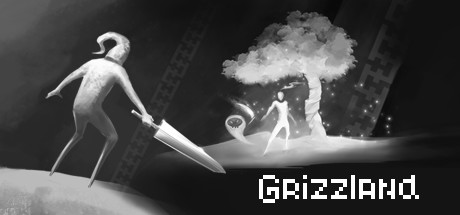
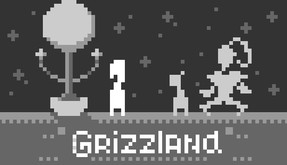
Grizzland, developed and published by Kiepska Spółka, is an exercise in minimalism and atmosphere that manages to achieve a sense of scale and mystery far greater than its simple presentation would suggest. Built entirely in a resolution of 128x96 and limited to five colors, it is a starkly designed Metroidvania-style exploration game that proves ambition isn’t tied to graphical fidelity or budget. It is a love letter to a time when imagination filled the spaces left by limited hardware, but it also stands on its own as a modern experiment in restraint and discovery. Beneath its rough, lo-fi aesthetic lies a carefully constructed world filled with secrets, danger, and a quiet melancholy that lingers long after the final scene.
The story unfolds on a dying planet where nature is fading and the last traces of life struggle to survive. You play as a lone wanderer armed with a sword, guided by vague directions and cryptic remarks from the few remaining inhabitants. There is no exposition or cutscene-heavy introduction—Grizzland begins without ceremony, letting its setting speak for itself. As you explore its interconnected environments, you piece together fragments of lore that hint at what went wrong. Each region tells a subtle story through its design: ruined cities swallowed by darkness, lifeless forests where corrupted creatures roam, and decaying machinery that hums with forgotten energy. The world is sparse, but every object feels intentional, and the absence of overt storytelling gives the game a contemplative tone. It is not about understanding every detail but about feeling the weight of desolation and the faint hope that something might still grow in the ashes.
Gameplay is the backbone of Grizzland, and it blends exploration, platforming, and combat with precision and purpose. The controls are responsive and immediate, a necessity given the game’s focus on tight platforming and deliberate swordplay. Movement is fluid, allowing players to jump, climb, and dash across the sprawling environment, while combat demands a measured approach. Each strike of your blade comes with a moment of vulnerability, so you must learn timing and positioning rather than rely on button mashing. Enemies, though simply drawn, are relentless and often unpredictable, darting and dodging in ways that keep you on edge. Boss encounters punctuate the experience with dramatic difficulty spikes, testing not only your reflexes but your patience and adaptability. Despite its simplicity, combat in Grizzland carries a certain weight—it feels tactile and risky, rewarding players who approach it thoughtfully rather than impulsively.
Exploration is where the game truly shines. The world is seamless, and every corner invites curiosity. There are no map markers or glowing guides to lead you—progress relies entirely on observation and intuition. Many of the most satisfying moments come from stumbling upon hidden paths or unlocking shortcuts that loop back to familiar areas. Secrets abound, from optional upgrades and lore snippets to entire hidden chambers waiting to be discovered. The design encourages experimentation; sometimes, simply revisiting an area with a newly acquired ability reveals previously inaccessible spaces, reinforcing that quiet Metroidvania rhythm of progress through understanding. The game trusts the player to find their own way, and that trust makes each discovery feel earned.
Visually, Grizzland’s five-color palette is both a limitation and a triumph. The lack of detail forces the imagination to fill in the gaps, turning the abstract shapes into convincing landscapes and architecture. The minimalist art style creates a mood of otherworldly isolation, and the contrast between light and shadow gives each frame a sense of mystery. The limited visuals are complemented by a subtle and haunting soundscape—soft ambient tones, the distant hum of machinery, and the occasional melody that drifts in at just the right moment. Together, the visuals and audio produce an atmosphere that feels meditative and alien, as if you are exploring a half-remembered dream.
Grizzland’s narrative, such as it is, remains intentionally ambiguous. The fragments of story you uncover never form a complete picture, leaving players to interpret the meaning of the planet’s decay and the protagonist’s role in it. Some may find this lack of clarity frustrating, but it fits the game’s design philosophy: Grizzland is not about resolution or revelation but about experience and introspection. It invites you to linger in its strange world, to draw your own conclusions from its silence. The lack of hand-holding extends beyond story into every part of its design, and while this can occasionally make navigation confusing, it also gives the world an organic sense of mystery that few games achieve.
Despite its strengths, Grizzland is not without flaws. Its combat can at times feel stiff, particularly when surrounded by faster enemies, and the limited variety of foes means encounters can become repetitive. The same can be said for the environments, which, while atmospheric, occasionally blur together due to the uniform art style. There are also moments when the game’s minimalism works against it—certain objectives or progression paths are too obscure, leaving players to wander aimlessly until they stumble upon the solution. Yet these frustrations are fleeting and often overshadowed by the satisfaction of discovery that follows.
In the end, Grizzland is a remarkable example of how creative constraint can foster innovation. It transforms its simplicity into strength, offering a world that feels both ancient and intimate, mysterious and personal. Its blend of exploration, challenging combat, and minimalist storytelling captures the spirit of old-school adventure while infusing it with a modern sensibility. It is a game that rewards patience and curiosity, and though it may be short, it leaves a lasting impression through its mood and vision. For those who value atmosphere and exploration over spectacle, Grizzland is a small but resonant gem—a haunting journey across a dying world that feels alive precisely because of its emptiness.
Rating: 7/10