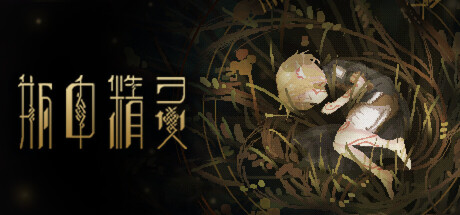
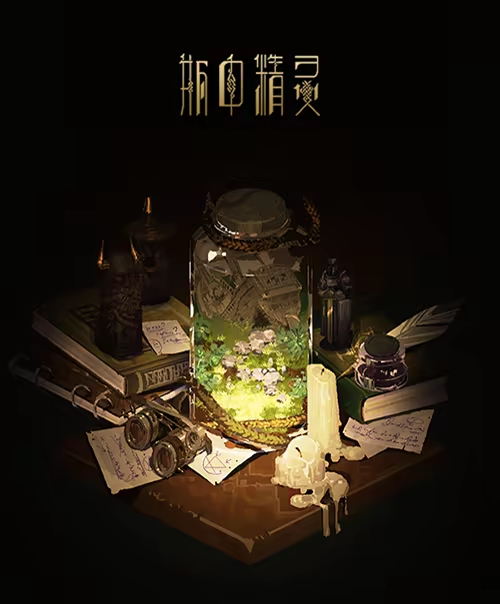
Fairy in a Jar, developed by 鸬鹚鱼塘 and published by Eternal Dream and 迷糊的安安, is a short but hauntingly beautiful narrative game that blends fairy-tale melancholy with minimalist design and emotional storytelling. It opens with a mysterious premise: a tiny fairy awakens inside a glass jar, stripped of memory and freedom, confronted by an unknown human presence who watches from beyond the glass. From this deceptively simple setup, the game unfolds as a quiet meditation on captivity, innocence, and the blurred lines between affection and control. The player’s role is less that of an active participant and more an observer or conscience, guiding the fairy through a confined but emotionally charged space where small choices shape the story’s outcome.
At its heart, Fairy in a Jar is more about atmosphere than mechanics. The player navigates the confines of a small environment, interacting with objects, uncovering fragments of memory, and making choices that gradually reveal the nature of the fairy’s imprisonment. Each decision carries subtle moral weight—whether to seek escape, empathy, or understanding of the captor—and leads to one of several endings that recontextualize the story’s meaning. There are no combat systems, complex puzzles, or elaborate interfaces here; instead, the game relies on narrative progression, tone, and environment to evoke emotion. Its pacing is deliberately slow, encouraging reflection and interpretation rather than urgency. The result is a game that feels less like a traditional adventure and more like a fable or parable—a work designed to be felt rather than conquered.
The visual presentation is among its most captivating qualities. Rendered in soft, hand-drawn pixel art, the world of Fairy in a Jar feels fragile and dreamlike, as if every frame were captured from a forgotten memory. The backgrounds shimmer with subdued color palettes—cool blues, dusty purples, and muted golds—that convey a mood of melancholy and wonder. Subtle animations, like the flicker of the fairy’s wings or the shimmer of light through the glass, add a delicate sense of life. Every visual element feels intentional, serving to heighten the contrast between beauty and confinement. This aesthetic sensitivity is what allows the game to transcend its technical simplicity; the player’s emotional response is guided not by spectacle but by texture, rhythm, and restraint.
The soundtrack reinforces this sense of quiet introspection. Gentle piano melodies, soft ambient hums, and fleeting choral tones weave through the story like a ghostly lullaby. The music rarely asserts itself but instead lingers at the edges, enhancing the emotional rhythm of each scene. Even after the story ends, many players find its main theme lingering in their memory, a testament to how effectively the audio complements the visual tone. There is no voice acting, but the absence of speech feels deliberate—it leaves space for the player’s imagination to fill in the emotional subtext. This combination of minimalist sound design and expressive imagery creates a world that feels intimate and deeply personal.
Narratively, the game’s strength lies in suggestion rather than exposition. The story hints at trauma, loneliness, and misplaced affection without spelling them out. Depending on the player’s choices, the relationship between the fairy and her captor can be read in many ways—symbiotic, tragic, or even romanticized in a twisted sense. Each ending offers a different emotional interpretation, from bittersweet acceptance to despairing liberation. The writing is spare but poetic, occasionally marred by small translation issues that reveal its indie origins, yet even these imperfections contribute to its sincerity. There is a certain vulnerability in the prose—a willingness to let silence and ambiguity carry emotional weight—that recalls the storytelling approach of art-house visual novels and short narrative experiments.
While the experience is brief, often lasting less than an hour, its impact lingers. Fairy in a Jar is the kind of game that invites reflection long after it ends. Its themes of confinement, empathy, and moral ambiguity resonate because they are delivered through tone and atmosphere rather than explicit message. The game leaves space for interpretation: some may see it as a commentary on control and dependency, others as a metaphor for lost innocence or the fragile nature of memory. Whatever the reading, it manages to evoke emotion through restraint—a rare quality in a medium often defined by excess.
Technically, the game runs smoothly and is accessible even on low-end systems. Its simplicity ensures few bugs or performance issues, though players have noted minor quirks in text formatting and localization. The interface is clean and intuitive, allowing focus to remain on the story and visuals. For a project of its scale, the polish is impressive, and the creative vision is clear. It never overreaches, instead choosing to stay within its limitations and refine what it does best.
Ultimately, Fairy in a Jar stands as a quiet triumph of mood and storytelling economy. It distills the essence of interactive fiction into something intimate and emotionally resonant. While its short length and minimalist gameplay may leave some wanting more, those who approach it as an artful experience rather than a traditional game will find something memorable. It is a story told through glances, silences, and the soft shimmer of light against glass—a fragile, haunting reflection on the boundaries between love, captivity, and freedom.
Rating: 9/10