Contact is a small-scale indie horror adventure that leans heavily on atmosphere, unease, and fragmented storytelling rather than mechanical complexity or overt scares. Developed by UKZ Arts and published by PsychoFlux Entertainment, the game presents itself as a retro-inspired, point-and-click experience that blends psychological horror with classic adventure game sensibilities. From the outset, it establishes a somber and unsettling tone, inviting players into a world that feels both familiar and deeply wrong, where memory, guilt, and fear bleed together into a quiet but persistent sense of dread.
The narrative begins with a traumatic incident that leaves the protagonist stranded in a distorted reality following a heated argument and a catastrophic accident. This premise immediately grounds the experience in emotional turmoil, and the story unfolds gradually through exploration rather than exposition. Dialogue is sparse, and much of the storytelling is environmental, encouraging players to piece together events through visual cues, brief interactions, and unsettling imagery. The search for family members acts as the central motivation, but the game deliberately avoids clear answers, instead favoring ambiguity and surreal transitions that blur the line between reality and nightmare. This approach gives the story an abstract, dreamlike quality that will resonate most strongly with players who enjoy interpretive narratives rather than straightforward plot progression.
Gameplay follows traditional point-and-click conventions, with players navigating through static scenes, examining objects, collecting items, and solving simple puzzles to advance. Interactions are intentionally limited, keeping the focus on observation and atmosphere rather than complex mechanics. Occasionally, the game introduces quick-time events and chase sequences that inject bursts of urgency, breaking up the slower pace of exploration. These moments are generally brief and scripted, serving more as narrative punctuation than as sustained gameplay challenges. While the controls and mechanics are easy to grasp, progression can sometimes feel unclear, requiring players to thoroughly scan environments for interactable elements that are not always immediately obvious.
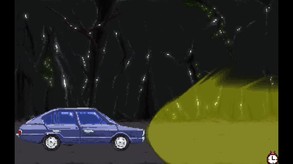
Visually, Contact adopts a pixel-art style that evokes older adventure and horror titles, reinforcing its retro identity. The environments are subdued and muted, often drenched in darkness or unnatural lighting that enhances the game’s oppressive mood. While the simplicity of the visuals supports the eerie atmosphere, it can also work against clarity, as important details occasionally blend into the background. Character sprites and creature designs are understated but effective, relying on suggestion rather than explicit horror to unsettle the player. The minimalist presentation aligns well with the game’s psychological focus, emphasizing what is implied rather than what is shown.
Sound design plays a crucial role in sustaining tension throughout the experience. Ambient noises, distorted effects, and unsettling musical cues create a constant undercurrent of unease, even during moments when nothing overtly threatening is happening on screen. Silence is used deliberately, allowing players’ imaginations to fill in the gaps and heighten anxiety. Rather than relying on loud jump scares, the game builds discomfort slowly, making players feel watched or unsafe without clearly identifying the source of danger. This subtle approach to horror is one of Contact’s stronger qualities, especially for players who prefer mood-driven fear over shock tactics.
That said, Contact’s limited scope is evident. The overall experience is relatively short, and the lack of mechanical depth or branching outcomes means replay value is minimal. Puzzles are straightforward and rarely challenging, and some narrative threads feel underdeveloped or abruptly concluded. Players seeking a deeply interactive adventure or a richly layered horror experience may find the game too slight to leave a lasting impact. Occasional pacing issues and moments of confusion can also interrupt immersion, particularly when progression depends on obscure interactions.
In the end, Contact stands as a modest but sincere indie horror adventure that succeeds most in its atmosphere and tone. It is not a game that aims to redefine the genre or deliver complex systems, but rather one that offers a brief, unsettling journey shaped by emotional trauma and surreal imagery. For players who appreciate low-budget psychological horror, retro aesthetics, and slow, contemplative exploration, Contact provides an experience that, while imperfect, carries a distinctive mood and a quiet sense of unease that lingers beyond its short runtime.
Rating: 5/10