
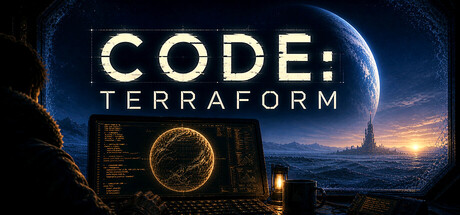
A deep automation and programming game on a frozen alien planet. Write real code to drive rovers, run power grids, fabricate parts, and fly drone fleets across the world. Your scripts run while you plan your next move. The more you terraform, the more the planet responds.
Modeled estimate, not a reported figure. How we estimate →
Charts
Each storefront's own chart, in its own country — the closest public signal to sales where none is published. A country missing from a list is one we don't collect there, not one where the game doesn't chart.
No United States chart position — it charts only in the markets below.
Same day: best UK #67, worst DE #88 · 3 markets collected
About
FREE DEMO IS AVAILABLE: Download and play the game now.
You've been sent to a frozen alien world. Your ship is silent. Sensors offline.
The only way to bring this place to life is to write code.
Code: Terraform is an automation/programming game where every action happens through scripts you write. Not visual programming. Not drag and drop. Real code, in a language modeled after Python, with a full editor, console, and documentation built into the game.
You don't click to mine. You write the mining script. You don't manage a power grid by hand. You script the policy that runs it. Solar trackers follow the sun because your code reads the clock. Drone fleets fly because your code dispatches them. The more systems you script, the more the planet responds.
Bring your base online one script at a time. Calibrate sensors. Activate solar power. Read raw instrument data and turn it into meaning. Every system is a component you interact with through code.
Your solar tracker follows the sun. Your rover surveys distant sites and drills the ones worth mining. Your smelter refines what comes back. They all run at the same time, your code working while you plan your next move.
Earth sends contracts. Data processing challenges with real rewards. Parse signals, filter datasets, compute solutions. The harder the contract, the bigger the payout.
Earn credits. Buy machines. Deploy modular rovers and Pioneers, swap nav and sonar and drill modules to suit the job. Smelt ore into ingots. Fabricate parts: pipe segments, machine frames, circuit panels, turbine rotors, cargo pods, thruster assemblies, battery packs. Ship orders to Earth's contractors for credits, recipe unlocks, and tech upgrades. Scale from a single solar panel to a planet spanning industry.
Drill water from underground reserves. Tap oil wells. Cap geothermal vents for steam. Pipe each medium across the planet, balance backpressure, and feed tier three machines that demand continuous flow to run at full output. Bridge crossing pipes with overpasses. Wire power subnets with line segments. The infrastructure layer is tile by tile, and yours to design.
Mark I machines bring you to a thin atmosphere. Mark II push you to breathable air. Mark III demand fluid input but unlock the climb to terraformed. Earn upgrade packs through orders, apply them to deployed machines, watch your output curve bend.
Plan pipes, power lines, and outposts in a tile based blueprint editor. Send a Pioneer with a Constructor module to execute the plan. Lay infrastructure piece by piece, exact tile by exact tile, the same way a real engineering crew would.
Assemble drones from chassis, thrusters, and modular pods. Plant outposts in the richest territory and operate them remotely. Write flight scripts that haul ore home, ferry supplies out, recover stranded fleets. Charging stations and refueling pads keep the fleet airborne. Recovery bays airlift the ones that don't make it back. Distance becomes a function of battery and fuel, not track. Share a route once as a library script and every drone uses it.
Full code editor with syntax highlighting, autocomplete, signature help, type aware completions, rename refactoring, and inline docs that jump on Cmd+click. Multiple scripts running concurrently. Library scripts for shared code: import a function once, use it everywhere. Breakpoints, log points, conditional breakpoints, three step modes for real debugging. Dock the editor to code and watch the results side by side.
Sensor readings that don't match. Warm patches where nothing should be warm. Structures that weren't there yesterday. Mission control asking questions they shouldn't need to ask. The more you terraform, the more the planet responds. Not to your equipment. To you.
No cutscenes. No cinematics. Every story beat arrives through the systems you already use. Briefings, sensor data, encrypted transmissions, contract anomalies. The truth unfolds while you work. Pay attention to the details.
There are docs and hints. No tutorials. Figure it out, like a real engineer would.
Genres
Stats
All-time low is the lowest price we've recorded for this game since we started tracking it.
Languages: English**languages with full audio support
Add-ons
Each DLC is estimated with the same model as a game, then summed — a modeled figure, not reported DLC sales.
Engagement
Reviews
Themes across 211 recent reviews and how positive each mention is. A keyword signal, not full sentiment analysis.
Reviews
It is exactly what it sells itself as. Coding your way through an incremental game. It's incremental nature means that you aren't punished for optimizing. Which is great, because I am a dirty self-taught so its a lot of trial and error for me. The documentation is good enough to fumble through with even a passing knowledge of Python and programmatic thinking. Easily the best money I have spent in the last month, if not two.
I have put a number of sleepless hours into understanding, optimizing, breaking, rebuilding, and rethinking the systems in this game, and I can confidently say that very few games have ever made me think this much about how I want to solve a problem. What makes this game special is that it does not just give you machines and tell you to place them. It gives you systems. Power generation, batteries, terraforming, logistics, vehicles, construction, resource processing, outposts, pipelines, electrical networks, automation, and scripting all interact with each other. Eventually you stop thinking about individual machines and start thinking about the entire planet as one interconnected system. The scripting is probably my favorite part. You can start with something incredibly simple and eventually find yourself writing controllers that inspect machine state, react to failures, manage resources, coordinate vehicles, recover from interrupted jobs, and continuously reconcile what the world actually looks like with what you want it to look like. The fact that the world persists while scripts can restart forces you to write automation that is actually resilient instead of relying on everything going perfectly. Machines may already contain cargo. Jobs may already be queued. Construction may be partially completed. Power conditions may have changed. Your scripts have to look at reality and make intelligent decisions from there. That is an incredibly satisfying design philosophy. The Pioneer system is another great example. At first it is simply a vehicle that can carry materials and construct things. Then you start building proper workflows around it: loading batteries, configuring modules, carrying storage bins, traveling to blueprints, constructing outposts, finishing pipelines, extending power infrastructure, and trying to automate larger and larger construction operations. Before long, you are no longer driving a vehicle. You are designing a construction fleet. The terraforming systems have the same progression. Early on, getting a single Heat Generator, Oxygen Generator, or Pressure Generator running feels significant. Later, you are thinking about power budgets, solar fluctuations, battery reserves, generator throttling, fuel consumption, multiple outposts, and how aggressively you can expand without destabilizing everything else. And that is where this game really shines. Every improvement creates another problem worth solving. You increase production, so now logistics becomes the bottleneck. You improve logistics, so now power becomes the bottleneck. You increase power, so now construction speed becomes the bottleneck. You automate construction, so now your automation architecture becomes the problem. Then you spend several hours redesigning something you were completely convinced was perfect yesterday. I mean that as a compliment. There is a tremendous amount of satisfaction in slowly turning a messy collection of machines into something that feels intentional, organized, automated, and alive. It also rewards experimentation. You will absolutely overengineer things. You will write scripts that are far more complicated than they need to be. You will create entire systems only to realize later that half of them can be removed. But figuring that out is part of the game. Some of my favorite moments have not come from unlocking something new. They have come from looking at a system I built many hours earlier and realizing, "I can make this dramatically simpler." Then rebuilding the whole thing. If you enjoy automation games, programming, logistics, engineering problems, optimization, or games that let you invent your own solutions instead of forcing you down one predetermined path, there is an enormous amount here to enjoy. This is the kind of game where you can spend countless and tireless hours discussing one vehicle class, one controller, one power system, or one automation problem—and somehow still discover another way to improve it. Highly recommended. Just be warned: eventually you may spend more time designing the system that builds the planet than actually building the planet. And somehow, that is the best part.
Media

Related
Related
Price dynamics, follower growth, revenue and sales trajectories with interactive tooltips
This and every other Pro feature is free until October 20, 2026. A free account is all it takes.
Related
| Game | Estimated lifetime revenue | Reviews | Review score | Price |
|---|---|---|---|---|
| $173.4K | 334 | 76% | $24.99 | |
| $173.5K | 805 | 93% | $8.99 | |
| $173.3K | 2.8K | 84% | $2.99 | |
| $173.3K | 270 | 77% | $14.99 | |
| $173.3K | 262 | 90% | $14.99 | |
| $173.3K | 7.2K | 89% | $0.99 |
Related
| Game | Estimated lifetime revenue | Reviews | Review score | Price |
|---|---|---|---|---|
| $4.2M | 4.1K | 77% | $20.79 | |
| $1.6M | 1.6K | 87% | $29.99 | |
| $1.3M | 1.7K | 75% | $19.99 | |
| $361.9K | 683 | 84% | $10.49 | |
| $109.3K | 113 | 88% | $24.99 | |
| $105.7K | 257 | 69% | $12.99 |
Hours played at review time, across 212 reviews with recorded playtime.
positive critical· bar length = how often the theme comes up
总体来说体验其实和OJ有点相似,总之就是做题,然后看结果,尤其是游戏里还真有类似OJ的固定题目。游戏内容方面不算特别丰富,而且目前因为编排原因其实很多内容还是更适合半自动游玩,也没那么多值得全自动处理的工作就是,所以如果是期待这款游戏是工厂模拟的玩家可能会失望(ps. 想玩编程形式的工厂模拟,为什么不真的找个工厂去给PLC写程序呢?),但是如果想勾起一些做OJ的痛苦回忆那这游戏应该还算合适。 然后也因为全自动意义有限,这款游戏的难度总体应该算是不高。当然,这也是对懂编程的玩家而言的。入门的话,只能说也不推荐了。Vibe Coding玩家嘛……你开心就好,只是以这游戏的难度来说真不至于。
Great game even while in EA. You have a lot of different devices and write code for them so that they work. There is no stress factor so you can spend as much time making your code as you want. And then you can spend more time optimizing it. You automate miners, solar panels, bio lab, scanners and a lot of other things. Eventually you even start building new outposts which you can focus on different things. It's crazy how many things there are and how much freedom you have. It's like Planet crafter but instead of exploration in 3rd person you are programming trucks and machinery to do everything for you. I am not a programmer and still I enjoyed messing with the code and trying to understand how to do things.
I can’t even edit a solar_panel ID. The IDs aren’t sequential and look really ugly.
I've spent hours playing this game in demo form, engaging with the developer on Discord, and now playing the full game. I can't recommend this more - unlike some other programming games, every detail in the developer environment has been taken care off to make it a pleasure to code (and debug) in this game! The planet outpost run by code mechanisms are well thought out and offer many unique challenges. I can't wait to see more!
Nice game for geeks and software devs! Hoping to have a real moving pieces for the next updates!
I've been enjoying this so far. I wouldn't recommend this for people that are trying to learn Python syntax for the first time. This exercises the oft-underlooked skill of RTFM to work out the APIs.
..................................................
Awesome game! The atmosphere is great and I love the background music. It is not just coding training in python. It has a storyline, creates a great atmosphere and then you start to piece together why you should not have come to this planet in the first place...
Selling now
See how fast this game is selling right now — estimated copies and revenue per day from recent review growth.
Active players
Estimated daily and monthly active players (DAU/MAU) modeled from peak concurrency.
Players by region
Where this game's players are, estimated from review languages.
Players also reviewed
The games this title's players most often review too — audience affinity.