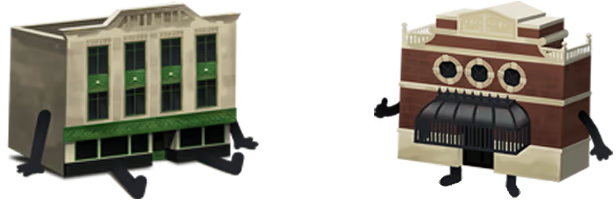
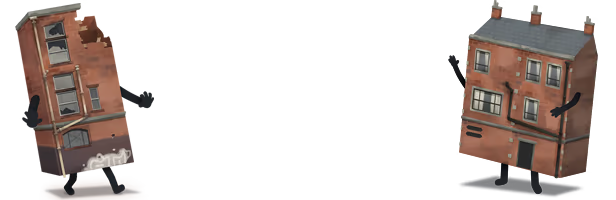
An exciting new city-management/puzzle game about buildings and the city they inhabit. You must grow your city to a bustling metropolitan centre with an array of shops, offices, entertainment facilities and amenities, to help your buildings thrive; or risk them being demolished forever.
Modeled estimate, not a reported figure. How we estimate →
Discounts
Every price cut of more than 20% we have observed, in each market that quoted one, with this game's chart position on either side of it. These are episodes, not a model: a sale is one event, and one event cannot tell you what the next one will do.
About


Sums Steam only; PlayStation, Nintendo publish no volume signal, so the true total is higher by an unknown amount.
| Store | Price | Audience | Score | Chart | Est. revenue |
|---|---|---|---|---|---|
SteamYou are here | $1.99−90% | 80reviews | 44% | — | $3.8K |
| $19.99 | 39ratings | 62% | — | not modelled | |
Engagement
Reviews
Themes across 47 recent reviews and how positive each mention is. A keyword signal, not full sentiment analysis.
Reviews
[★★카페 개장하기]가 카페 2개를 차리기란 것을 진작 알았더라면,, ★ 2.5 / 5
其他评论说的真的对、、根本不是建造类游戏,单纯的益智类游戏。
I am trying to understand the gameplay & get accomplishment but I didn't. Played too long to qualify for refund. The theme is fitting but gameplay didn't match to me.
Media

Related
Related
Price dynamics, follower growth, revenue and sales trajectories with interactive tooltips
This and every other Pro feature is free until October 20, 2026. A free account is all it takes.
Reviews, worldwide (the counter carries no country): 0/day in the week to Aug 2 → 0/day in the week after.
For scale, across Steam · Top Sellers · Brazil over the last 30 days: the 26 chart moves that followed a price cut of more than 20% went a median of 7 places towards #1, and the 2,400 moves with no price cut behind them went 2 away. One store, one chart, one country — it is the only place we have enough observations to say even that.
Prices outside the United States have been collected since 6 August 2026 and chart positions since 19 July 2026, so a cut older than that has no market to compare and a market that joined later has no history yet. Nothing here is converted between currencies.
Genres
Stats
All-time low is the lowest price we've recorded for this game since we started tracking it.
Languages: English*, Simplified Chinese, French, German, Spanish - Spain, Japanese*languages with full audio support
| $1.99−90% |
| — |
| — |
| — |
| not modelled |
Matched by title — a reused name can pair the wrong games. * is a critic aggregate. Prices and positions are each store's United States storefront; Epic charts worldwide. Audience and Score too, except Steam's, which is worldwide.
Hours played at review time, across 47 reviews with recorded playtime.
positive critical· bar length = how often the theme comes up
The game is just swell, its charming. Yet all I see is it getting absolutely blasted for every minute problem. It is basically nitpicking. The game is what it is trying to be and does a good job at it. To be honest I don't get the hate, I have read review after review and I have tried all the problems from the reviews and have found none of them to be an issue. The biggest problems are that it gets quite repeative, that the popups for upgrades sometimes don't go away, and that the music is kinda ass. However, all of these are simple fixes. The repeativness is caused when you have to switch to a new place and rebuild all over again, the upgrade glitch can be solved by just going to a different place then returning. Then the music, the music should just be replaced. Other than that it is exactly what you get on the tin. 7/10
The game holds an interesting premise and is really well made, however the mechanics are a little too fussy. You have to many menus and sub-menus to navigate in order to be able to determine the wants and needs of each building, I feel if that was a little more streamlined in how it operated it would make a play through a lot smoother. Its not that its a bad game, just needs a bit more streamlining.
I didn't care for the game play. I thought it was city builder management type game but it's not at all. It's a puzzle game. The game play revolves around placing the correct buildings next to each other so that they level up. A rented rooms next to a grocery store next to a pub and so forth. The only thing related to cities is that they are buildings. I suppose the emergent game play is leveling up the buildings and therefore unlocking more buildings with more needs but that just didn't do it for me. I wasn't interested in continuing after the second map. The graphics and art style were nice though and at $3.99 I didn't bother refunding.
1. UI가 불편함 2 ★★ < 이게 ★★을 2개 지으라는 의미임. 이걸 어떻게 알아... 지역 이동은 튜토리얼조차 없어서 아무거나 누르면서 알아서 찾아야됨 2. 조작감이 안좋음 이걸 조작감이라 표현해야하는지는 잘 모르겠는데 이동하고 나서 멈췄을 때, 화면이 완전히 멈추는 데까지 1초 이상이 더 걸림 그런데 건물을 짓거나 옮길 때 클릭해야하는 포인트가 너무 작아서, 그 1초 이상을 기다려야함 옮길 때는 클릭이 2번이니까 거의 3초 정도 의미없는 시간이 소모됨 ㅈㄴ 답답함 3. 재미가 없음 주인공이 건물이라는 점에서 일단 몰입감이 떨어짐 건물이 살아있고 감정을 느끼고 걸어다닌다는 점이 너무 아동용 게임같아서 몰입감은 물론 흥미도 떨어짐 건물을 지었다 부쉈다 옮겼다의 반복이지 내가 무언가를 디자인한다는 느낌은 전혀 없어서 결과적으로 재미가 없음 컨셉 자체에 대해서는 별 의견 없음. 건물이 살아있다 뭐 그럴 수 있지 근데 결과적으로 "건물에 요구품 넣어주기"가 핵심인데, 그런 게임은 이미 많음 ANNO 시리즈, 프로스트펑크, 배니시드 등등 너무 많음 이 게임은 그 게임들의 하위호환에 불과함. 딱 하나 차별화 포인트는 캐주얼인데 그것도 투 포인트 시리즈가 있어서... 개선할만한 포인트를 다 개선하더라도 그걸 벗어나긴 어렵다고 봄
Ich war wirklich gespannt, aber das Spiel hat mich innerhalb einer Stunde verloren... Die Oberfläche ist meiner Meinung nach sehr chaotisch gestaltet, weil beispielsweise die primären Schaltflächen (Geschäft einziehen, Reparieren...) wenig von den sekundären (Details, Zurück) unterscheidbar sind. Außerdem habe ich nicht das Gefühl, dass sich das Spiel von mir "spielen" lässt. Es weiß sehr genau, welche Häuser verschoben werden dürfen, was ich tun darf etc. Und vom Gameplay auch sehr anstrengend, wenn die Auswahl jedes Mal den Bildschirmausschnitt verschiebt.
Buildings Have Feelings Too!, developed by Blackstaff Games and published by Silver Lining Interactive and Maple Whispering Limited, is one of those rare indie titles that dares to blend charm, wit, and urban management into something entirely different. It takes the familiar premise of a city-building game and reimagines it through a whimsical, almost theatrical lens where the buildings themselves are the citizens. In this world, structures walk, talk, complain, and dream about progress, giving an entirely new perspective to urban development. You play as one of these buildings, tasked with revitalizing an old city district that’s on the verge of decline. What begins as a lighthearted idea—helping anthropomorphic buildings find happiness—soon transforms into a surprisingly intricate puzzle game that hides its challenge behind charming visuals and personified architecture. The first thing that stands out about Buildings Have Feelings Too! is its presentation. The game is visually delightful, with a distinctive hand-drawn aesthetic that brings character and emotion to every structure. Each building type—whether a pub, an office, a warehouse, or a tenement—has its own personality and voice. They gossip about their neighbors, worry about being demolished, and express joy or frustration based on how you manage their placement. The streets are alive with charm, and the art direction successfully transforms something as static as urban design into a world of movement and humor. The soundtrack adds to the atmosphere, featuring cheerful, bouncy tunes that evoke the bustling rhythm of a growing city. The attention to detail in how each building reacts to its surroundings makes the environment feel dynamic, even when the gameplay itself slows down. At its core, the game is a hybrid between a city-building simulation and a puzzle management game. Unlike traditional city builders where you control zoning and infrastructure on a large map, Buildings Have Feelings Too! confines the action to a two-dimensional street view. You move buildings around, assign them different functions, and try to create harmonious neighborhoods where businesses and residences thrive together. Each building has likes and dislikes that influence how well it performs. For example, a pub prefers being near other social spaces like restaurants, while an apartment complex might lose satisfaction if it’s placed next to a noisy factory. The goal is to meet each area’s prosperity requirements by creating balanced arrangements of buildings that support one another. It’s a clever twist on city management, transforming the genre’s typically broad, strategic decisions into intimate, street-level problem-solving. While the concept is refreshing, the execution can be uneven. The game often feels more like a logic puzzle than a relaxed city-builder, demanding precision and experimentation to find the perfect combination of building types. The challenge lies not in managing resources but in understanding the invisible web of dependencies between structures. Unfortunately, the game doesn’t always communicate these mechanics clearly. The tutorial is vague, and certain rules—such as how adjacency bonuses work or why a building suddenly loses happiness—can feel opaque. Trial and error becomes a necessity, and at times the process of relocating buildings and reassigning roles can turn tedious. When a mistake triggers a chain reaction that causes multiple buildings to fail or “demote,” it’s easy to feel frustrated rather than rewarded. What starts as a pleasant exercise in urban creativity can devolve into a cycle of micromanagement and guesswork. Despite these frustrations, there are moments where everything clicks beautifully. Watching a street flourish as businesses complement each other and new opportunities unlock is deeply satisfying. The process of unlocking new industries and upgrading neighborhoods gives the game a sense of progression, while the narrative framework—where buildings express their fears about obsolescence or gentrification—adds unexpected emotional depth. It’s not just about optimization; it’s also about the passage of time and the changing identity of cities. Factories give way to apartments, old cinemas close down, and modern towers replace heritage buildings. There’s a subtle melancholy beneath the humor, a recognition that urban growth often comes at the cost of history and character. This emotional undercurrent elevates the game beyond its mechanical quirks and gives it a surprising resonance. Technically, the game runs smoothly and looks polished, though its interface can be clunky. Moving buildings across the street requires precision, and the lack of an undo option can make mistakes unnecessarily punishing. The control scheme, especially on consoles, feels a bit stiff for a game that requires constant rearranging. That said, its performance on PC is stable, and the stylized art ensures it remains visually appealing without demanding high-end hardware. The pacing, however, can feel inconsistent—some levels flow naturally, while others drag on due to overly strict objectives. These pacing issues, combined with the trial-and-error nature of progression, can make the later stages feel like a chore. Buildings Have Feelings Too! is ultimately a game defined by its charm and its ambition. It dares to humanize urban spaces and make players think about the life of the city from a new perspective. Its personality and visual style carry it a long way, even when its mechanics stumble. Beneath the humor lies a thoughtful commentary on progress, nostalgia, and the balance between preservation and modernization. It may not satisfy those looking for a traditional management sim, but for players willing to embrace its eccentric design and accept a few frustrations along the way, it offers something genuinely unique. It’s a love letter to cities—not as grids of data and infrastructure, but as living, feeling entities that evolve and struggle just like the people who inhabit them. Rating: 5/10
I am really sorry to refund this game, but UI made me :( Love idea and charm of this project. Don't like how the communication between player and game is made. Sorry( Please fix it and send update. I really hope to try once more and change my mind about it
Selling now
See how fast this game is selling right now — estimated copies and revenue per day from recent review growth.
Players by region
Where this game's players are, estimated from review languages.
Related
| Game | Estimated lifetime revenue | Reviews | Review score | Price |
|---|---|---|---|---|
| — | 0 | — | — | |
| — | 0 | — | — | |
| $63.3M | 73.9K | 89% | $29.99 | |
| $3.5M | 4.6K | 88% | $22.00 | |
| $1.7M | 1.9K | 77% | $24.99 | |
| $95.2K | 355 | 90% | $8.99 |
Related
| Game | Estimated lifetime revenue | Reviews | Review score | Price |
|---|---|---|---|---|
| $3.8K | 50 | 94% | $2.99 | |
| $3.8K | 78 | 91% | $2.09 | |
| $3.8K | 134 | 64% | $0.99 | |
| $3.8K | 50 | 32% | $4.99 | |
| $3.8K | 60 | 65% | $4.99 | |
| $3.8K | 50 | 98% | $4.99 |