Steam's character limit is asinine, full review [url=https://www.dragon-quill.net/the-blackwell-series/]here[/url].
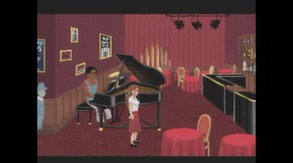
The gameplay is down to a science here, and splitting the human/ghost interactibility (which started with Unbound) worked really well and made the puzzles more interesting. I enjoyed the return of the computer puzzles, and appreciate that these were less obtuse than the ones in Shivah. I don't know if this is just me but I find the search string puzzles really satisfying? Like, they're definitely the ones that make me feel the most smug, lol. But yeah, no guide necessary. There's also a built-in hint mechanism of Rosa asking Joey for advice that worked well the one time I was feeling a bit stumped; the clue about "There must be some cat out there who knows something" was honestly clever in and of itself and I liked it. So yeah 10/10 gameplay, everything I'd want from this genre.
Convergence was a bigger story, in the sense that the lens wasn't so tightly focused on the protagonist and it had more epic stakes; I think this worked well. Sometimes serial killer stories can cease to be detective stories (something I'll definitely have to get into at some point...) but the stakes here were kept real and human enough that I think the scope felt natural.
And Joey isn't an ♥♥♥♥♥♥♥ anymore! This change seems permanent and I'm so glad for it. Rosa is definitely more sheepish and sad than Lauren, but their dynamic feels SO much better here than in Legacy, largely just because Joey has been dialed back into being a normal human. He's even nice to animals now, playing with a cat so Rosa can check its collar. I also like him calling Rosa "Red" instead of generic diminutives; a more personalized nickname makes it feel like he's still addressing her as a human being and I like the duality of a nickname being both more personal and more impersonal. I think Joey in this game reads much more as someone afraid of getting attached again, afraid of getting trapped again, and it makes him a much fuller character. I also appreciated at the beginning him caring about how you save the jumper ghost; it was a nice humanizing touch to show it meaning something to him to treat someone well. And he explains what Rosa asks him to and lets her in on what's going on! Bless you Retcon Joey.
Rosa's plotline here is really a maturation one, where we see her get stronger and more confident as the game goes on. Rosa's anxiety feels feel and not forced or performative on the game's part; she's a college student still insecure about her place in the world and how people see her and it feels very grounded.
I brought this up in the Darkside Detective review way back in the first post about these games, but one thing I think is interesting is that there's really two types of these games: games where the player is asked to solve a mystery by deductive reasoning, and games where the genre beats serve as a jumping-off point for getting characters and stories to act in certain ways. I like both these things equally. In fact, I think part of what I like about detective fiction so much is that when it's really good it can be both a logic puzzle and a meditation on how weird humans are, but I think it's equally valid to focus on one at a time, and I think what the WE games have done so well (except Legacy) is recognized that detective stories are a good way to bring up a lot of big questions about the human condition, using the genre beats as a structural element that drives the more important narrative ones instead of being "about" detectives or detecting in any key way. I actually find that really interesting, that the broad strokes of the form are culturally imprinted enough that they can serve as a structuring tool that doesn't need to be explained in and of themselves. I just think it's a neat insight into what genre is for, why it's a thing we've invented and continue to lean on. It lets us skip over the setup and focus on the meat.
If Lauren's story in Unbound was about isolation, and the damage it does to us and others, this game takes it a step further by asking questions about our moral responsibility to other people. Is it okay to profit from someone's death? Does that create a kind of culpability? When does someone become culpable -- by witnessing a death? By knowing it might happen and doing nothing? By knowing it will happen and doing nothing? Can someone be a murderer without actually ever killing someone?
[spoiler]
To me, the game comes down pretty clearly on the side of yes, we have an innate obligation to other human beings and as soon as we violate that we have some responsibility. I thought the cases here were incredibly interesting, of the Countess who is killing people but is unable to understand that's what she's doing, Gould who has no idea anyone is dying, and then Mitchell and Meltzer, who both realize they have Death Note powers but one of them basically torpedoes his career to avoid hurting anyone while the other uses it to profit, and then leans on the idea he didn't know for sure it was real as an excuse. I really liked the part at the end where Mitchell says he thought at times about Death Noting people, but always stopped himself from acting on it, and I like the normalization of the intrusive thought as being distinct from the action -- Mitchell wasn't a bad person because he thought about killing people, he was a good person because he didn't act on those thoughts. I also liked Madeline bringing up that Lauren, in losing her ability to care about anything, stopped caring about others -- I think that's a really sad and meaningful flaw, and I like that it makes the question, "Can Rosa keep caring in the face of the burden placed on her?"
It's just so nice to see a story about empathy and mutual obligation. Maybe this is 2025 brain talking but god does it feel like this is an important thing to write about. And I think the game's willingness to have empathy for the Countess and to draw a distinction between thought and action is such an important part of the lesson here. We should do our best for others, but there are times where we can't control what's happening as well as times where we can. This is a good moral. [/spoiler]
Also, my complaints about the masquerade are finally answered! I really loved the ending where Rosa is like, "We have the internet now, we can just Reigen and Mob it up, no one will think it's weird and hauntings will come to us." It was honestly so funny, but in a good way? I really liked it both as an answer to my last remaining gripe but also as a final moment of Rosa taking control of what was happening to her. I also feel like Joey's reaction FINALLY gave me some closure on what his problem was, though I'm not sure how much sense it makes. I think if he was like a generation older, feeling like them telling anyone would result in them like, being exorcised or arrested or institutionalized would make more sense, but even by the 1930s there were tons of people claiming to be mediums (and making bank on it, tbh) who were living normal lives -- as Blake Manor illustrates, the spiritualism craze begam in the mid-Victorian era and was quickly a cross-Atlantic phenomenon. I think the story wanted it to be that he was convinced they'd be institutionalized from the start, but it just doesn't really work with his timeline. After all, Lauren was only put away because she started having like, episodes, right? It wasn't just her saying she was a medium. Though admittedly the game has been 'whatevs' about the grandma; I'd accept a retcon where Grandma Blackwell tried to tell someone and did get locked up for it and Joey has some PTSD going on. That would explain a lot. But mostly I'm just glad the game has finally addressed this. So many people in real life believe in ghosts, and they're not even real in our universe, lol.