Between Two Castles - Digital Edition brings the delightful experience of the original board game to your computer! Build unique procedural castles, make strategies and play online with your friends!
Modeled estimate, not a reported figure. How we estimate →
About
Stats
All-time low is the lowest price we've recorded for this game since we started tracking it.
Languages: English, French, Portuguese - Brazil, German, Simplified Chinese
Engagement
Reviews
Themes across 40 recent reviews and how positive each mention is. A keyword signal, not full sentiment analysis.
Reviews
what the ♥♥♥♥ is going on
玩的什么?
Não entendi
Media

Related
Related
Price dynamics, follower growth, revenue and sales trajectories with interactive tooltips
This and every other Pro feature is free until October 20, 2026. A free account is all it takes.
Hours played at review time, across 40 reviews with recorded playtime.
positive critical· bar length = how often the theme comes up
Оно того не стоит.
Never played the board game but I think having the computer run the numbers makes it so much easier. It's not something I;d sink days into but I found it enjoyable. Definitely worth a few bucks.
Не испытал ничего, кроме уважения к существованию проекта и желания закрыть его
There is a supposedly fun board game behind this, but it seems that the digital version falls short. You either play with a friend or a bot, and he can change your orders without asking you. The game itself is boring, it seems there's no point for whatever's going on.
nie git
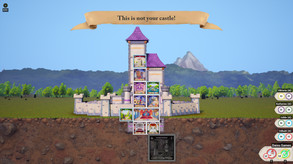
Between Two Castles – Digital Edition, developed and published by Daisu Games, is a faithful digital adaptation of the strategic board game Between Two Castles of Mad King Ludwig. Built around a clever blend of cooperation and competition, the game challenges players to draft and place room tiles in collaboratively constructed castles while still aiming to outscore their opponents. The core concept is deceptively simple: each player works with the neighbor on their left and the neighbor on their right to build two separate castles simultaneously. However, your final score is determined by the lower-scoring of the two castles you helped create, forcing you to balance cooperation carefully on both sides rather than focusing on a single strong partnership. This scoring twist creates a dynamic tension that defines the entire experience. Gameplay revolves around drafting tiles from a shared selection, then negotiating and deciding with your neighbors where those tiles should be placed. Each tile represents a specific room type—such as kitchens, bedrooms, corridors, or utility rooms—and each category scores differently depending on placement patterns, adjacency bonuses, or overall distribution. Some rooms reward clustering, others encourage symmetry, and still others grant points for diversity or placement near certain types. Because each castle is a shared effort, players must communicate, compromise, and anticipate how their partners will prioritize scoring opportunities. The game excels at creating a constant negotiation loop where every decision has both cooperative and competitive implications. The digital edition preserves the core mechanics of the tabletop version while adding the conveniences of automation and online connectivity. Scoring calculations, rule enforcement, and tile validation are handled seamlessly by the system, eliminating the manual bookkeeping often associated with physical board games. The interface presents castles clearly in a grid format, with tiles visually distinct and scoring criteria easily accessible. While the visual presentation is functional rather than flashy, it serves its purpose effectively, emphasizing readability and clarity over elaborate animation or aesthetic embellishment. The castles gradually take shape on-screen in a satisfying mosaic pattern, making progress visible at a glance. One of the game’s strongest features is its multiplayer functionality. Online matchmaking allows players to experience the social dynamics that are central to the design. Since success depends heavily on negotiation and communication, playing with human opponents often produces more engaging sessions than AI matches. The unpredictability of human strategy—how much someone prioritizes symmetry, whether they compromise fairly, or if they subtly sabotage one castle to weaken a rival—adds depth to each session. AI opponents are available for solo play and practice, but they cannot fully replicate the subtle social interplay that makes the concept shine. However, the digital adaptation is not without its limitations. Technical issues, including occasional connectivity problems in online matches, have been noted by players. While these do not define every session, they can disrupt momentum in a game that depends on smooth interaction between participants. Additionally, because the core loop remains consistent—draft, negotiate, place, score—the experience can feel repetitive after extended play sessions. The strategic decisions remain meaningful, but players seeking evolving mechanics, campaign progression, or long-term unlock systems may find the replay value somewhat finite compared to more expansive digital strategy games. In terms of depth, Between Two Castles occupies a middle ground. It is more thoughtful and nuanced than casual tile-laying games but does not reach the complexity of heavier strategy titles. The scoring conditions encourage careful planning, and balancing two collaborative projects simultaneously requires mental agility. Yet the learning curve remains accessible, making it easy for newcomers to grasp the fundamentals within a single session. This accessibility broadens its appeal but also limits how dramatically strategies can evolve over time. Ultimately, Between Two Castles – Digital Edition succeeds in translating a distinctive cooperative-competitive board game into an accessible digital format. Its innovative scoring system fosters constant engagement, ensuring that players must care about both of their shared castles rather than focusing solely on maximizing one partnership. While it may lack the depth and polish of more ambitious digital strategy adaptations, it captures the heart of its tabletop inspiration and offers a satisfying experience for players who enjoy negotiation-driven gameplay. For fans of digital board games and strategic tile placement, it stands as a solid and enjoyable adaptation that thrives most when played with others. Rating: 5/10
nah
Selling now
See how fast this game is selling right now — estimated copies and revenue per day from recent review growth.
Players by region
Where this game's players are, estimated from review languages.
Related
| Game | Estimated lifetime revenue | Reviews | Review score | Price |
|---|---|---|---|---|
| $41M | 74.5K | 96% | $19.99 | |
| $12M | 56.3K | 90% | $6.99 | |
| $11.1M | 16.1K | 82% | $24.99 | |
| $5.4M | 8.6K | 89% | $20.99 | |
| $1.5M | 9.8K | 95% | $7.99 | |
| $4.5M | 8.7K | 85% | $19.99 |
Related
| Game | Estimated lifetime revenue | Reviews | Review score | Price |
|---|---|---|---|---|
| $6.5K | 270 | 67% | $1.49 | |
| $6.5K | 68 | 88% | $5.99 | |
| $6.5K | 130 | 82% | $1.99 | |
| $6.4K | 51 | 61% | $5.99 | |
| $6.5K | 52 | 85% | $4.99 | |
| $6.5K | 448 | 63% | $0.65 |