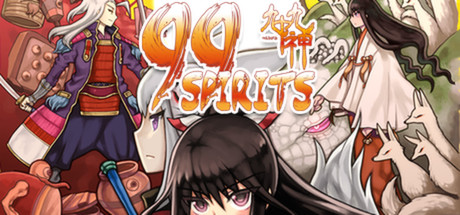
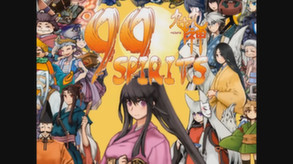
99 Spirits is an unusual hybrid between a puzzle game and a traditional Japanese role-playing game developed by TORaIKI and published internationally by Fruitbat Factory. Rather than following the familiar structure of many JRPGs that rely primarily on statistics and turn-based combat systems, the game introduces a unique mechanic that blends deduction and word puzzles directly into its battles. Set in a world inspired heavily by Japanese folklore, 99 Spirits presents a supernatural journey that combines mythology, mystery, and strategic thinking into an experience that stands apart from most RPGs in the genre.
The story takes place in feudal Japan and centers on a young warrior named Hanabusa. Her life is changed forever after her mother is killed by a malevolent spirit, leaving Hanabusa consumed by a desire for revenge. Determined to hunt down the supernatural beings responsible for the tragedy, she begins training as a spirit hunter. Along the way she obtains a mystical sword capable of revealing the true identities of the creatures she encounters. These enemies are not ordinary monsters but Tsukumogami—spirits born from everyday objects that have gained consciousness after existing for many years. According to Japanese folklore, items such as tools, household objects, or weapons can eventually become living spirits, and this concept forms the backbone of the game’s world.
As Hanabusa travels through villages, forests, and ancient shrines, she gradually learns more about the supernatural forces shaping her destiny. The story expands beyond simple revenge as she encounters other characters with their own connections to the spirit world. Allies join her journey, and fragments of information about her missing father begin to surface, hinting at a deeper mystery behind the events that changed her life. Although the narrative follows familiar themes of vengeance, loss, and personal growth, it unfolds gradually through character interactions and supernatural encounters that reveal the strange balance between the human world and the realm of spirits.
Where 99 Spirits truly distinguishes itself is in its battle system. Combat initially appears similar to traditional turn-based RPG encounters, with Hanabusa facing spirits in one-on-one battles. However, defeating enemies requires more than simply attacking them repeatedly. Hanabusa’s sword contains magical gems that must be charged during combat by performing attacks or defensive actions. Once enough energy has been collected, the player receives clues about the enemy spirit’s identity in the form of letters or hints. Using these clues, players must correctly identify the spirit by guessing its name. If the guess is correct, the spirit’s true form is revealed and it becomes vulnerable to damage. If the guess is wrong, the attempt fails and the player must recharge the sword again before making another attempt.
This deduction system transforms battles into a combination of combat strategy and puzzle solving. Instead of focusing entirely on statistics or abilities, players must interpret clues and make educated guesses about the enemy’s identity. The mechanic introduces an intellectual challenge that feels very different from typical RPG combat. Over time, additional gems can be added to the sword, providing extra clues that make it easier to identify enemies. Some gems reveal partial words, while others narrow down the possibilities, allowing players to approach each battle with increasing confidence.
Another interesting aspect of the gameplay is the ability to capture spirits after defeating them. Once recruited, these spirits can assist Hanabusa in combat or help solve environmental puzzles encountered during exploration. Each spirit possesses unique abilities that can be used outside of battle, such as interacting with objects or unlocking hidden paths. This feature adds an extra layer of strategy to the game, encouraging players to collect a variety of spirits that may be useful in different situations.
Exploration in 99 Spirits takes place on grid-based maps that represent various locations throughout the game world. Players guide Hanabusa through villages, wilderness areas, and other environments where they can interact with characters, collect items, and uncover secrets. Although the exploration mechanics are relatively simple compared to larger RPGs, they support the puzzle-focused nature of the gameplay by presenting obstacles that require clever use of captured spirits or environmental manipulation.
Visually, the game adopts an anime-inspired art style that complements its folklore-based setting. Character portraits are expressive and detailed, helping bring personality to the dialogue sequences. Enemy designs are particularly creative, often transforming ordinary household objects into eerie or whimsical spirits that reflect the concept of Tsukumogami. While the overworld environments can appear somewhat minimal in detail, the strong character artwork and distinctive monster designs help give the game a memorable visual identity.
The soundtrack further enhances the atmosphere by drawing inspiration from traditional Japanese musical themes. Melodies often combine mystical tones with energetic rhythms that match the supernatural battles taking place. Voice acting is included in both English and Japanese, giving players the choice of how they want to experience the characters’ dialogue. These presentation elements contribute to the game’s cultural identity and help immerse players in its mythological world.
Despite its creativity, the game does have several weaknesses. The battle system, while innovative, can occasionally become repetitive over long play sessions. Charging the sword repeatedly before making guesses may slow down the pacing of combat, especially when fighting multiple enemies in succession. Additionally, the map design and exploration mechanics are somewhat basic compared to more complex RPG titles, which may leave some players wishing for greater depth in the world itself.
Another minor issue involves certain gameplay systems that feel somewhat unnecessary. For example, the game includes a hunger mechanic that requires players to manage food supplies while exploring. Although this system was likely intended to add a survival element, it can sometimes interrupt the flow of the adventure rather than enhancing it.
Even with these flaws, 99 Spirits remains a fascinating and highly original RPG experience. Its unique battle mechanics and strong cultural inspiration make it stand out among indie role-playing games. By combining puzzle solving with traditional RPG progression, the game offers a refreshing alternative to the genre’s more conventional combat systems.
Overall, 99 Spirits is a creative and memorable adventure that blends folklore, strategy, and puzzle mechanics into a distinctive gameplay experience. While its pacing and exploration systems may not satisfy players looking for a large-scale RPG, its originality and thematic inspiration make it a compelling choice for fans of experimental indie titles and Japanese mythology.
Rating: 7/10