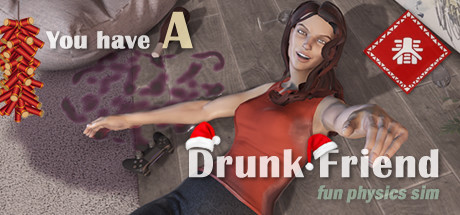
You Have a Drunk Friend, developed and published by PhyzixMind, is an odd and humorous experiment in physics-based interaction that takes a simple concept and stretches it into a chaotic sandbox of awkward movements and unpredictable outcomes. At its core, the premise is absurdly straightforward: your friend has had far too much to drink, and it’s your job to take care of them. From that single idea, the game builds a slapstick simulation where the player must navigate clumsy controls, unpredictable physics, and an environment filled with objects that can either help or hilariously hinder your attempts at caretaking. It’s a game that thrives on its ridiculousness, leaning into its flaws and rough edges to create moments of accidental comedy rather than precision gameplay.
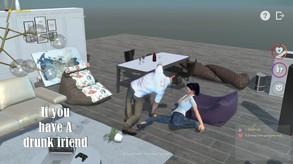
The experience begins with you in a small, confined room where your drunk friend lies slumped and disoriented. Your main goal is to interact with the environment—moving furniture out of harm’s way, helping your friend sit or lie down, pouring them water, or otherwise trying to stop them from injuring themselves. The game never explains much, instead letting players discover through experimentation how to handle each task. Every interaction is subject to exaggerated physics, meaning simple actions like lifting your friend or placing a cup on a table can spiral into chaos as objects bounce, tumble, and collide in unpredictable ways. This unpredictability forms the heart of the experience: the comedy of errors that comes from trying to act responsibly in a world where nothing behaves quite as intended.
The controls, intentionally or not, are clumsy to the point of absurdity. Moving your character feels slightly delayed, and object manipulation is imprecise, turning every attempt at order into potential disaster. Yet, this awkwardness becomes part of the fun. The humor doesn’t come from achieving your goals perfectly, but from the struggle itself—the sight of your avatar dragging a limp ragdoll body across the floor while bumping into walls, knocking over tables, and breaking random objects in the process. The physics system gives each playthrough a slightly different rhythm, ensuring that even repeated attempts never play out quite the same way. The result is an experience that feels both frustrating and strangely entertaining, the kind of chaos that invites laughter rather than mastery.
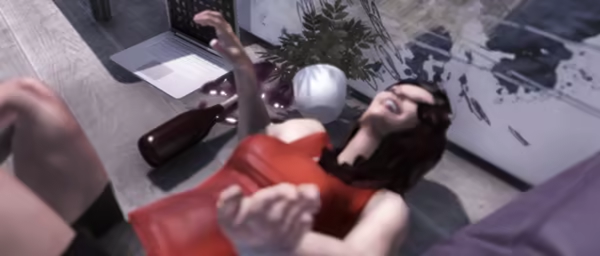
Graphically, the game is basic, reflecting its small indie origins. The environment is limited to a few simple rooms, sparsely furnished with interactable objects like chairs, tables, and bottles. The models are crude and unpolished, yet functional enough to serve their comedic purpose. What stands out most is the drunk friend’s animation: a floppy ragdoll that reacts dramatically to every nudge, stumble, or fall, sometimes collapsing in ways that feel more like a physical comedy sketch than a physics simulation. The sound design is minimal but effective—clattering objects, exaggerated groans, and occasional background noise all add to the sense of chaotic immersion. There’s no soundtrack to guide the mood, leaving players with the quiet absurdity of the situation, which only amplifies the awkward humor.
Beneath the laughter, though, You Have a Drunk Friend struggles with repetition. The game’s novelty wears off after a short while, as there are only a handful of objectives and limited environments to explore. Once you’ve successfully—or unsuccessfully—helped your friend through a few rounds of chaos, there’s little reason to continue beyond the occasional replay for comedic value. Some players may find amusement in experimenting with different ways to interact with the world, especially given how unpredictable the outcomes can be, but the lack of progression or variety prevents it from sustaining long-term engagement. It feels more like a physics toy than a fully realized game, something meant to be played in short bursts or shared among friends for laughs rather than completed or mastered.
From a technical standpoint, the game runs smoothly even on modest hardware, a benefit of its minimalistic design. The developer’s use of Unity allows for surprisingly stable performance despite the physics-driven unpredictability. However, the same physics system that makes the game funny also makes it buggy—objects can get stuck, characters may clip through walls, and sometimes the environment reacts in ways that defy even the loose rules of the game’s own world. Yet these technical imperfections contribute to the game’s identity. It’s not a polished simulator, but a deliberately clumsy experience that invites players to embrace chaos and failure as part of the fun.
In the end, You Have a Drunk Friend is best understood as an experiment in humor and interaction rather than as a traditional game. It’s short, unpolished, and repetitive, but within its simplicity lies a certain charm. It captures the feeling of trying to manage an impossible situation, where every good intention leads to disaster, and the only reasonable response is to laugh. It’s the kind of game that might not hold your attention for long but can create a few memorable moments of laughter and confusion in its brief runtime. For players who enjoy physics-based absurdity, slapstick humor, or unconventional indie projects that don’t take themselves seriously, You Have a Drunk Friend offers exactly what its title promises—a messy, unpredictable, and oddly human experience of dealing with a drunk friend who just won’t cooperate.
Rating: 6/10