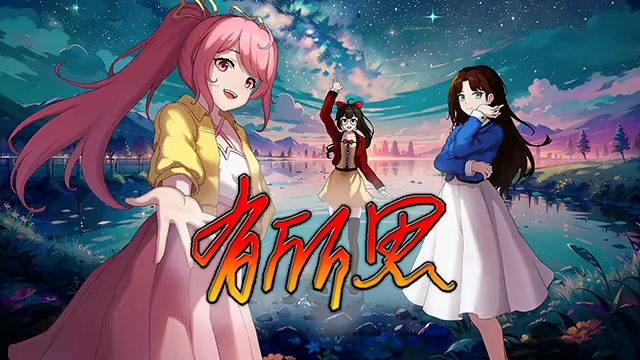
“Yearning” is a visual novel type of game, telling the story of the protagonist Tan Kai’s ordinary and extraordinary life in the modern Chinese university campus.
Revenue comes from in-game items and microtransactions, which our price-based model doesn't estimate. The player count below is how many people own it, not what they spent.
About

Genres
Stats
Languages: Simplified Chinese**languages with full audio support
Engagement
Reviews
看得出来,作者取这个名字一定是经历了一些,想借游戏表达出来,并巧妙结合了恋爱选项。 但是,第一,作者只从食堂问题入手,并未深入,而且处理方式竟是集团老总一通电话?!私以为这一方法并不妥当。 第二,虽是挂有恋爱标签,但提供的选项有些也太咄咄逼人了(汗),且仅仅是挨在一起就会误认为恋爱是否有硬凑之嫌? 第三,我个人认为形象塑造最好的是校长【?】因为其他人都感觉有些不务正业(雾),校方三天三升级防范措施,也让人感觉有些不太现实。 缺点有优点也有,游戏的配音和美术还是比较能让人满意的,尤其司柔的声音非常有特点,题材也比较新颖,比较期待今后的表现 一点小建议:在内容上多进行打磨;增强一些恋爱相关动作,微表情之类,让人更能体验到感觉,毕竟大部分人都是冲着这个来的嘛;有所思,也可以不只是思学校,而在大学生活中遇到一些事情。 以上。不过毕竟是兼职做出的作品,可以理解,希望等到完整版(另外,文本中貌似有两处错误哦)
Игра '有所思 Yearning' – это уникальный опыт, погружающий игрока в атмосферу меланхолии и одиночества. Ожидание длиною в 400 дней становится неспешным путешествием по мрачным пещерам, где время течет по своим законам. Графика, хоть и минималистичная, создаёт завораживающий мир, полный тайн и недосказанности. Игровой процесс основан на медленном исследовании окружения, решении головоломок и взаимодействии с немногочисленными объектами. Нет быстрых действий или экшена, только созерцание и осознание неизбежности хода времени. Это игра не для всех, она требует терпения и готовности погрузиться в состояние медитации. Особенно хочется отметить звуковое сопровождение, которое идеально дополняет общую атмосферу тоски и предчувствия. Мелодии печальные и завораживающие, они словно шепчут истории о забытых временах. 'Yearning' – это не просто игра, это интерактивный опыт, который останется в памяти надолго. Если вы ищете что-то необычное, способное заставить вас задуматься о времени, одиночестве и смысле ожидания, то эта игра для вас. Но будьте готовы к тому, что 400 дней покажутся вечностью.
Media

Related
Related
Price dynamics, follower growth, revenue and sales trajectories with interactive tooltips
This and every other Pro feature is free until October 20, 2026. A free account is all it takes.
Hours played at review time, across 25 reviews with recorded playtime.
虽然有些地方的情节有点硬,但是就我自己的游戏体验感而言还是挺好的,人物角色个性分明,还挺有代入感,缺点不知道怎么说但是还算能接受,期待续作快点出来吧,这种玩到一半的感觉好难受i啊
刚开始玩就他妈不想玩了,傻逼剧情,底下那帮人就因为是免费的就给好评?真是惯的毛病
本来是走了一条剧情线的,但是后面就没有新的剧情了,让我倍感遗憾,所以第一想法是应该不会有更多的剧情了,整体觉得可以接受。 现在这里说一下为什么我觉得可以接受: 1.开篇直接引入矛盾点食堂的“老鼠”,引出一个围绕全文的线索(个人这么认为的) 2.每个女生都有各自的特点。 红衣班长(以下简称班长)这个角色,热心肠,对于马克思主义非常坚定不移,甚至在面临吃饭问题上是敢作敢为拉同学去签定“万民书”。但是结合实际一些的话,这种性子非常容易被上层打压(辅导员奖学金一事),这种热心为周围人谋福利的人,很容易深得民心,但是同时也很容易触碰上层利益(去校长室请愿一事)。她所带有的品质过于理想主义化,可惜社会资源永远都是局限的,因此矛盾总是会存在的,班长没有蓝发千金(以下简称千金)那种家庭背景,其实是很容易起起落落的。 粉毛蒋星妍(以下简称粉毛)这个角色相对于班长,她已经有了明显的思想觉悟的突破(不是光靠喊口号就成功),这种话说出来说明已经在塑造她打破了一定的思想枷锁。粉毛很会耍小心机(褒贬都有),想担任女主角,还指望男主角投她一票;在万民书事件中,明确说“老谭,这个不能签的呀”,说明她已经预见了“万民书”注定不会成功,而面对班长男主只能说到这里,“万民书”的结果成与败,主要功劳或主要处罚,都会是班长。 千金这是目前角色中,最有钱,最有背景的一位。她想担任演戏女主,没有亲自出马,而是她的黄衣跟班(以下简称跟班)主动为她拉票,甚至在学校各种不让定外卖的政策下,“校长亲口说过,千金也不吃学校食堂怎么会凑热闹”,她也是能吃到健康美味的饭菜的。我只能说,很多东西其实不用她去争取,自然会有很多人上来巴结她。但是我个人猜测,制作组应该不想造出一个为富不仁的人物形象,因此她对于男主是很包容的,并且也愿意去在万民书上签字,为同学们去争取利益。所以在剧情中,千金一边享受着一部分的特权,一遍有着为富且仁的人设(至少明面上可以称为为富且仁)。 跟班这个角色和社长,其实都是前去巴结千金的人设,因此他们戏份太少,没什么可评的。 这是我玩过一次剧情线后的感受,真实感情,确实如此。 3.学校和学生的矛盾,JJ矛盾。食堂的饭菜本来是一个小问题,饭菜嘛也主要围绕价格,可口两方面。学校却逐渐把它升级。 学校:吃不吃食堂都可以 → 不外卖送到学校 → 不准点外卖,增加电网 → 不准在校园出现外卖。 学生:吃食堂,吃出苍蝇,忍 → 食堂吃到死老鼠,校外吃,外卖吃,泡面吃,零食吃 → 点外卖去校外取(粉毛出主意) → 点外卖在学校围栏取(粉毛出主意)→ 万民书(班长在失去自己奖学金的条件后甚至赌上自己班长的职位) → 班长作为学生代表和校长理论 → 千金出马用货车拉外卖 → 千金老爸出手,食堂承包商换人 我们会发现其实本来是一个非常小或者说不难解决的矛盾,却能一步一步激化,好在为富且仁的千金选择站在学生群体,与上层校方作斗争,最终取得谈判成功。但是问题出在哪?问题出在!千金本身不吃食堂如果不是万民书,她可能也不会知道这么多,更不会出手。而千金不出手或选择支持校方的话,在剧中,我看不到学生群体的半点胜算。所以这次学生群体得到了千金的支持,那下一次呢?这个游戏中她出手了,现实中会是谁出手呢?所以我认为,这是一个JJ问题的缩影。 4.这个游戏的巧妙巧在。 它运用了类似狂飙的矛盾,引出前期的主线剧情,而到剧情中间,早期的矛盾已然升级,成了进一步的新矛盾。 而校长的一顿说辞,似乎运用了 名义中高育良的诡辩论 “不是所有好同志都要提拔上来做大官嘛,刘SQ和清洁工人都是为人民服务嘛”, 校长诡辩 “之前食堂的承包商能做好,说明有这个能力,而现在出了问题,只是暂时的,我们要相信它,贸然更换新的承包商是不可的,其他的承包商未必会比现在的做得好” 可能是我过度解读,大家看个乐呵。 如果你看到这里,就认为这是我的全部评价,那就显得片面了,因为上文都是我打了其中一种结局感受到的。 但是当我回过来看游戏的评价(准确说是差评) 我看到了不一样的剧情和结局。。。。。。粉毛事先和社长的利益交换(我这样称谓可以吧?)是为了获得排练女主的位置,当然我们为富且仁的千金肯定实至名归是女主,因为社长看上她的人脉和背景。 而其中的一种坏结局,是粉毛差一点被社长强暴,而主角被社长找人打进医院,最后直接结局退学转校。甚至这个结局中主角都没能看到最后食堂问题如何解决。。。真的是很意难平,这不是我们玩家想看到的结局。。。他们不想看到的是fz分子逍遥。。。而我更多是不想看到,我心中这样难得能思想觉醒的人,因为耍这样的小聪明而受到这样的伤害,可能是我比较圣母吧(尊重各种看法观点)。 怀着对于其他结局的好奇,都去探索了一下。 除了这个坏结局,其他的都是一样的套路最终都是食堂问题的顺利结局。 对于班长,确实她敢于为学生群体争取利益,确实和她所加入的社团(她的兴趣爱好)有关联。 对于粉毛,说实话,在这里这位我最中意她,一方面是懂得趋利避害,一方面是她的善意真的只对自己朋友,偶尔想投机取巧一次却被人心险恶所害(社长)。没办法,社长这种人在现实中难防并且还自带一点作威作福,他和班长虽然都能担任一些职务,但是实际上像他这样的,才是多数,进一步证明了班长的理想主义化。 对于千金,此人为富且仁,我们只能庆幸这样的角色好在站在正义一方,因为想要攀附的人(社长),都会想方设法来巴结她 打了多个结局后发现,其实跟班和千金的关系,似乎真的很好,并没有像剧中很多趋炎附势之人一样,可能她们的友情其实不是靠着千金的家境背景。 就写这么多啦,期待游戏能继续开发后续,但是请不要再出让玩家心碎的结局了。
整体风格挺好的,剧情介于写实和漫画感之间。辅导员一本正经的京腔实在生草,学校领导更是逆天诡辩技巧极强,而且我确信这学校一只蚊子都没有,“电蚊拍”是足够了。当然不足上就是感觉整体节奏很闷,感觉很多地方都是可有可无的走过场
有些[i] bad ends [/i]感觉是写不下去后续强行让主角送人头。 但大学生[i] buff [/i]就在那里,私以为见识过自己读的学校有多恶心的人多少是能共情起人物经历然后读完一遍的。
Keep abreast of current events
Уй
有所思 Yearning is an independently developed Chinese visual novel that combines university romance with a more reflective story about growing up, losing direction, and deciding what kind of life is worth pursuing. Developed and published by 有所思制作组, the game follows Tan Kai, a university student whose once-promising academic life has gradually deteriorated. He had been an excellent student with strong principles during high school, but university has left him increasingly unmotivated and uncertain about his future. Rather than beginning with an ambitious hero chasing a clear objective, Yearning centers its story on someone who has lost his sense of purpose, creating a fitting foundation for a narrative concerned with ideals, social pressures, relationships, and the difficult transition into adulthood. Tan Kai's stagnant routine begins to change through his relationships with three women whose personalities and circumstances represent very different approaches to life. This structure gives the romantic component greater thematic importance because each heroine is more than a potential partner. Their ambitions, backgrounds, and conflicts challenge Tan Kai in different ways while also allowing the story to explore questions about individual freedom, responsibility, wealth, family expectations, and personal conviction. Romance remains central to the experience, but the relationships are designed to function alongside a broader coming-of-age narrative rather than existing solely as rewards for selecting the correct dialogue choices. Jiang Xingyan is Tan Kai's classmate in the computer department and immediately stands out because her actual dream has little connection to her current academic path. She wants to become an actress, but her family strongly opposes that ambition. She is academically capable, energetic, sociable, and relatively comfortable financially, yet those advantages do not provide the freedom she wants. Her conflict revolves around whether she should accept the stable future expected of her or risk pursuing something uncertain that genuinely matters to her. Her determination to resist her family's plans gives her storyline an appealing tension between security and independence. Si Rou presents another form of idealism. As class leader and an exceptional student, she is responsible, helpful, principled, and deeply committed to improving the world around her. Her enormous ambition of contributing to humanity's happiness could easily have been portrayed as naive, but an important part of her characterization is her willingness to put those beliefs into practice. Her determination can also become stubbornness, causing disagreements when her principles collide with other people's perspectives. Coming from a comparatively ordinary working family, she provides an interesting contrast to the other heroines and represents the question of whether powerful ideals can survive the compromises demanded by reality. Song Shuyao occupies a very different social position. Raised in a wealthy family and given an elite education, she is cultured, talented, graceful, and accustomed to privilege. That upbringing also gives her a domineering side that she does not always recognize. Despite having material advantages, she faces her own restrictions because her father has expectations for her future. Her desire is ultimately simple but personally significant: she wants the freedom to marry someone she genuinely loves. Her situation reinforces one of Yearning's recurring ideas, namely that comfort and privilege do not necessarily provide personal independence. Her route therefore complements Jiang Xingyan's struggle over career ambitions and Si Rou's dedication to social ideals. The combination of these characters makes Yearning more thoughtful than its romantic visual novel presentation might initially suggest. The game deliberately incorporates commentary and satire concerning social phenomena, while its overall narrative appears interested in what happens when youthful beliefs encounter practical reality. Tan Kai's uncertainty becomes particularly useful in this context because he is positioned between characters who still possess strong ambitions of their own. His interactions with them have the potential to become as much about rediscovering his identity as choosing a romantic partner. Gameplay follows the familiar visual novel formula, placing most of its emphasis on reading dialogue, observing character interactions, making decisions, and developing relationships. Player choices are intended to influence the direction of the narrative and contribute to different outcomes. This approach suits the subject matter because decisions involving relationships and personal values can carry narrative significance without requiring elaborate mechanical systems. Full voice acting is another welcome part of the presentation, giving conversations greater personality and helping distinguish the central cast. The colorful character artwork and anime-inspired visual style similarly complement the youthful university setting. Accessibility is considerably more restrictive for players outside the game's intended audience. The game primarily supports Simplified Chinese, including its interface, dialogue, and voice-related presentation, while English support is absent. For players unable to read Chinese, this represents a substantial obstacle because Yearning depends heavily on dialogue, characterization, cultural context, and nuanced discussions of personal and social issues. Unlike an action-oriented title where language can sometimes be secondary, understanding the writing is essential to appreciating what this game is attempting to accomplish. A more significant concern is its Early Access condition. The originally outlined vision was substantially larger than the available introductory material, with the developers discussing a seven-chapter structure containing expanded storylines, additional decisions, romantic developments, multiple conclusions, and other supporting features. The initial Early Access release represented only the beginning of that planned journey. This means the existing material is better approached as the foundation of a larger visual novel rather than a completely resolved narrative. The ambitious character conflicts require considerable development to achieve their full potential, particularly because the themes involving adulthood, social expectations, and personal beliefs cannot easily be resolved within a short opening chapter. The game's modest technical requirements appropriately reflect its focus. Yearning does not attempt to impress through demanding three-dimensional graphics or complicated gameplay systems. Its resources are instead concentrated on illustrations, character portraits, dialogue, music, voice performances, and branching storytelling. That simplicity is perfectly appropriate for the genre, although it also means the quality of the overall experience depends heavily on how invested the player becomes in Tan Kai and the three heroines. Ultimately, 有所思 Yearning has an appealing identity as a university romance that wants its relationships to represent something larger. Tan Kai's loss of motivation creates a sympathetic starting point, while Jiang Xingyan, Si Rou, and Song Shuyao each introduce distinct conflicts concerning ambition, ideals, privilege, parental control, love, and independence. The characters provide promising foundations for a thoughtful exploration of youth confronting adulthood, but the incomplete Early Access state prevents the larger narrative ambitions from being fully realized. For Chinese-speaking visual novel enthusiasts who appreciate romance mixed with introspection and social commentary, there is meaningful material here, though anyone expecting a completely developed multi-route experience should keep its unfinished nature in mind. Rating: 7/10
Selling now
See how fast this game is selling right now — estimated copies and revenue per day from recent review growth.
Players by region
Where this game's players are, estimated from review languages.
Related
| Game | Estimated lifetime revenue | Reviews | Review score | Price |
|---|---|---|---|---|
| $72.6K | 210 | 91% | $19.99 | |
| $25.6K | 101 | 96% | $24.99 | |
| $24.2K | 49 | 94% | $12.99 | |
| $16K | 143 | 92% | $3.99 | |
| $2.2K | 29 | 79% | $4.99 | |
| $512 | 0 | — | $8.99 |