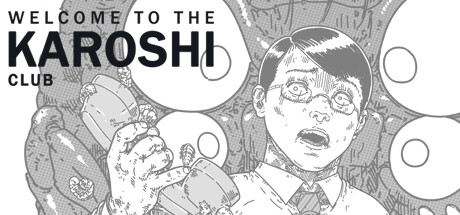
Welcome to the Karoshi Club turns one of modern working life’s most uncomfortable rituals, the job interview, into the foundation for a strange and effective psychological horror story. Rather than beginning with monsters, abandoned buildings, or conventional supernatural threats, it focuses on unemployment, professional insecurity, corporate expectations, and the pressure to convince strangers that you are worthy of a job. Developed and published by Kamishibai Interactive, this free visual novel describes its distinctive style as Japanese horror “business punk,” and that unusual combination gives the experience a personality noticeably different from typical indie horror.
The story follows Kenji Haishima, a former game developer attempting to find employment and secure a sales specialist position. What initially appears to be an ordinary career problem gradually becomes considerably more disturbing. The premise works because Kenji’s situation is believable before the horror elements begin taking control. Searching for work already carries rejection, uncertainty, financial anxiety, and the uncomfortable necessity of presenting an idealized version of yourself. The game takes these familiar pressures and distorts them into something surreal, making the transition from mundane anxiety to psychological horror feel surprisingly natural.
Choice is central to the experience, with decisions carrying consequences and contributing to multiple possible outcomes. The interview concept complements this structure particularly well. Conversations become more than simple dialogue because every response potentially represents a compromise between honesty, self-preservation, morality, and telling an employer what they want to hear. This gives the narrative an interesting underlying question: how much of yourself are you prepared to change when your livelihood depends on being accepted? The branching structure encourages another playthrough because alternative decisions can reveal different sides of the situation and its characters.
Its black-and-white, hand-drawn manga presentation is another major strength. The monochrome artwork creates a bleak atmosphere that fits the corporate and psychological themes without requiring elaborate visual effects. Characters can move from relatively normal expressions to disturbing imagery while maintaining a consistent aesthetic, and the manga influence allows the developers to exaggerate unsettling moments without making them feel disconnected from the rest of the presentation. The result resembles an interactive horror comic, where individual images and expressions can be more memorable than elaborate animation.
The 1990s Japanese backdrop also serves a meaningful purpose. The game draws connections between economic crisis, unstable employment, capitalism, and anxieties that remain recognizable in contemporary working life. This prevents the setting from functioning purely as nostalgic decoration. Corporate culture becomes part of the horror itself. There is an especially personal dimension behind these themes because Kamishibai Interactive describes its multinational team as consisting of developers affected by gaming-industry layoffs who subsequently decided to create something independently. Knowing that background makes the employment anxiety underlying the narrative feel less arbitrary.
The horror is therefore strongest when it combines supernatural or surreal ideas with problems that are entirely ordinary. Losing a job, searching for another one, wondering whether your experience is valuable, and being evaluated by potential employers are hardly traditional horror subjects, yet the game demonstrates how easily these situations can generate fear. Science-fiction and supernatural touches expand the mystery surrounding the Karoshi Club universe, while the psychological component keeps the experience grounded in Kenji’s vulnerable position.
Its modest scale is worth understanding. This is designed partly as a showcase for a broader Karoshi Club concept, with the creators using it to introduce their world and gather feedback. Consequently, players expecting an enormous visual novel with an exceptionally long campaign may find the experience comparatively compact. That limitation is easier to accept because the game is free and concentrates on establishing its concept rather than artificially stretching the story. Additional free manga and soundtrack material also help expand its identity beyond the core game.
Gameplay remains primarily narrative-driven, so the appeal depends heavily on whether the player enjoys reading, making dialogue choices, exploring narrative possibilities, and absorbing atmosphere. This is not action-oriented survival horror. There is no need for elaborate combat mechanics when the central source of tension is social and psychological pressure. For players attracted to unconventional visual novels, branching narratives, surreal horror, manga artwork, and stories dealing with uncomfortable real-world subjects, that focused approach is an advantage rather than a weakness.
Steam Deck compatibility is particularly welcome for this kind of experience. The game is rated Playable on Steam Deck and runs successfully through SteamOS. Its default controller configuration provides access to the game’s functionality, interface text is considered legible, and the default graphical configuration performs well. The main qualification preventing a completely seamless handheld presentation is that some prompts may display mouse, keyboard, or non-Steam-Deck controller icons. Given the visual-novel format, however, this is a relatively minor inconvenience, and the portable form factor is naturally suited to its reading-heavy structure.
Ultimately, this is a creative example of psychological horror finding fear in an unexpectedly mundane place. The strongest aspect is not simply its supernatural material but the way job hunting, corporate culture, unemployment, personal compromise, and economic uncertainty are transformed into components of horror. Its distinctive monochrome manga artwork reinforces that identity, while meaningful choices and multiple endings provide additional incentive to investigate its world from different perspectives. The limited scope makes it feel more like an introduction to a larger concept than a fully expansive saga, but it establishes that concept with confidence. For visual-novel enthusiasts who appreciate socially grounded horror and unusual themes, it is an intriguing and memorable experiment.
Rating: 8/10