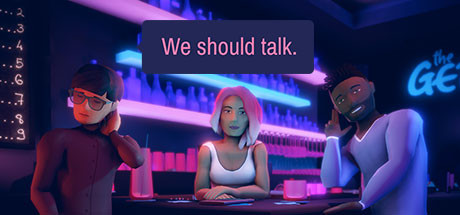
It's not what you say, it's how you say it. We should talk is a short-form narrative game that will make you think carefully about the words you choose. Can your relationship survive the night?
Modeled estimate, not a reported figure. How we estimate →
Prices
The United States storefront in every case, so this compares stores and not countries.
About


Genres
Stats
All-time low is the lowest price we've recorded for this game since we started tracking it.
Languages: English
Sums Steam only; PlayStation publishes no volume signal, so the true total is higher by an unknown amount.
| Store | Price | Audience | Score | Chart | Est. revenue |
|---|---|---|---|---|---|
SteamYou are here | $6.99 | 171reviews | 56% | — | $17.5K |
| $6.99 | 51ratings | 67% | — | not modelled |
Matched by title — a reused name can pair the wrong games. * is a critic aggregate. Prices and positions are each store's United States storefront; Epic charts worldwide. Audience and Score too, except Steam's, which is worldwide.
Engagement
Reviews
Themes across 44 recent reviews and how positive each mention is. A keyword signal, not full sentiment analysis.
Reviews
I practically got this game for free but want my 20 minutes back
[h1][b]You should try[/b][/h1] A short experimental game about what it's like to break up or make up with your girlfriend via text messages while you're out drinking and trying to have a good time. Each game takes about 15mns and there are endings for every taste, but wait for it to be on sale as the content is on the scarce side.
This game was unique. I wouldn't call it terrible but it wasn't very fun? Interesting? I liked going through and trying to get the achievements but otherwise the story itself is pretty mid. Cute concept though.
Media

Related
Related
Price dynamics, follower growth, revenue and sales trajectories with interactive tooltips
This and every other Pro feature is free until October 20, 2026. A free account is all it takes.
Hours played at review time, across 44 reviews with recorded playtime.
positive critical· bar length = how often the theme comes up
It's bad. Can't really say anything positive about this game. It's boring, cringe and the relationships it tries to convey are just toxic and overall terrible. Got it in a bundle but yeah don't bother, it's not worth neither your time nor money.
i went into We Should Talk expecting a narrative where my choices would genuinely shape the story, but it really falls short of that. The dialogue system feels shallow and repetitive, and after a short time it becomes obvious that most choices lead to a very similar outcome.
the game is really short and it doesn't really feel complete. You are mostly stuck looking at a phone responding to messages from your partner. Feels more like a game than an actual product. If this was Free to Play I would recommend it as an interesting idea. But at the current price it's not good.
This ♥♥♥♥ is ass
This game might as well be called 'Two Immature People with Issues Talking to Each Other' or 'Cheating Simulator/♥♥♥♥♥♥ Partner Simulator/Breakup Simulator.' The game mechanics are actually the only saving grace of this game. So far, it is pretty unique to me that you can customize your answers 'brick by brick'—that is genuinely cool. However, the graphics are awkward, the game is buggy, and the text speed is so slow that even when you adjust it, you cannot skip seen texts, which makes achievement hunting not worth it. A lot of the dialogue is just boring or cringey, and none of the characters within the story are interesting or relatable. I tried some different routes, and none of them were remotely interesting or memorable. The routes barely change with the texts, so it often feels like an illusion of choice. Just not worth it.
We should talk. is a compact but emotionally intricate narrative experience developed by Insatiable Cycle and published by Whitethorn Games alongside the developer. Rather than relying on traditional gameplay systems, expansive environments, or complex mechanics, it narrows its focus to a single evening in a bar and the fragile state of a relationship hanging in the balance. The premise is deceptively simple: you are out at a local bar while your partner, Sam, remains at home, and throughout the night your conversations—both in person and via text—shape the future of your relationship. What unfolds is less about dramatic plot twists and more about the subtleties of communication, trust, insecurity, and intention. The defining feature of We should talk. is its innovative dialogue construction system. Instead of selecting from prewritten, fixed responses, players build sentences by choosing fragments from rotating word clusters. This design forces you to think carefully not just about what you want to say, but how you want to say it. Tone becomes everything. A slight adjustment in phrasing can transform a message from defensive to reassuring, flirtatious to distant, confrontational to vulnerable. The mechanic mirrors real-life communication in an unusually effective way, emphasizing that meaning often lies between the lines. By giving players control over nuance rather than simply offering binary dialogue options, the game creates a feeling of responsibility for every interaction. The narrative unfolds entirely within the cozy yet tension-filled confines of the bar, a setting that becomes both a social hub and an emotional battleground. Throughout the evening, you encounter a handful of distinct characters—friends, acquaintances, and strangers—each conversation subtly influencing your mindset and the way you respond to Sam’s messages. Flirtation, honesty, deflection, and self-reflection all compete for your attention. The game does not push you toward a single moral direction; instead, it allows your personality to emerge organically through repeated choices. The result is a story that can branch into multiple endings, each shaped by the emotional tone you’ve cultivated throughout the night. What makes the experience resonate is its grounded realism. The conflicts are intimate and recognizable rather than exaggerated. Discussions about jealousy, boundaries, and dissatisfaction feel authentic, capturing the awkward pauses and uncertain phrasing that characterize difficult conversations. The writing handles themes of identity and relationships with sensitivity, presenting characters who feel contemporary and relatable. Despite its brief runtime—often under an hour per playthrough—the emotional weight of the dialogue lingers because it reflects situations many players may have encountered in their own lives. Visually, We should talk. adopts a minimalist aesthetic that keeps attention firmly on the text and atmosphere. The bar setting is rendered with stylized lighting and subtle background details that evoke a late-night mood without distracting from the dialogue interface. Character portraits are expressive enough to convey personality without elaborate animation. The soundtrack enhances the ambience, adding a layer of warmth and melancholy that underscores the emotional undercurrents of the evening. The simplicity of the presentation is intentional, reinforcing the idea that the heart of the experience lies in words and tone rather than spectacle. Replayability stems from the branching endings, though revisiting scenes inevitably means encountering familiar conversations. Because the game’s structure remains constant across playthroughs, the sense of discovery gradually shifts from uncovering new plot events to experimenting with different communication styles. Trying to be open and honest in one run, evasive or reckless in another, reveals how dramatically tone can reshape outcomes. The relatively short runtime makes these repeated explorations accessible rather than tedious, though players seeking large-scale narrative variation may find the scope limited. Ultimately, We should talk. succeeds as a focused exploration of communication’s power and fragility. It is less a conventional game and more an interactive vignette about relationships and the weight of language. By transforming dialogue into its central mechanic, it captures something rare: the tension of choosing the right words when everything feels uncertain. For players drawn to introspective storytelling and emotionally nuanced experiences, it offers a brief but thought-provoking journey that demonstrates how small shifts in tone can change everything. Rating: 5/10
It's ugly, not very interesting, or entertaining.
Players by region
Where this game's players are, estimated from review languages.
Related
| Game | Estimated lifetime revenue | Reviews | Review score | Price |
|---|---|---|---|---|
| $18.3K | 137 | 88% | $7.99 | |
| $0 | 0 | 92% | Free | |
| $887.9K | 6.2K | 93% | $4.99 | |
| $148.9K | 1K | 98% | $4.99 | |
| $60.2K | 282 | 78% | $5.99 | |
| $19.5K | 343 | 73% | $1.99 |
Related
| Game | Estimated lifetime revenue | Reviews | Review score | Price |
|---|---|---|---|---|
| $17.5K | 224 | 44% | $2.99 | |
| $17.5K | 66 | 97% | $9.99 | |
| $17.5K | 54 | 67% | $9.99 | |
| $17.5K | 164 | 66% | $4.99 | |
| $17.5K | 164 | 61% | $4.99 | |
| $17.5K | 145 | 92% | $4.99 |