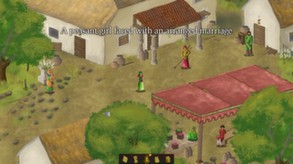
Unrest is a role playing adventure game set in a fantasy interpretation of ancient India that adapts to death, failure, and the choices you make. Play as ordinary people in a struggle for safety, freedom, and a chance at peace. Use conversation, manipulation (and rarely, violence) to achieve your goals.
Modeled estimate, not a reported figure. How we estimate →
About
Genres
Stats
All-time low is the lowest price we've recorded for this game since we started tracking it.
Engagement
Reviews
Themes across 110 recent reviews and how positive each mention is. A keyword signal, not full sentiment analysis.
Reviews
3/10
11/10
Very fun game
Media

Related
Related
Price dynamics, follower growth, revenue and sales trajectories with interactive tooltips
This and every other Pro feature is free until October 20, 2026. A free account is all it takes.
Languages: English**languages with full audio support
Hours played at review time, across 110 reviews with recorded playtime.
positive critical· bar length = how often the theme comes up
I had wanted so much more from this game but I did discover that it was, very simply, everything it had advertised itself to be. Come join me in the sudden and gripping fear that all of your choices actually do have consequences, and entire plot lines can be snuffed away with one wrong move.
I wanted to like Unrest. The fantasy India setting is relatively underused and the promise of a dynamic storyline with multiple paths sounded great. Unfortunately, I played through the game once and quickly had my fill. The background lore is cool but playing the game felt like a chore due to slow movement and dull dialogue. The abrupt ending continued to sour my experience.
Unrest is an ambitious and unconventional role-playing game developed and published by Pyrodactyl Games that stands out for its focus on social storytelling rather than combat or traditional RPG mechanics. Set in the fictional ancient city-state of Bhimra, inspired by classical India, the game unfolds during a period of drought, famine, and growing political turmoil. Instead of casting the player as a hero destined to save the world, Unrest asks them to embody a range of ordinary people whose lives intersect amid social upheaval. The game’s premise is simple yet powerful: explore the dynamics of power, survival, and morality in a society on the brink of collapse, not through grand battles, but through dialogue, empathy, and choice. The most striking element of Unrest is its narrative structure. The story is told from multiple perspectives across different social classes and walks of life. In one chapter, you might play as a young princess facing an arranged marriage that could shape the future of Bhimra’s fragile political alliances; in another, you’re a peasant girl struggling to survive in the slums, or a naga—an intelligent serpent-like creature—trying to negotiate peace between two conflicting races. Each chapter feels self-contained yet interconnected, gradually revealing how small decisions ripple through the city’s wider social fabric. The writing is subtle and layered, delving into caste, faith, privilege, and rebellion without ever feeling heavy-handed. Rather than offering clear moral binaries, the game thrives on ambiguity: kindness can backfire, defiance can cost lives, and silence can sometimes be the only form of resistance left. Gameplay in Unrest revolves primarily around conversation and decision-making. Every interaction is built on a system of relationship metrics—fear, respect, and friendship—which determine how other characters perceive you. Choices influence these values, shaping not only immediate outcomes but also future interactions. This creates a sense of personal accountability rarely found in games; even seemingly trivial exchanges can alter the story’s trajectory. There is no combat system in the traditional sense—conflicts are verbal or political, resolved through dialogue rather than violence. This design choice reinforces the game’s commitment to portraying vulnerability rather than empowerment. You are often reminded that your characters, no matter how noble or defiant, exist within rigid hierarchies that limit their freedom to act. This lack of agency is not a flaw, but a thematic statement about life under oppressive systems. The art and presentation of Unrest complement its tone perfectly. The hand-painted visuals give the city of Bhimra a vivid, storybook quality, rich in color and atmosphere. Each environment—from palace courtyards to bustling markets and dilapidated alleyways—feels alive, reflecting the social stratification that defines the city. The soundtrack, built on traditional Indian instruments and rhythms, lends authenticity to the world, while the minimalist interface keeps attention focused on the narrative. The technical execution, while not flashy, serves its purpose well. Animation and movement are simple, and some players may find them stiff or basic, but this simplicity also allows the storytelling and dialogue to take center stage. The result is a world that feels both grounded and mythical, where realism blends with allegory in equal measure. One of the game’s strengths is its replayability. Since every chapter offers branching choices and moral dilemmas, outcomes vary dramatically depending on how you navigate each conversation. Characters can live, die, or disappear depending on your actions, and yet the story continues regardless—there are no game-over screens, just consequences. This continuity gives the narrative weight, making every decision meaningful even if it leads to failure. The relatively short playtime—around four to five hours for a single run—encourages experimentation with different paths and perspectives. However, the brevity also limits the sense of depth that longer RPGs might offer. Some storylines end abruptly or leave you wishing for more time with certain characters, but this imperfection mirrors the unpredictability of the world the game portrays. Unrest is not a game for those seeking action, puzzles, or intricate mechanics. It is a slow, contemplative experience, more akin to an interactive novel than a conventional RPG. What it lacks in complexity, it makes up for in sincerity and thematic richness. Its depiction of social inequality, faith, and human frailty feels authentic and unfiltered. Few games capture the sense of existing within a living society rather than standing above it as a hero. By focusing on the powerless and the marginalized, Unrest delivers a kind of realism rarely attempted in the medium. It’s a thoughtful exploration of how people survive within broken systems, how empathy can both heal and harm, and how even small acts of courage can reverberate through a fragile world. Ultimately, Unrest succeeds as a distinctive narrative experiment—a quiet, introspective RPG that challenges expectations of what role-playing can mean. It is not about conquering enemies or collecting rewards, but about understanding the complexities of humanity in a time of crisis. The experience may be brief and occasionally rough around the edges, but its message lingers long after the credits roll. For players drawn to meaningful storytelling and moral nuance, Unrest stands as one of the most original and thought-provoking indie RPGs of its time. Rating: 6/10
I got this game because I was looking for an RPG that did not use fighting or collecting loot as a mechanic, and that is what this is. It is all dialogue-driven, and the choices you make have consequences that affect how the rest of the game plays out. The dialogue in this game, in and of itself, is some of the best and most realistic that I have seen. The character scores that each choice affects are, however, not intuitive and seem to have no bearing on the final state. The game is also quite short and anti-climactic, with an abrupt ending. Considering its length, it would probably have been better if it had fewer character arcs so that you would be given a chance to play each individual character more and bond with them.
Good little interactive story with complex intertwined character political choices to save a dying empire. Set in ancient India in an imaginary kingdom, Unrest can boast good music and has a pleasant and exotic atmosphere. A lot of reading is involved but however, don't expect too much adventuring: there's no choosing where you want to go when you want to, swapping between characters is forced upon you and there's no hidden inventory or secret stats to boost to change the game's outcome. If you're skillful and cunning enough, the fate of protagonists will be good, bad or neutral and the general outcome will either be on the positive side or on the negative.
Внешний вид заинтересовал, но внутри плохая игра. Первые пару глав ещё туда-сюда, но потом появляются всё более рандомные микротараканы, на которых очень насрать и за происходящим уже невозможно следить... Мандиб... Джейдиб... Кто это ♥♥♥♥♥ такие? Да я уже не помню. Ну описали тебе их жизнь в паре абзацев, ну побегал, пообщался. Они вообще никто и холодная вселенная, точнее жаркий городок, полный черножопых индусов, про них тоже никогда не вспомнит.
Curator Review: Unrest, a text driven role playing game based in fantasy India. Take control of characters from all different sects of the same region and determine all of their fates. The main city of Bimbhra is in a state of turmoil and the foreigners, Naga, are encroaching upon their land. What decisions will you make? Can you change the future of this once great city? https://youtu.be/DWlY7QOEtTk
Selling now
See how fast this game is selling right now — estimated copies and revenue per day from recent review growth.
Players by region
Where this game's players are, estimated from review languages.
Players also reviewed
The games this title's players most often review too — audience affinity.
Related
| Game | Estimated lifetime revenue | Reviews | Review score | Price |
|---|---|---|---|---|
| $0 | 459 | 97% | Free | |
| $93.3K | 254 | 94% | $14.99 | |
| $10.6K | 85 | 92% | $7.99 | |
| $10K | 24 | 79% | $14.99 | |
| $5.4K | 13 | 69% | $19.99 | |
| $1.2K | 11 | 100% | $7.99 |
Related
| Game | Estimated lifetime revenue | Reviews | Review score | Price |
|---|---|---|---|---|
| $27.5K | 99 | 83% | $14.99 | |
| $27.5K | 79 | 78% | $17.99 | |
| $27.5K | 174 | 70% | $5.99 | |
| $27.5K | 976 | 79% | $0.99 | |
| $27.5K | 259 | 86% | $5.99 | |
| $27.5K | 87 | 44% | $14.99 |