[b][h1]TTV2 - A Comprehensive Review[/h1]
[h2]Introduction: A Minimalist Descent into Reflex and Tension[/h2]
TTV2 is not a game that explains itself. It drops you into a shifting, semi-abstract space of vines and machines, and it expects you to move. There is no tutorial, no narrator, and no hand-holding. The premise is deceptively simple: find the edge of the screen to progress, and touch anything to die . It is an arcade retro hardcore maze wanderer minigame, the sequel to Trip to Vinelands, and it was released on September 11, 2017 . For a game that costs less than a cup of coffee, TTV2 delivers a concentrated dose of tension and reflex-based gameplay that has earned it a **Very Positive** rating on Steam, with 87-89% of over 1,400 user reviews recommending it .
[h2]Gameplay and Mechanics: The Maze That Moves[/h2]
At its core, TTV2 is a game about attention and agility. You control a small figure navigating abstract, dangerous environments filled with rotating shapes, closing walls, and lethal obstacles . The goal is always the same: find the exit, which is usually the edge of the screen. The challenge lies in the fact that the environment is constantly shifting. What looks like a safe path one moment can become a death trap the next.
The game was built to test your reflexes and your attention to detail . Death is instant and frequent. There are no health bars, no checkpoints, and no forgiveness. You either react correctly or you start over. This brutal simplicity is the game's defining characteristic. A Steam reviewer described it as "abstract 2D escape room through shifting and rotating semi-abstract shapes," noting that it is "a bit too hardcore" for extended play but remains "fun in short bursts" .
The difficulty is deliberately punishing, but it is also fair. Every death feels like a failure of observation or reaction, not a cheap trick. The game demands a specific kind of focus—a meditative, almost trance-like state where you stop thinking and start reacting. The Rage Collective curator described it as "a contemplative maze runner with stunting gameplay experience," a "high octane minigame to chill out at the end of the day" . That paradox—high tension and relaxation coexisting—is perhaps the best way to describe TTV2's unique appeal.
[h2]Presentation: Original Audio and Art[/h2]
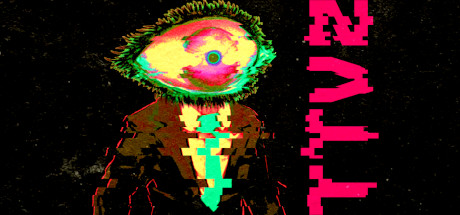
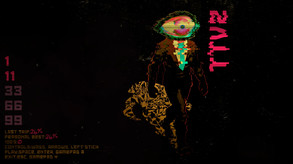
TTV2 is the work of Walter Machado, the creator of the UBERMOSH series, and it shares that lineage's commitment to original, stylized presentation . The game features original audio and art, with a setting dominated by dark elements like vines and machines . The visuals are minimalist and abstract, favoring geometric shapes and stark contrasts over detailed sprites.
The soundtrack is a significant part of the experience. One reviewer on Backloggd specifically praised "the way the music shifts per stage," noting that the audio design evolves as you progress . This dynamic soundtrack reinforces the game's sense of momentum and keeps each stage feeling distinct, even when the visual palette remains consistent. The music is not just background noise—it is a cue, a warning, and a companion through the maze.
The art style is deliberately ambiguous. You are not told what you are or where you are. The vines and machines suggest an organic or industrial space, but the game never confirms or denies any interpretation . This abstraction serves the gameplay: without a clear narrative or recognizable world, your attention is forced entirely onto the mechanics. There is nothing to distract you from the task at hand.
[h2]Content and Longevity: Small but Slick[/h2]
TTV2 is not a long game. It is a "minigame" by design, and its content is correspondingly compact . The Backloggd reviewer noted, "Not much content, but you're getting a slick experience for very little cash" . This is an accurate summary. TTV2 does not offer dozens of hours of progression or a sprawling campaign. It offers a tightly designed, replayable challenge that you can pick up and put down in short sessions.
The game supports Windows, Linux, and Nintendo Switch, with a file size of just 219 MB on Switch . It runs on modest hardware—a 2.5GHz processor and 1GB of graphics memory are sufficient . This accessibility is part of its charm. TTV2 is not trying to be an epic. It is trying to be a perfect little challenge, and it largely succeeds.
For players who enjoy chasing high scores or perfect runs, TTV2 offers replayability through mastery. The shifting environments and instant-death mechanics mean that no two runs are identical, even if the underlying structure remains the same. The game rewards patience and practice, and the satisfaction of finally clearing a stage that has killed you twenty times is genuine.
[h2]Criticisms and Limitations[/h2]
TTV2's most obvious limitation is its length. It is a minigame, and it does not pretend otherwise. Players looking for a substantial single-player experience with narrative, progression, or variety will find TTV2 lacking. It is a concentrated burst of gameplay, not a meal.
The difficulty is also a double-edged sword. While the hardcore nature of the game is its identity, it will alienate players who lack the reflexes or patience to endure repeated failure. The Steam reviewer who gave it a 5/10 acknowledged this explicitly: "It's a bit too hardcore for me" . TTV2 does not offer difficulty options or accessibility features. It is what it is, and you either meet it on its terms or you don't.
The abstract presentation, while thematically coherent, also means there is very little to latch onto emotionally or narratively. There is no story to speak of, no characters, and no world-building. The game is pure mechanics, and for some players, that purity is a feature. For others, it is a void.
[h2]Conclusion: A Perfect Little Nightmare[/h2]
TTV2 is not for everyone. It is a game for players who enjoy precision, reflex, and the particular satisfaction of mastering something difficult and strange. It is a game that respects your time by demanding very little of it—you can play for five minutes or fifty, and the experience remains consistent. It is a game that knows exactly what it is: a hardcore arcade maze wanderer, made with original art and audio, and priced accordingly.
The Very Positive rating on Steam, sustained over more than 1,400 reviews, suggests that TTV2 found its audience . That audience is small but devoted—players who appreciate the UBERMOSH creator's particular brand of minimalist, reflex-driven design. For those players, TTV2 is a slick, tense, and endlessly replayable challenge. For everyone else, it is a curiosity, a tiny nightmare in a dark room, waiting to see if you can find the edge of the screen before it finds you.
At its current price, often discounted to less than a dollar, TTV2 is almost impossible to regret . It is a shot of adrenaline, a test of nerve, and a reminder that sometimes the simplest games are the hardest to put down.[/b]