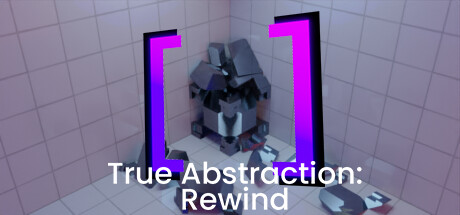
True Abstraction: Rewind is a first-person science-fiction puzzle adventure that combines logical problem solving with exploration, physics-driven interactions, platforming, and an undercurrent of horror. Developed and published by PrismBytes, it takes place within a secret experimental facility on the Moon, where the isolation of space immediately gives the experience an unsettling quality. Rather than simply moving through disconnected test chambers, the player is placed in circumstances involving danger, questionable loyalties, and experiments that have clearly gone beyond being harmless scientific exercises. The premise gives the puzzles a narrative purpose while encouraging curiosity about what happened inside the facility and whether anyone can truly be trusted.
The main attraction is its substantial collection of 75 levels, each designed around environmental challenges and experimental technology. Progress largely depends on examining a room, understanding how its mechanisms behave, and determining how different objects or systems can be combined to create a solution. Physics play an important role, so the experience is not limited to entering codes or activating switches in a predetermined sequence. Manipulating objects and interacting with machinery makes puzzle solving more physical, and the first-person viewpoint helps create the feeling of personally conducting experiments rather than observing them from a distance.
The difficulty comes from learning the rules established by the environment and then applying them in increasingly complicated situations. Earlier challenges can teach an individual concept before later rooms demand that several ideas be considered simultaneously. This produces a satisfying sense of progression because advancement is tied to the player's understanding rather than conventional character upgrades. Platforming and movement challenges also introduce some variety, preventing the campaign from becoming an uninterrupted collection of stationary logic problems. When these different elements work together, solving a chamber feels like overcoming a genuine physical obstacle rather than merely discovering the answer to a riddle.
Horror significantly changes the mood of these otherwise cerebral challenges. The lunar laboratory is not a safe testing environment, and the suggestion of something dangerous lurking within the complex means exploration carries a persistent degree of uncertainty. This is particularly effective because puzzle games normally encourage players to take their time and inspect everything carefully. Here, that methodical behavior exists alongside the feeling that remaining comfortable for too long might be a mistake. The contrast between careful reasoning and environmental tension gives the game much of its personality.
The Moon itself is an excellent choice of setting. An isolated research facility on Earth could still imply that civilization exists somewhere nearby, whereas a lunar complex naturally feels detached from ordinary life. Cold technological interiors, experimental equipment, darkness, and the hostile emptiness outside contribute to a convincing sense of confinement. The science-fiction theme also justifies unusual machinery and unconventional puzzle devices, allowing strange mechanics to feel like legitimate parts of the laboratory rather than arbitrary obstacles created solely for gameplay.
Narratively, betrayal and uncertainty provide additional motivation for continuing through the facility. The protagonist has reasons to question someone once considered a friend, while the suggestion that another person may still believe in them prevents the story from becoming completely hopeless. These relationships create questions that can remain in the player's mind while moving between puzzles. The story does not need to overwhelm the gameplay to be useful; its primary strength is giving context to the journey and making the next area interesting for reasons beyond simply finding another challenge.
One of its more unusual ideas is microphone interaction. Incorporating microphone functionality into a puzzle-oriented science-fiction game fits surprisingly well with the experimental nature of the setting. It provides another potential method of interacting with challenges instead of restricting everything to standard keyboard, mouse, or controller inputs. It is a somewhat unconventional feature and will naturally appeal more to players comfortable with alternative interaction methods, but it demonstrates that the project is interested in trying ideas outside the most predictable first-person puzzle formula.
The large number of individual levels can be both an advantage and a limitation. Having 75 stages gives the developers room to explore different mechanics and gradually expand the complexity of their puzzles. At the same time, players who prefer enormous interconnected locations may find the chamber-based progression comparatively segmented. The mixture of puzzle solving, horror, action elements, platforming, and exploration also means that no single genre completely dominates every moment. Someone expecting constant horror encounters or combat may find the cerebral sections too prominent, while a player seeking an entirely relaxing puzzle experience may not appreciate the threatening atmosphere.
The presentation nevertheless benefits from how closely its themes complement its gameplay. Experimental technology naturally supports physics puzzles, the lunar setting strengthens isolation, and horror makes otherwise clinical environments feel unpredictable. Instead of appearing like several unrelated genres combined for variety, these ingredients generally serve the central concept of being trapped inside a dangerous research complex where intelligence and observation are essential for survival.
As a single-player experience, True Abstraction: Rewind is best suited to players who enjoy methodical environmental puzzles but want more atmosphere and tension than a traditional collection of test chambers normally provides. Its extensive level count, physics-based mechanics, experimental interactions, platforming components, mysterious narrative, and threatening lunar environment give it a recognizable identity. PrismBytes has created an ambitious independent puzzle adventure that understands the satisfaction of discovering how a complicated room works while giving players a reason to remain uneasy about what might be waiting after they solve it.
Rating: 7/10