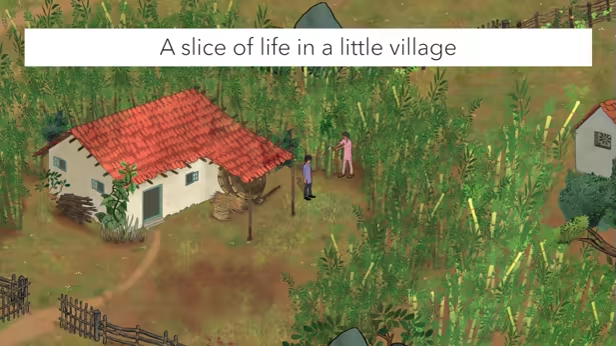
The Palace on the Hill Prologue is a calm and character-focused adventure that distinguishes itself through its rural Indian setting, watercolor-inspired presentation, and emphasis on ordinary life rather than conventional action. Developed and published by Niku Games, it serves as an introduction to the larger The Palace on the Hill experience, following a teenage boy named Vir as he navigates personal responsibilities, friendships, ambitions, and the history surrounding his home. Instead of immediately presenting players with dramatic confrontations or complicated systems, the prologue establishes its identity through exploration, conversation, creativity, and the small routines that shape Vir's life.
Set in rural India during the 1990s, the story benefits enormously from a location and period that remain uncommon in video games. Vir is a young man with aspirations that extend beyond his present circumstances, and this tension gives the narrative much of its emotional foundation. His journey is not simply about uncovering an external mystery. It is also about understanding his community, confronting the limitations around him, and discovering what he wants from his future. There are hints of romance and personal relationships, but these elements complement rather than overwhelm the broader coming-of-age theme.
One of the most intriguing aspects of the experience is the ruined palace that Vir can explore. The remains connect the relatively recent 1990s setting with a much older historical period, creating an interesting contrast between everyday village life and traces of India's past. Exploring these ruins gives the adventure a sense of discovery without transforming it into an action-heavy archaeological expedition. The palace instead functions as a source of atmosphere, history, and curiosity. This makes exploration feel meaningful because players are gradually learning about the environment alongside Vir rather than simply searching rooms for collectibles.
The game's artistic presentation is arguably its most immediately memorable quality. Its colorful hand-painted watercolor aesthetic gives landscapes, buildings, characters, and natural surroundings a warm illustrated appearance. The approach fits especially well with the nostalgic nature of the story. Rather than pursuing realistic graphics, Niku Games uses stylization to make the world resemble a collection of memories captured through paintings. The artistic direction also connects naturally with Vir's creative interests, allowing the visual presentation to feel like part of the game's themes rather than merely a decorative choice.
Painting itself becomes an interactive activity through relaxing puzzle-oriented mechanics. This is a clever addition because it transforms one of Vir's interests into something the player can participate in directly. The mechanic provides a change of pace from walking, talking, and completing errands while remaining consistent with the game's peaceful atmosphere. Players looking for highly complicated puzzles may find these interactions relatively gentle, but intense difficulty would arguably conflict with what the game is attempting to achieve. Painting works best as another way of engaging with Vir's perspective and appreciating the world around him.
The prologue also incorporates gardening, cooking, and various tasks for the people Vir encounters. Establishing a garden and preparing Indian dishes contribute considerably to the slice-of-life atmosphere. These activities reinforce the idea that Vir belongs to the community instead of being an anonymous adventurer who has arrived solely to complete quests. Cooking also provides another opportunity for the cultural setting to emerge through gameplay. Rather than relying entirely on dialogue to explain the world, the game allows everyday activities, food, architecture, landscapes, and social interactions to communicate much of its identity.
Completing errands for the game's colorful supporting characters provides structure while encouraging players to become familiar with the community. These tasks are generally more valuable for the situations and personalities they reveal than for mechanical complexity. Anyone expecting elaborate RPG quests or sophisticated simulation systems should therefore approach the experience with appropriate expectations. The game borrows ideas from adventure, role-playing, and life-simulation genres, but storytelling and atmosphere remain at the center. Conversations and small interactions matter because they gradually build a portrait of Vir's environment and the people who inhabit it.
The slower pace can be both a strength and a limitation. Players who enjoy relaxed narrative adventures may appreciate being given time to observe the scenery and absorb the atmosphere. Those who require constant action, challenging combat, or complex progression systems are unlikely to find the same level of satisfaction. The Palace on the Hill Prologue is comfortable allowing relatively ordinary experiences to occupy the player's attention. Gardening, cooking, painting, exploring ruins, and talking to villagers may sound mundane individually, but together they create an unusually cohesive representation of Vir's daily existence.
Its status as a prologue is also important when evaluating the experience. This is fundamentally an introduction designed to establish characters, themes, mechanics, and setting rather than provide the complete dramatic payoff of a full-length adventure. Consequently, some ideas feel more like previews of greater possibilities than fully developed systems. Story threads naturally leave room for continuation, and players expecting a completely self-contained narrative may find the conclusion less definitive than desired. On the other hand, the limited scope prevents the game from overstaying its welcome and allows its strongest qualities to remain concentrated.
From a technical perspective, the game does not depend on demanding hardware to achieve its visual identity. Its stylized presentation allows the artwork and environmental design to carry the experience without requiring cutting-edge graphical technology. This accessibility complements the relaxed nature of the project and keeps attention focused on the story, characters, paintings, landscapes, and historical architecture. The artistic consistency is ultimately more important than graphical complexity, and Niku Games understands that distinction.
What makes The Palace on the Hill Prologue particularly appealing is the coherence between its different components. Vir's interest in art connects with the watercolor presentation and painting mechanics. His place within the community connects with gardening, cooking, conversations, and errands. The palace ruins connect his contemporary circumstances to a deeper historical backdrop. Even the leisurely pacing supports the reflective coming-of-age narrative. These elements rarely feel as though they were included merely to expand a feature list; most contribute directly to the game's central themes.
As an introduction, The Palace on the Hill Prologue leaves a favorable impression by offering something culturally distinctive and emotionally grounded. Its mechanics are deliberately modest, and its prologue format means that the experience cannot fully resolve everything it introduces, but its personality compensates for those limitations. Niku Games demonstrates that an adventure does not require combat or enormous environments to create a compelling sense of discovery. For players interested in narrative exploration, Indian culture, historical environments, watercolor artwork, gentle puzzles, and slice-of-life storytelling, this is a charming and thoughtfully constructed opening chapter.
Rating: 8/10