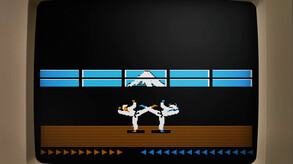
Play the history. Go behind the scenes of Jordan Mechner's landmark game Karateka in this interactive documentary from Digital Eclipse, with archival materials, video features, and more. Experience pixel-perfect versions of this legendary game, with all-new features.
Modeled estimate, not a reported figure. How we estimate →
Discounts
Every price cut of more than 20% we have observed, in each market that quoted one, with this game's chart position on either side of it. These are episodes, not a model: a sale is one event, and one event cannot tell you what the next one will do.
Reviews, worldwide (the counter carries no country): 0/day in the week to Aug 27 → 0.14/day in the week after.
About
Genres
Sums Steam only; GOG, Xbox, Epic, Nintendo publish no volume signal, so the true total is higher by an unknown amount.
Engagement
Reviews
Themes across 42 recent reviews and how positive each mention is. A keyword signal, not full sentiment analysis.
Reviews
Pura nostalgia! Com as versões mais famosas do jogo e seu remake impecável! Quem gostava deste jogo, vai querer ter!
Great digital museum for Karateka. Multiple versions of the game included as well as other games created by the same guy, and a remaster of Karateka. Awesome story of early computer games well worth the money for anybody into retro computer games or interest in the history of video game development. Digital Eclipse has redefined game collections of this style. I was familiar with Karateka prior to playing , but had no idea about the story behind it's development. Hope Digital Eclipse continues to create stuff like this.
Media

Related
Related
Price dynamics, follower growth, revenue and sales trajectories with interactive tooltips
This and every other Pro feature is free until October 20, 2026. A free account is all it takes.
For scale, across Steam · Top Sellers · Brazil over the last 30 days: the 26 chart moves that followed a price cut of more than 20% went a median of 7 places towards #1, and the 2,400 moves with no price cut behind them went 2 away. One store, one chart, one country — it is the only place we have enough observations to say even that.
Prices outside the United States have been collected since 6 August 2026 and chart positions since 19 July 2026, so a cut older than that has no market to compare and a market that joined later has no history yet. Nothing here is converted between currencies.
Stats
All-time low is the lowest price we've recorded for this game since we started tracking it.
Languages: English*, French, Italian, German, Spanish - Spain, Japanese*languages with full audio support
| $5.99−70% |
| 56ratings |
| 98% |
| — |
| not modelled |
| $19.99 | — | — | — | not modelled |
| $19.99 | — | — | — | not modelled |
Matched by title — a reused name can pair the wrong games. * is a critic aggregate. Prices and positions are each store's United States storefront; Epic charts worldwide. Audience and Score too, except Steam's, which is worldwide.
Hours played at review time, across 42 reviews with recorded playtime.
positive critical· bar length = how often the theme comes up
The Making of Karateka is a fascinating example of how video game history can be preserved without reducing it to a collection of screenshots, interviews, and old software hidden behind separate menus. Developed by Digital Eclipse and published by Digital Eclipse and Atari, this interactive documentary explores the creation of Jordan Mechner’s Karateka and the experiments that eventually led to one of the most memorable early examples of cinematic game design. Instead of treating the original title as an isolated artifact, the collection reconstructs the creative journey behind it through playable prototypes, archival documents, photographs, design materials, interviews, videos, and multiple versions of the game. The central timeline is what makes the experience distinctive. Historical materials are arranged chronologically, allowing players to follow Mechner’s progression from his earliest experiments to the development of Karateka. Documents and commentary explain what was happening during different stages, while playable builds allow many of those ideas to be experienced directly. This makes the history much easier to appreciate because players are not simply being told how the game changed. They can actually interact with earlier versions and observe how mechanics, animation, presentation, and design concepts developed over time. Particularly interesting is the attention given to animation. Karateka became notable for character movement that appeared unusually fluid for its era, and the collection demonstrates how rotoscoping contributed to that result. Footage, development materials, and explanations reveal how real human movement informed the animation. These sections also demonstrate the ambitions behind the project. Mechner was interested not only in creating functional combat mechanics but also in using movement, framing, music, and visual presentation to give the action a cinematic quality. The playable historical material is one of the strongest reasons to explore the collection. Different versions and prototypes provide a practical demonstration of the development process, including experiments that would otherwise be difficult for most players to access. The original Karateka is preserved as an important part of the package, while modern features such as rewind, save functionality, and convenient navigation make vintage software considerably more approachable. These additions reduce unnecessary frustration without diminishing the historical character of the games. Karateka itself naturally feels different from contemporary fighting and action games. Movement is deliberate, combat is relatively straightforward, and the adventure is compact by modern standards. However, judging it solely through contemporary expectations misses much of its significance. Once the documentary has shown the technical limitations and design challenges involved, its animation and cinematic presentation become far more impressive. The experience provides the context necessary to understand why seemingly ordinary features represented meaningful accomplishments when the game was originally created. The collection is not restricted to straightforward preservation. Karateka Remastered provides a modern interpretation that revisits the original concept while making it more accessible to contemporary players. It complements rather than replaces the historical versions. Playing the remaster after exploring the timeline is especially satisfying because it becomes possible to recognize ideas that originated decades earlier and see how they translate into a more modern presentation. Another noteworthy component is Deathbounce: Rebounded, which revisits an unpublished project from Mechner’s earlier work. Reimagined as a twin-stick shooter, it offers faster and more immediately arcade-oriented gameplay than Karateka. More importantly, its presence strengthens the documentary's examination of creative failure and experimentation. The project illustrates that an abandoned idea can still influence a developer’s growth and eventually contribute indirectly to later success. The presentation maintains an effective balance between museum-like organization and accessibility. Archival documents retain their historical character, while interviews and commentary provide context without making the collection feel like an academic database. Personal materials also reveal the human side of development, showing the persistence, uncertainty, experimentation, and outside influences involved in turning an idea into a finished game. For anyone interested in game development, these details may ultimately prove more compelling than the finished game itself. There are understandable limitations. Players expecting a conventional action game with hours of continuous combat may be disappointed because a substantial portion of the experience involves watching, reading, examining, and comparing historical materials. Some documents will naturally appeal more strongly to enthusiasts of game history than casual players. Likewise, the original Karateka can feel mechanically restrictive compared with modern action titles. The package works best for players willing to engage with its documentary structure rather than rushing directly through the playable games. Steam Deck compatibility is generally favorable as it is rated Playable. The collection is well suited to portable play because much of the experience consists of navigating timelines, watching documentary segments, examining archival material, and playing relatively lightweight classic games. Steam Deck users should nevertheless be aware that official compatibility classifications and Proton behavior can change over time, so the current Steam Deck status should be checked directly on the device or Steam client. From a design standpoint, however, this type of collection is naturally comfortable for handheld sessions. Ultimately, The Making of Karateka succeeds because it preserves more than a finished product. It preserves the process of making that product, including prototypes, discarded concepts, technical experiments, personal influences, and the gradual refinement of ideas. Digital Eclipse presents these materials in a way that allows players to participate in the history rather than simply read about it. It is an impressive celebration of Jordan Mechner’s early work and a persuasive demonstration of what interactive video game preservation can accomplish. Rating: 9/10
Digital Eclipse strikes us with 'The Making of Karateka,' a first in their lineup of "Gold Master" series in which they present a documentary presented with some historical pieces that also gives you a game collection with it and Karateka's is a mostly fantastic package to go through. Compared to 'Tetris Forever' (as of this review the only 2 I've tried in the series) the pacing and documental telling of how Karateka was made is way more consistent to follow, it rarely broke up the video sections abruptly and actually let people talk. It's a really good watch especially when you see Jordan Mechner doing things like rotoscoping the animations frame by frame or even how his father Francis Mechner inspired a lot of the choices in the game including the rotoscoping and heck he even composed the soundtrack of Karateka on multiple platforms as well, just a fun watch when looking at everything from how Karateka set a standard to how handmade everything truly was with it, just really good. The game collection here is pretty good even if I did want to see a couple more versions of Karateka here, but this could've been done to licensing issues considering a good portion of ports weren't done by Brøderbund. You'll get 14 different games all together which is also including the prototypes. I won't talk about every single title, but I will give my thoughts on a bit of them below if interested. The original trio of Karateka from the Apple II, Commodore 64, and lastly the Atari 8 bit, while the Apple II version is the original and did a lot of creative things for said platform I think the Atari 8 bit version is the best as it just simply felt better to play, but the C64 itself has the best soundtrack. 'Karateka Remastered' however is simply the best version of the game here as it simply controls better with higher framerate, looks way better, and does sound pretty good, but the goals here especially since they don't save are an absolute pain in the @$$. 'Deathbounce' was a cool idea that never got released until now, this was spun off from an 'Asteroids' clone Jordan had made, at first being bouncy balls getting changed into birds and birds that laid eggs that are reminiscent of the bouncy balls, etc, it's got a lot going on in the character department, but is fun if you like 'Asteroids.' 'Deathbounce Remastered' is probably the best version here, while the other builds are mostly cool they are also prototypes and incomplete while this is fully complete, a pretty fun twin stick shooter going from room to room on these trains trying to get to the last room to destroy and orb. Pretty fun. Overall yes I do recommend 'The Making of Karateka,' if you like the aspect of a game collection with a documentary being attached then it's absolutely great, also from the stance of game preservation. I think $20 is more than fair for what's being asked, but at $7 on sale right of writing this up, it's an easy snag that you won't regret.
リマスタのカラテカ内の実績がゲーム終了後リセットされる バグ?
"The Making of Karateka" is another great docu-game from Digital Eclipse. "Karateka" is not a game I enjoy that much but it is amazing how much has been documented and shown here, everything from drawings to prototypes. "MoK" is very thorough and while I do love that, as someone who saw everything here some of the information can feel repetitive. I did also feel that Jordan's segments could have been filmed better as they are somewhat shaky and poorly framed (you can only see half of his face). Overall "The Making of Karateka", with all the added context, is probably the best way to experience "Karateka". 3/5
카라데카! 국딩시절 NES로 하면서 태권도로 불렀다는 그 게임. 여러 버전이 수록되었고 리메이크된 버전은 확실히 그래픽도 좋아지고 깔끔하다. 옛날에 하던 그 조작감 그대로 구현이 되어있다. 가볍게 시간 때우면서 하기에는 좋은 게임 그런데 이렇게 어려웠던가? 힘드네...
A masterpiece presentation of a masterpiece presentation. The Making of Karateka is a must play and a must watch for anyone who is interested in game development and its history.
These Interactive Museum Pieces mean so so much to me, they may not be entirely just games which sort of puts some off but the stories that especially these first two entries before the 3 enormous big big ones to follow are just so valuable and important i hope and pray that Digital Eclipse will continue to do individual spotlights aswell as companies
Espetacular historia de um jogo que mudou a industria!
Selling now
See how fast this game is selling right now — estimated copies and revenue per day from recent review growth.
Players by region
Where this game's players are, estimated from review languages.
Related
| Game | Estimated lifetime revenue | Reviews | Review score | Price |
|---|---|---|---|---|
| $0 | 0 | — | $3.99 | |
| $117.4K | 294 | 89% | $19.99 | |
| $15.7K | 34 | 76% | $17.99 | |
| $3K | 14 | 93% | $8.99 | |
| $186 | 5 | 80% | $1.99 | |
| $0 | 0 | — | $5.99 |
Related
| Game | Estimated lifetime revenue | Reviews | Review score | Price |
|---|---|---|---|---|
| $61.3K | 155 | 61% | $14.99 | |
| $61.3K | 469 | 89% | $6.29 | |
| $61.3K | 149 | 87% | $12.99 | |
| $61.3K | 140 | 74% | $8.99 | |
| $61.3K | 314 | 85% | $12.99 | |
| $61.3K | 130 | 61% | $13.99 |