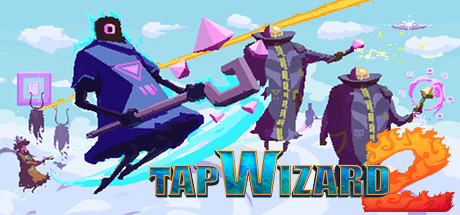
Tap Wizard 2, developed and published by TopCog, is a curious blend of idle design and action RPG sensibilities that manages to feel both relaxed and mechanically dense at the same time. It presents itself as a top-down survival game where a lone wizard battles endless waves of enemies, but the twist is that much of the action unfolds without direct input. Instead of micromanaging every attack, players take on a more strategic role, shaping how their wizard grows stronger over repeated runs. This approach gives the game a distinct identity, setting it apart from more hands-on entries in the genre while leaning heavily into long-term progression and optimization.
The structure revolves around a time-loop concept in which defeat is not only expected but necessary. Each run ends in eventual failure, sending the wizard back with accumulated resources that can be reinvested into permanent upgrades. Over time, this creates a steady sense of growth as previously overwhelming enemy waves become manageable and new layers of the game begin to unfold. The loop is simple—fight, fall, improve, repeat—but it’s executed in a way that makes progression feel meaningful rather than purely incremental. There’s a constant sense that each attempt pushes you a little further, even if the immediate gameplay doesn’t change dramatically.
Combat plays out automatically, with the wizard casting spells at nearby enemies while moving through a confined arena. Players can reposition the character and make occasional tactical decisions, but the bulk of the action is governed by the systems you build around your character. Spell selection, passive bonuses, and upgrade paths determine how effectively your wizard survives, turning each run into a test of planning rather than reflexes. This semi-passive design can be surprisingly engaging, especially for those who enjoy tweaking builds and watching them perform. However, it also creates a degree of detachment, as success often feels tied more to preparation than to moment-to-moment skill.
One of the game’s strongest features is the sheer breadth of its progression systems. There are multiple layers to explore, including research trees, enchantments, relics, and different magical specializations that dramatically alter how your wizard functions. This depth encourages experimentation, as players can try out different combinations of abilities and upgrades to see what works best. Some builds focus on overwhelming damage output, while others emphasize survivability or crowd control. This variety helps keep the experience fresh, even when the core gameplay loop remains largely unchanged.
That said, the complexity can also be a hurdle. The game introduces its many systems quickly and doesn’t always provide clear explanations, leaving players to figure things out through trial and error. Early on, it’s easy to feel overwhelmed by the number of options and uncertain about which upgrades will have the most impact. For players who enjoy discovery and experimentation, this can be part of the appeal, but for others it may come across as unnecessarily opaque.
Visually, Tap Wizard 2 adopts a retro pixel-art style that prioritizes clarity over spectacle. The environments are relatively simple, often repeating similar layouts, but the variety of spell effects and enemy designs helps maintain visual interest. The presentation is functional rather than flashy, fitting for a game that places more emphasis on systems than on aesthetics. Audio follows a similar pattern, providing energetic background tracks that support the gameplay without demanding too much attention.
What makes the game particularly compelling is its idle component. Even when you’re not actively playing, progress continues, allowing resources to accumulate in the background. This makes it easy to engage with the game in short bursts, checking in periodically to upgrade your wizard and start another run. It’s well-suited to a more casual playstyle, where the game can run alongside other activities without requiring constant focus. The steady flow of rewards and upgrades creates a satisfying rhythm that keeps drawing you back.
However, the reliance on repetition is impossible to ignore. While new abilities and systems add layers of complexity, they don’t fundamentally change the structure of the experience. The cycle of battling waves, dying, and upgrading remains consistent throughout, and over time this can start to feel predictable. Players who prefer more active control or evolving gameplay mechanics may find the experience lacking in variety, while those who enjoy incremental progress will likely appreciate its consistency.
In the end, Tap Wizard 2 succeeds as a deeply systems-driven idle action RPG that rewards patience and strategic thinking. It doesn’t aim to deliver high-intensity gameplay or dramatic storytelling; instead, it focuses on building an addictive loop of gradual improvement and experimentation. For fans of idle games and optimization-heavy design, it offers a surprisingly rich experience that can easily become a regular habit. For others, its passive nature and repetitive structure may limit its long-term appeal.
Rating: 7/10