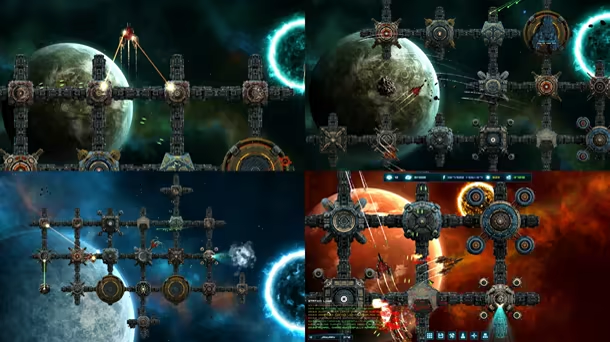
StellarHub is a compact but surprisingly involved space-station management simulation built around the challenge of keeping a remote human colony alive, productive, and capable of expanding. Developed by Casualogic and published by Valkyrie Initiative, it puts the player in the captain’s chair and makes nearly every important decision revolve around balancing ambition against limited resources. Rather than simply allowing you to construct an impressive station without consequences, the game connects expansion to energy, oxygen, materials, workforce availability, and the continuing needs of the people living aboard it.
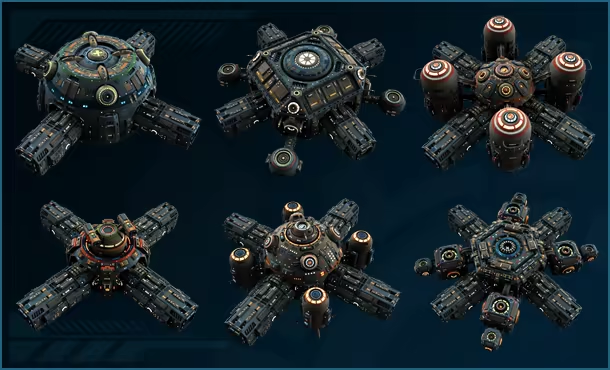
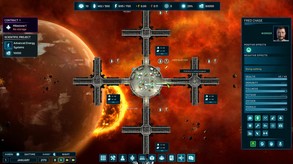
Station construction provides the foundation of the experience. Around 30 different modules are available, including crew quarters, solar panels, research laboratories, organic farms, greenhouses, medical areas, and other specialized facilities. Each addition has practical consequences because modules require construction resources and time while consuming essential supplies such as energy and oxygen. Expanding too aggressively can therefore weaken the entire colony. This creates a satisfying planning loop where the player must determine not only what would be useful next, but whether the station can actually support it.
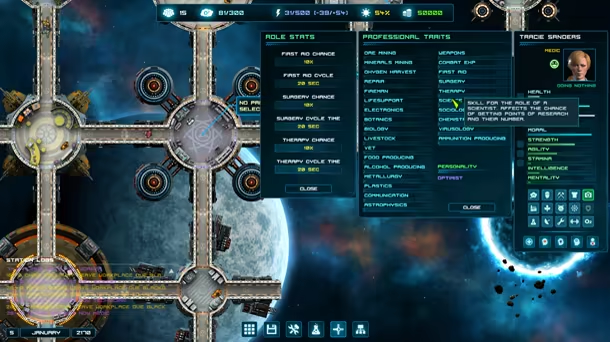
Crew management adds a more personal dimension to the economic simulation. Colonists possess different abilities, skills, personality traits, and individual requirements, making sensible job assignments important. Workers can contribute to construction, research, resource extraction, commerce, and other activities, but efficiency is only part of the equation. Health and morale also demand attention. Leisure facilities and medical modules become genuine necessities when the colony grows, especially because death is permanent. Losing an experienced worker can leave a serious gap in station operations and potentially trigger further problems if the colony is already struggling.
The resulting difficulty comes largely from interconnected systems rather than constant scripted disasters. An oxygen shortage can prevent expansion, insufficient resources can delay a vital facility, poor morale can reduce the effectiveness of the workforce, and weak preparation can leave the station vulnerable when environmental dangers emerge. The game rewards players who think several steps ahead. Recovering from a poorly planned expansion can be more satisfying than simply following an obvious optimal construction sequence, although the interface does not always communicate every relationship as elegantly as it could.
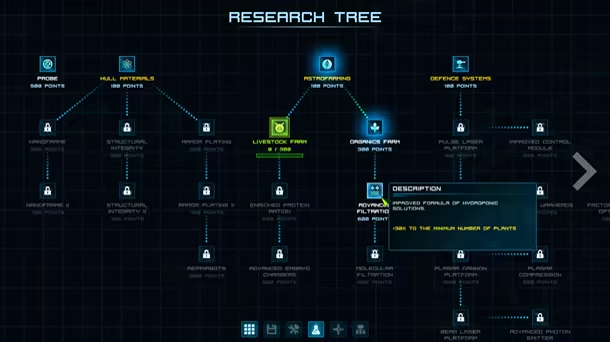
Research offers another meaningful avenue for development. The Scientific Research Map contains technologies and bonuses capable of improving important aspects of the colony, including resource efficiency, defensive capability, and livestock development. Research choices therefore complement the player's broader strategy instead of existing as an isolated progression mechanic. Investing in technologies that address a current weakness can dramatically improve a struggling station, while long-term upgrades can make later expansion considerably easier.
Trading provides additional flexibility. Resources and ores can be exchanged with visiting merchants, giving the player an alternative when internal production cannot meet demand. This prevents every shortage from having a single solution and encourages players to consider the economic value of their resources. Combined with extraction and research, commerce creates a reasonably interconnected economy where excess production in one area can help compensate for deficiencies elsewhere.
Environmental variety helps keep subsequent attempts from becoming completely predictable. Six worlds offer different circumstances involving resource availability and placement, meteor activity, solar conditions, and the threat of space pirates. Randomly generated maps further increase variation. These differences can significantly change priorities because a strategy that works under generous conditions may become dangerous when resources are scarce or external threats are more severe. The game consequently has more replay value than its relatively modest presentation initially suggests.
Its limitations become clearer after extended play. StellarHub does not possess the extraordinary systemic depth of the largest colony simulators, and some mechanics eventually become familiar enough that the early sense of uncertainty decreases. Presentation is functional rather than spectacular, while interface convenience and information delivery can occasionally feel dated. Players expecting an enormous sandbox with countless layers of automation and customization may find its scope restrictive. On the other hand, this smaller scale makes the game easier to understand than many management simulations without eliminating the satisfaction of optimization and survival.
Steam Deck compatibility requires an important qualification. StellarHub does not currently carry an official Steam Deck Verified or Playable designation on its Steam store listing, and the listed platform support is Windows. Therefore, it should be treated as officially unsupported or unverified for Steam Deck rather than assumed to provide a seamless handheld experience. Proton may potentially allow the Windows version to run, but compatibility, controls, interface readability, and stability should not be regarded as guaranteed. Its management-oriented interface may also be more naturally suited to mouse-driven interaction than native gamepad controls.
Overall, StellarHub succeeds as a focused space-colony management game by making construction, survival, personnel, research, trade, and environmental conditions depend on one another. Permanent crew deaths give poor decisions meaningful consequences, while the variety of modules and worlds provides enough strategic flexibility to encourage experimentation. Some dated presentation, interface roughness, limited scope, and uncertain handheld support keep it from reaching the level of the genre's strongest simulations, but its core management loop remains engaging for players who enjoy gradually transforming a vulnerable outpost into a sustainable station.
Rating: 6/10