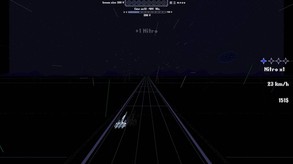
Star Fields, developed by AG media and published by Back To Basics Gaming, is a minimalist arcade-style game that focuses on quick reflexes, pattern recognition, and score optimization rather than narrative depth or complex mechanics. Released on Steam in 2016, the game is designed around short, repeatable play sessions where players navigate through a constantly shifting cosmic field filled with objects to collect and hazards to avoid. Its design philosophy draws inspiration from classic arcade titles, prioritizing immediate accessibility and replayability over expansive content or elaborate progression systems. As a result, the experience feels closer to a modern interpretation of a classic arcade cabinet than a traditional feature-rich indie game.
The gameplay structure is straightforward but engaging. Players guide a small craft through a dynamic starfield environment where rings and obstacles appear in rapid succession. The main objective is to collect colored rings while maintaining control of the ship and avoiding collisions with hazards scattered throughout the field. Each ring contributes to the player’s score, but the game adds a subtle layer of strategy by encouraging players to collect rings in specific color combinations to maximize score multipliers. This mechanic transforms what could have been a purely reflex-driven experience into a game of timing and decision-making, as players must choose between grabbing the nearest ring or waiting for the correct color sequence to appear.
As the session progresses, the pace gradually intensifies. Objects move more quickly, the playfield becomes more crowded, and the opportunities to maintain high scoring combinations require faster reactions and more precise control. This escalating difficulty is central to the game’s arcade-style design. Rather than presenting structured levels or a defined campaign, Star Fields relies on this increasing challenge to push players to improve their performance with each attempt. Surviving longer and maintaining higher multipliers becomes the key to climbing the global leaderboards and achieving competitive scores.
Although the gameplay is simple at its core, the inclusion of power-ups introduces moments of tactical opportunity. Certain items grant temporary benefits such as score boosts or enhanced control, allowing players to navigate difficult sections of the playfield more effectively. These bonuses often appear in risky positions that require players to maneuver through clusters of obstacles to reach them. This risk-versus-reward dynamic adds tension to the gameplay, encouraging players to make quick decisions about whether pursuing a power-up is worth the potential danger.
The pacing of Star Fields makes it particularly well suited for short play sessions. Individual runs often last only a few minutes, which allows players to quickly jump in and attempt to improve their scores without committing to long gaming sessions. This design approach mirrors the philosophy of classic arcade games, where quick restarts and incremental improvement were key to maintaining player engagement. For players who enjoy chasing personal records or competing for leaderboard positions, the constant pursuit of higher scores provides a strong incentive to keep playing.
Visually, the game adopts a deliberately minimalist aesthetic. The playfield consists of glowing geometric shapes and colorful rings set against a dark cosmic background filled with stars. While the graphical presentation is simple, it serves an important functional purpose by keeping the screen clear and readable even during intense moments. The bright colors and clean shapes make it easy for players to distinguish between collectible rings, hazards, and power-ups, ensuring that the focus remains on quick decision-making and movement.
One of the more distinctive aspects of Star Fields is its approach to audio. The game features an energetic electronic soundtrack that enhances the sense of speed and motion during gameplay. Synthwave-inspired music accompanies each session, giving the game a retro-futuristic atmosphere that fits well with its arcade influences. In addition to the built-in soundtrack, the game also allows players to import their own music files and play them during gameplay. This feature adds a degree of personalization, allowing players to customize the experience with their preferred music while navigating the starfield.
Despite its enjoyable arcade mechanics, Star Fields is undeniably limited in scope. The gameplay loop remains largely unchanged throughout repeated sessions, which means that players looking for evolving mechanics or long-term progression systems may find the experience somewhat repetitive. The absence of levels, story content, or unlockable features reinforces the game’s minimalist design but also reduces the sense of progression that many modern players expect from indie titles.
Another factor influencing the game’s longevity is its reliance on the scoring system as the primary motivation for continued play. While the leaderboard competition can be compelling for players who enjoy arcade challenges, those who prefer structured objectives or narrative-driven gameplay may struggle to remain engaged over long periods. In many ways, the game feels intentionally designed as a lightweight experience rather than a deep or expansive one.
Even with these limitations, Star Fields succeeds at delivering what it sets out to do: provide a quick, accessible arcade challenge built around reflex-based gameplay and score chasing. Its clean design, fast pacing, and energetic soundtrack create an experience that is easy to pick up and enjoy in small bursts. The subtle strategic element of matching ring colors adds just enough depth to keep players thinking about how to optimize their runs, preventing the gameplay from feeling entirely repetitive.
Overall, Star Fields is best appreciated as a compact and straightforward arcade experience rather than a fully featured indie production. While its simplicity may limit its long-term appeal for some players, those who enjoy classic score-driven gameplay will likely appreciate its focused design and quick play sessions. For fans of minimalist arcade challenges, the game offers a satisfying and polished take on the genre’s fundamental principles.
Rating: 6/10