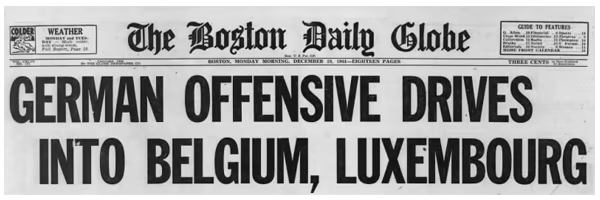
On 16 December 1944, under appalling weather conditions, the Germans launch their last major offensive in the West. Their goal: cut off the Allies from their sources of supply by taking Antwerp. To do so, they must break through the Ardennes salient, starting the battle of the Bulge…
Modeled estimate, not a reported figure. How we estimate →
About

SGS Battle of the Bulge is a game simulating the great World War II battle fought between the German army and the Allied forces - mainly American - in the months of December 1944 to January 1945. It covers the great German counter-offensive “Wacht am Rhein” (Guard on the Rhine), later renamed Herbstnebel (“Autumn Mist”), which began on December 16, as well as the Allied counter-offensive which began around Christmas and continued throughout January.

As the German player, you have at your disposal the 5th and 6th Panzer armies, as well as the 7th Army, i.e. over twenty divisions, reinforced to the maximum of the German war economy and human reserves at the time. Your objective is to launch a vast surprise offensive, breaking through the thin American defensive lines in the Ardennes to seize key positions along the Meuse as quickly as possible, destroying as many Allied forces as possible before your meagre supply stocks run out. A real race against time! Such a result would already represent a major feat, destabilizing Allied plans in the West for several months to come. The final phase of Hitler's plan to capture the port of Antwerp appears totally unrealistic and is not represented in the game. Only the forces actually engaged in the battle are represented. The 15th Army covering the German right wing, as well as the American and British forces deployed in Holland and in the Aachen sector being represented only in the abstract.
As an Allied player, your initial forces are meagre (essentially the four divisions of VIII Corps of General Bradley's 1st Army scattered over a 120-kilometer front), but reinforcements will soon arrive from everywhere, notably Patton's 3rd Army and the reinforced British XXX Corps sent by Montgomery. You must resist the initial German onslaught and delay its advance as long as possible while you gather your ground and air forces. Then you can move on to the counter-attack. The final objective of the campaign is to recapture all the lost ground and return to the initial situation, or even, if possible, to drive a wedge into the fortified line of the Westwall defending the Reich's western borders to achieve a major victory.
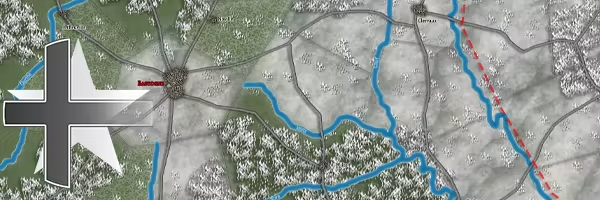
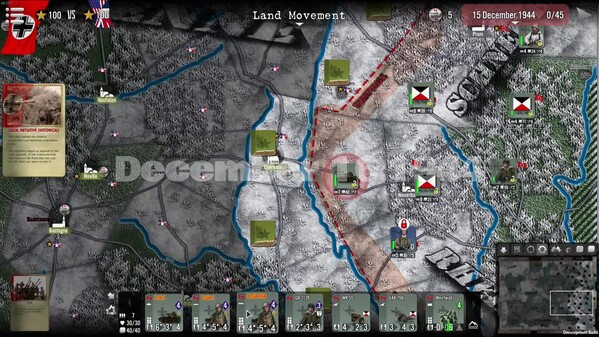
The heart of the game is represented by the complete “Battle of the Bulge” campaign, which, on the scale of one day per turn, is spread over 45 turns, from December 16, 1944 to January 30, 1945, with turn 0 representing the night of the 15th to the 16th, allowing certain operational decisions to be taken and simulating the surprise effect of the German offensive. Other scenarios are already planned to vary situations and game times. Some will be implemented directly on release, others in future free updates. These include
Wacht am Rhein: free alternative campaign (45 turns), with freer placement of initial forces and the absence of the initiative gauge. For a wargamer's challenge stripped of certain special rules and allowing for a wide variety of situations.
The Siegfried Line: 2nd phase of the Battle of the Bulge (30 turns). This campaign scenario covers the Allied counter-offensive in January to regain lost ground up to the Westwall defenses, nicknamed the “Siegfried Line” since 1939.
Herbstnebel: shortened campaign (16 turns) covering the German offensive phase only (December 16-31). In reality, this phase ends when the German “momentum”, represented in the game by an initiative gauge, is broken (historically around December 25, 1944, i.e. around ten game turns).
Objective Liège: short scenario (10 turns) centered on the 6th Panzer Army's sole offensive on Monschau and the Elsenborn heights, as well as the failed breakthrough attempt by Kampfgruppe Peiper (responsible for several massacres of American prisoners and Belgian civilians, notably at Baugnez and La Gleize) on the Amblève river.
Nuts! The Siege of Bastogne (8 turns): scenario covering General McAuliffe's resistance around the town of Bastogne, encircled by three German divisions, until the position was cleared by the arrival of Patton's armored troops (December 20-27).
Game units are represented at regimental or equivalent level (brigade, group, Combat Command...), with some variations according to country and troop type. Command units are at corps level, and there are also a number of specialized battalions (heavy armor, reconnaissance, engineers, etc.), garrison and defense units. Air forces, essentially fighters and fighter-bombers (operating directly on the battlefield, while bombers generally operate at much greater depth), are represented on the scale of the British Wing, the American Group or the German squadron (Geschwader), with a variable number of aircraft ranging from 50 to 150.
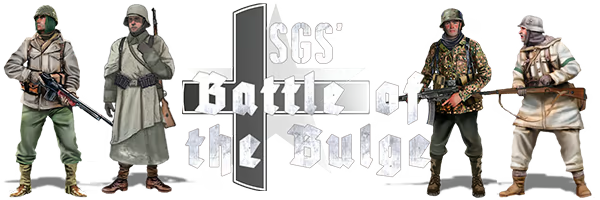
It should be noted that, in the spirit of the game, a unit engaged on the map never represents the totality of its forces, but simulates a series of missions and sorties in a given zone. Similarly, ground units never actually attack “en bloc” on the ground, but more often than not via one or more local sub-groups deploying combined assets and support elements.
From 1 or 2 hours for the shortest scenarios, much more for the longest campaign, if the player takes the time to observe the situation, plan his operations properly and articulate his forces (stacking rules, in particular, can cause severe and unexpected bottlenecks, and thus prevent your best units from fighting as you had planned, for lack of space to do so. Conversely, a neglected “hole” in your front line can have disastrous consequences. In short, simple “pawn-pushing” is particularly inadvisable if you hope to win, on either side.)
Neither side is favored, and both have solid forces and are equally interesting to play, albeit at a different tempo.
The German player has most of his trump cards in hand at the start of the battle, and some, like his heavy armor, are particularly powerful. He also has a few surprises in store as the game progresses, and must make the most of them to outflank the American forces whenever possible, or find himself pinned down and outflanked with deadly threats on his flanks.
The Allied player is rather weak at the start, but can afford to give ground and can be sure of numerous reinforcements in the future, as well as powerful air support as soon as the (more or less random) good weather returns. However, the Luftwaffe, although outclassed, still represents a threat not to be overlooked. Similarly, certain communication nodes whose collapse would be too advantageous to the Germans, and which would be difficult and costly to recapture, must be defended with the utmost energy. They could be the key to the whole battle.
Who said Bastogne?
Genres
Stats
All-time low is the lowest price we've recorded for this game since we started tracking it.
Languages: English, French, Italian, German, Spanish - Spain, Simplified Chinese, Polish, Portuguese - Portugal, Russian
Reviews
I enjoy the SGS game series. Battle of the Bulge is another solid addition to the series with fantastic artwork. I posted on discord that I can spend an hour just looking at all the units, the artwork is that good. The game is released with a full campaign scenario, a short "Nuts" scenario which is great for learning the game, and two intermediate scenarios. A what if scenario "Wacht am Rhine" giving the Germans more flexibility, and several other scenarios will be added for free in the future. For me, the SGS games provide a scale that allows me to finish games in a reasonable amount of time. The introductory scenario took about 30 minutes, the short campaign about 3 hours. The two scenarios were fun and I look forward to playing all the scenarios from both sides. As a mainly solo player I find the ai capable and definitely good for learning the game. Others say the SGS games shine in PBEM matches. In the interest of fair disclosure, the SGS game system is unique and takes some learning to understand the UI. Time well spent, in my opinion. You can become frustrated if you expect to jump in without reading the rules and again, my opinion, watching a few tutorial videos and or YouTubes.
我说一件事: 这个游戏和视频中的表现,以及描述文本中写的“每回合一天”完全不一样,实际游戏里一回合代表现实2天(但不知为什么算子数据竟然没改),和我的预期完全不一致; 部分桥梁(Wiltz附近的)失效; 因为步兵只打一轮,装甲也只打两轮,并且地面战骰子是d20,地面战非常看运气,一堆VG如果吃的修正多,冲不下来一个没人的壕是常事; 盟军补员非常多,大剧本后面基本随意就能补满了,并且被打死的单位竟然抽到卡就能重建(点名106inf的两个团),这几天怎么重建出来的,返德者是吧; 现在剧本的一些设计,比如大概率t1刷巴斯托涅的101abn,感觉强制让玩家按历史走; 部分地图外box花费1mp就能走到边缘格入场,给了ax巨大的北边缘防守压力; 综上,不推荐
Media

Related
Related
Price dynamics, follower growth, revenue and sales trajectories with interactive tooltips
This and every other Pro feature is free until October 20, 2026. A free account is all it takes.
A very good scenario for the new SGS engine to shine in! I have really enjoyed my time with this game and you can check the full review here https://youtu.be/nt__rNYHyMQ?si=vXp2-zsSFUs6T1Pj
Interesting design of one of the most popular battles for wargames; I particularly like the combat system in the SGS series and using cards adds a bit of chance that can swing a battle one way or the other. This keeps the game exciting, especially in big battles where multiple cards can be played. No two games play exactly the same, which increases replayability.
打完发现元首胆子是真的大
wanted to like this but what a ♥♥♥♥ show.. so many things untold and unclear, and missing undo buttons.. when i gave a unit a move order it ended up in an infinite animation loop and i decided that was enough waste of my time
Not for me.
Rarement vu un jeu de stratégie avec offrant une expérience aussi déplorable. Les interfaces utilisateurs datent de l'époque. Incroyable. Impossible de me le faire rembourser par Steam. Passez votre chemin.
If you like other SGS WWII or similar titles, like SGS Downfall, Korean War, or Avalanche you will probably enjoy playing this one through. Overall, it has similar mechanics to those games, and the combination of random weather dynamics and Axis cards adds some reasonable replayability. That said, the attempt to represent army and corps areas of responsibility by limiting unit movement is at once both clever, and frustratingly poorly executed, as well as opaque to the player. Additionally, the campaign options and length advertised on the store page do not match what is actually playable in game. [b]The Positives:[/b] Similar mechanics to other SGS titles. If you have played one before, you will pick this one up quickly. Random weather and card selections allow for variability over the initial turns and ensures differences from one play through to the next. Quick turns, it's one of the faster paced titles. Partly because the entire air turn is sometimes eliminated by weather. [b]The Negatives:[/b] The game attempts to add semi-realistic army and corps areas of responsibility to represent command and control limitations, and enforces them by limiting unit movement to regions in their respective areas of operations. This is a nice concept, and one that is rarely represented in operational level wargames. It does prevent the player from simply grouping all of their best units at will, and it forces more realistic planning constraints. However, these army and corps boundaries are not shown on the map, or to the player in any way, nor are the command hierarchies shown between units. So, as the player you really just have to know that the US First Army area is roughly north of Houfalize, and that US Third Army is south of that line. This can create some awkward situations as you deal with a German thrust along the army boundaries. On one hand, operational boundaries are often weak points, where different formations meet and may fail to cohesively interoperate, so this can be realistic. But from a gameplay perspective this leaves you with a frustrating inability to easily know which units will be able to enter which regions as you withdraw in front of an emerging thrust, or attempt to cutoff a salient. Resulting in situations where you have plenty of force in a general area, but they cannot be committed to the actual point of pressure, or into a specific tactical geography to cutoff an enemy force. Even more frustrating, this concept is carried down to the corps level. For example, having successfully penetrated the Westwall with combined elements of US 4 ID and 11 AD (Third Army) at Diekirch you may now wish to turn north and seize the town of Neuerburg, only to find that the full stack cannot make that move. At which point you will recall that 4 ID is XII corps, while 11 AD is VIII corps, and their areas diverge here. This results in the need for a great deal of trial and error, testing where each unit in a stack can move, and or requires the player to have an encyclopedic knowledge of force structures and areas of responsibility for this battle. You may actually want to keep an online historical tactical map handy to tab out to when planning. Realistically, this frustration would have been reduced if the game showed the areas of responsibility in some graphical way, and likely could have been solved by the addition of a tactical card allowing some selected units to leave their assigned zone for X turns (representing temporary attachment to a tactical command) which would solve the 4 ID – 11 AD example. This could have actually been an interesting mechanic, but as designed it just ends up being frustrating to play with. [b]The Store Page:[/b] One of my greatest critiques is that what is promised on the store page, and to a lesser extend in the manual, is not really what is delivered in game. The store page lists 6 scenarios, including a 45 turn historical Battle of the Bulge campaign. However, the actual Bulge campaign in game is 23 turns long, while covering the same dates. Evidently because the turn scale was changed, but the description was never updated, so comparing to other SGS titles this will be a shorter game than you might expect from the description. Second, and more importantly, the store page and manual describe an alternative Bulge campaign with freer initial force deployment, and relaxed special rules, like the operational areas for units and an alternative German battle plan. After you play the historical Bulge scenario you will likely want to try your hand at this what-if alternative. Unfortunately, it is not one of the 4 scenarios actually included in the playable game. The in-game scenario information mentions that this scenario is a planned addition, but it does not appear to have ever been released, which is quite disappointing.
我心目中前三的sgs作品 作为进攻方,西墙判定-3是不是太高了,对面放几个单位协助防守根本就打不下来,基本就是7-8点才能换掉德国一点点西墙墙皮,或者是像前作一样加入远程火炮来变相增强一下?毕竟工兵火炮和装甲师全力压上好几回合打不下一段墙太难蚌了 希望增强下两边的ai,我突出部反攻开局两侧包围之后德国人几乎完全不会主动突围,有点太憨了,美国ai一动不动往比利时塞一坨单位,不管前线在哪都不动,我咋突然胜利啊( 而且,被我包围因补给不足被消灭的敌人居然不算入我的分数? 顺便提一句,小bug太多了,在空中掩护的时候经常卡住,有次两个编队的奶瓶,动画卡住了在天上飞来飞去
Related
| Game | Estimated lifetime revenue | Reviews | Review score | Price |
|---|---|---|---|---|
| $7K | 55 | 78% | $5.99 | |
| $7K | 57 | 81% | $4.99 | |
| $7K | 218 | 74% | $1.99 | |
| $7K | 87 | 28% | $4.99 | |
| $7K | 430 | 84% | $0.79 | |
| $7K | 102 | 98% | $2.99 |
Related
| Game | Estimated lifetime revenue | Reviews | Review score | Price |
|---|---|---|---|---|
| $36.3K | 93 | 88% | $19.99 | |
| $234.2K | 231 | 82% | $39.99 | |
| $205.5K |
| 371 |
| 85% |
| $19.99 |
| $129.4K | 231 | 78% | $29.99 |
| $77K | 186 | 90% | $14.99 |
| $69.2K | 86 | 77% | $29.99 |