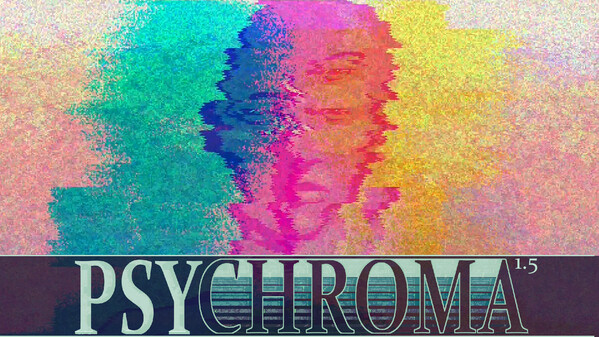
Psychroma is a psychological horror side-scroller set in a haunted cyberpunk house. Collect cards and explore the memories stored on them to piece together your past. But the deeper you go, the more you expose yourself to the brightest heat, the warmest color...
Modeled estimate, not a reported figure. How we estimate →
Discounts
Every price cut of more than 20% we have observed, in each market that quoted one, with this game's chart position on either side of it. These are episodes, not a model: a sale is one event, and one event cannot tell you what the next one will do.
Reviews, worldwide (the counter carries no country): 0/day in the week to Aug 4 → 0.29/day in the week after.
For scale, across Steam · Top Sellers · Brazil over the last 30 days: the 26 chart moves that followed a price cut of more than 20% went a median of 7 places towards #1, and the 2,400 moves with no price cut behind them went 2 away. One store, one chart, one country — it is the only place we have enough observations to say even that.
Prices outside the United States have been collected since 6 August 2026 and chart positions since 19 July 2026, so a cut older than that has no market to compare and a market that joined later has no history yet. Nothing here is converted between currencies.
About
Psychroma is a psychological horror side-scroller set in a haunted cyberpunk house. Collect cards and explore the memories stored on them to piece together your past. But the deeper you go, the more you expose yourself to the brightest heat, the warmest color...

/INVESTIGATE A HAUNTED CYBERPUNK HOUSE
Discover the hidden corridors and uncover the sordid past of a house out of time and place within a futuristic cyberpunk city
/COLLECT CARDS
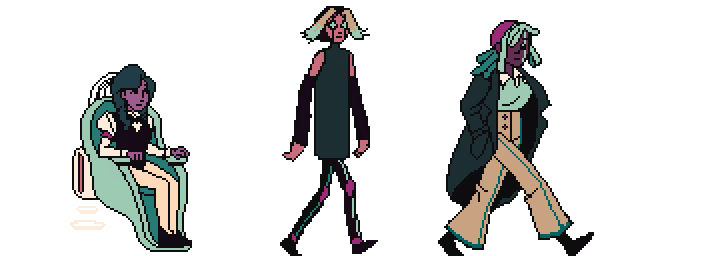
Collect the memory cards of three main characters, An underground cultist, an ambitious philanthropist, and a drifter. Explore their realities to help piece together your own fractured memory.
/FIGHT THE TERROR OF THE PAST.
Hidden deep within the memories something watches you. Not every part of yourself is easy to face.
/THE YEAR IS 2489.
Acid rain rots away exposed rebar in the half-developed megacity once known as Toronto. Humanity modifies itself at a frequency never seen before. One lone house remains amongst a towering landscape. A house with an inescapable past, as a group of outcasts try their best to turn it into a home.
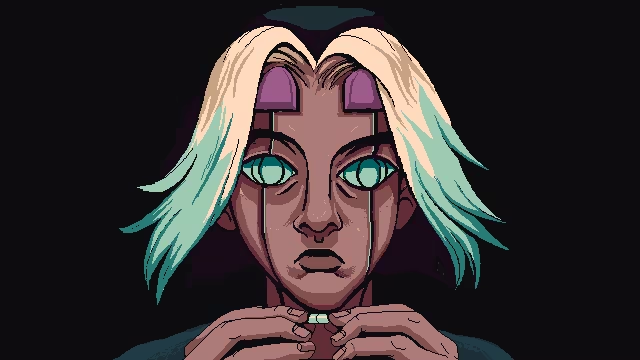
You are Haze, one of those outcasts. You've woken up without any memory of who, or where you are. The only clues you have are a memory card with your name on it and a vision of a color that haunts you.
Something about the house is wrong... The past can't be contained here... You'll have to face it.
TIME JUMPING
Use a cybernetic memory card system to navigate through time.
Gain the perspective of others' stored memories.
Gain access to new parts of the house.
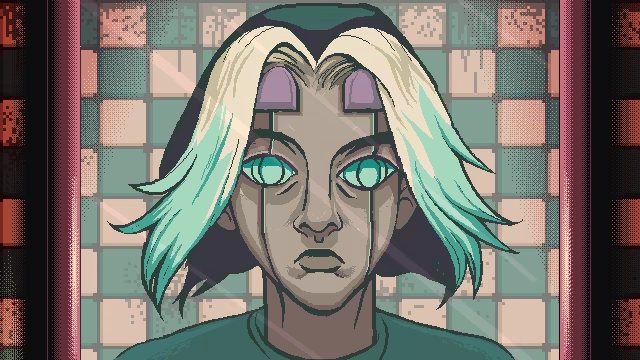
CYBER POSSESSION
Allow the digital ghosts of the past to possess your body in order to descramble memories, solve puzzles, and see through their perspectives.
INTERACTABLE SCREENS
Enter Haze's perspective and interact with horrifying tableaus. Pull levers, activate altars, search for hidden objects, and more.
INTRICATE PIXEL ART
An art style that takes inspiration from the limited color palettes of the past and cyberpunk works of art like Akira, Blade Runner and Ghost in The Shell.
CHILLING ORIGINAL SOUNDTRACK
An experimental soundtrack steeped in the influences of classic horror and cyberpunk films.
Add-ons
Each DLC is estimated with the same model as a game, then summed — a modeled figure, not reported DLC sales.
Engagement
Reviews
Themes across 55 recent reviews and how positive each mention is. A keyword signal, not full sentiment analysis.
Reviews
a truly phenomenal game that won't take up too much of your time, it tells a intriguing and visually stunning story of queer love and the fragility of memories (among other themes too). it can be easy to get stuck at certain points in the game and admittedly the story took me a couple play throughs to really reveal itself in full, but imo it's *so* worth the time. really hope we see more stuff like this from the devs!
半價(或四折?)入手,恐怖詭譎的氣氛不錯,解迷容易但長度短。 因為要到處穿梭別人的回憶所以劇情有點混亂,但整體上來說可以。 本作其實算普通,血腥恐怖的味道不夠重,但詭異的時候確實夠詭異,及格。
Nice and short. Not too scary but all the way unsettling (Which is better for me) That kind of game only takes 3h to complete but you can still talk about it another 3h afterwards.
Media

Related
Related
Price dynamics, follower growth, revenue and sales trajectories with interactive tooltips
This and every other Pro feature is free until October 20, 2026. A free account is all it takes.
Genres
Stats
All-time low is the lowest price we've recorded for this game since we started tracking it.
Languages: English*, Portuguese - Brazil*, French*, Italian*, German*, Spanish - Spain*, Dutch*, Greek*, Hungarian*, Korean*, Portuguese - Portugal*, Russian* +5 more
Hours played at review time, across 56 reviews with recorded playtime.
positive critical· bar length = how often the theme comes up
Its just so peak words cant do it justice
세일할때 한번 사서 나쁘지 않게 함. 퍼즐이라기엔 조금 애매한 느낌도 있는데 그럭저럭 잘 나아감 스토리가 은근 난해하면서도 재밌었음.
Psychroma is a compact but ambitious psychological horror adventure that blends cyberpunk science fiction, supernatural unease, and deeply personal themes surrounding memory and identity. Developed by Rocket Adrift and published by Gamma Space Collaborative Studio, the game places storytelling above action, building its experience around exploration, environmental puzzles, fragmented memories, and unsettling discoveries. Rather than treating its futuristic setting as simple visual decoration, Psychroma uses technology as part of its central mystery, asking what remains of a person when memories can be recorded, manipulated, entered, and experienced by someone else. The story takes place in 2489 within the remains of a partially developed megacity that was once Toronto. Acid rain and deteriorating infrastructure create a bleak backdrop for a society in which extensive technological modification has become commonplace. Despite the enormous scale implied by this future city, the narrative focuses primarily on a mysterious house inhabited by people living on the margins of society. This smaller setting gives the story an intimate quality. The house gradually becomes more than a physical location, functioning as a repository for memories, secrets, trauma, and events that refuse to remain buried. At the center of the story is Haze, who awakens without knowing who they are or how they arrived at the house. Their few clues include a memory card carrying their name and a disturbing vision connected to a particular color. Amnesia is a familiar narrative device, but Psychroma integrates it effectively into its gameplay instead of using it merely to conceal information from the player. Haze's missing memories become the reason to investigate the environment, while every new discovery has the potential to reshape the player's understanding of both the protagonist and the people connected to the house. Memory cards form one of the game's most distinctive systems. Haze can discover cards belonging to several important individuals and enter the memories stored within them. These sequences allow events to be experienced from perspectives other than Haze's own, revealing different pieces of the mystery while changing how familiar places are understood. The game consequently avoids presenting its narrative as a straightforward timeline. Past and present overlap, and the player gradually reconstructs events by comparing information obtained from different viewpoints. Memories can even provide access to locations that could not previously be reached, making narrative discovery directly relevant to progression. Psychroma expands this concept through cyber possession, in which digital remnants of people from the past can temporarily inhabit Haze. This mechanic allows memories to be descrambled and situations to be viewed through another person's perspective. It also creates one of the game's most interesting thematic ideas: technology and haunting have become almost indistinguishable. A digitally preserved consciousness can behave like a ghost, while accessing another person's memories resembles supernatural possession. The game deliberately keeps the boundaries uncertain, creating horror from the possibility that technology capable of preserving human experience may also preserve the suffering attached to it. The actual gameplay is deliberately restrained. Players explore rooms, investigate objects, search for concealed passages, manipulate mechanisms, activate unusual devices, and solve environmental puzzles. Interactive close-up sequences occasionally provide more detailed manipulation of screens and other objects. There is little emphasis on traditional combat, elaborate character progression, or constant physical danger. Psychroma instead expects players to pay attention to environments, dialogue, visual details, and narrative clues. This slower approach suits the mystery, although anyone looking for an action-oriented horror experience may find the mechanical systems comparatively limited. The house is particularly effective as a horror environment because its meaning constantly changes. A seemingly ordinary room can become disturbing once the player understands what happened there in another period. Revisiting spaces through different memories creates the sensation that multiple versions of the same building coexist. Hidden corridors and previously inaccessible locations strengthen the impression that the house contains more history than its visible architecture initially suggests. There is also a threatening presence connected to the memories Haze explores, ensuring that uncovering the past never feels completely safe. Visually, Psychroma uses pixel art and restricted color palettes to establish an unusual atmosphere. The developers draw inspiration from limited historical palettes as well as influential cyberpunk works such as Akira, Blade Runner, and Ghost in the Shell. The result is not an attempt to reproduce the polished neon spectacle commonly associated with cyberpunk. Instead, the limited colors make the environments feel distorted, artificial, and occasionally dreamlike. This approach works especially well because color itself has narrative significance through Haze's recurring visions. Sound and music further support the atmosphere with an experimental approach influenced by horror and cyberpunk cinema. Since much of the game involves careful exploration rather than constant action, audio carries considerable responsibility for maintaining tension. The soundtrack and environmental sounds help make quiet spaces uncomfortable without requiring frequent jump scares. The game also contains mature material, including strong language, violence, frightening imagery, body horror, tobacco use, and emotionally difficult subject matter. These elements are generally used to reinforce the disturbing themes rather than simply provide shock value. Psychroma's greatest potential weakness is also a consequence of its strongest creative decision. Because narrative takes priority over mechanical complexity, players who prefer extensive combat systems, large environments, or complicated progression may consider it too limited. Its fragmented chronology can also require concentration, especially as identities, memories, and perspectives begin overlapping. The story does not always provide immediate explanations, and some satisfaction comes from personally assembling its scattered information. For players willing to engage with that structure, however, the confusion becomes part of the intended experience rather than simply an obstacle. Rocket Adrift has created a focused horror adventure that understands how effectively science fiction can be used to explore personal fears. With Gamma Space Collaborative Studio serving as publisher, Psychroma stands out through its combination of cyberpunk imagery, queer characters, digital consciousness, body horror, memory manipulation, and haunted-house storytelling. Its relatively modest gameplay systems prevent it from appealing equally to every horror fan, but its strong atmosphere, distinctive visual identity, clever memory mechanics, and thoughtfully constructed mystery make it worthwhile for players who enjoy narrative-heavy experiences. Psychroma is less interested in making the player fight monsters than in asking whether confronting forgotten pieces of yourself might be more frightening than any creature waiting in the darkness. Rating: 8/10
A deliberately opaque mix of cyberpunk and cosmic horror, with a a healthy serving of queer themes and claustrophobic side-scrolling. If that sounds like you're kind of thing, you owe it to yourself to buy this.
thumbs up
A fascinating and beautifully rendered little mystery. I was able to finish it in one sitting.
Players by region
Where this game's players are, estimated from review languages.
Players also reviewed
The games this title's players most often review too — audience affinity.
Related
| Game | Estimated lifetime revenue | Reviews | Review score | Price |
|---|---|---|---|---|
| $337 | 7 | 86% | $2.99 | |
| — | 0 | — | — | |
| — | 0 | — | — | |
| $1.3M | 5.1K | 85% | $16.99 | |
| $327K | 986 | 87% | $14.99 | |
| $13K | 144 | 90% | $6.99 |
Related
| Game | Estimated lifetime revenue | Reviews | Review score | Price |
|---|---|---|---|---|
| $34.5K | 119 | 36% | $14.99 | |
| $34.5K | 67 | 79% | $19.99 | |
| $34.5K | 55 | 75% | $39.99 | |
| $34.5K | 81 | 72% | $18.99 | |
| $34.6K | 72 | 97% | $14.99 | |
| $34.6K | 62 | 94% | $16.99 |