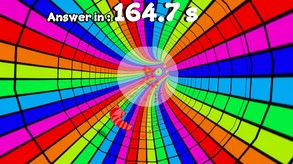
Psychocat: The Answer is a compact but cleverly constructed arcade experience developed and published by Chewa. Released in 2016, it represents the kind of focused indie design philosophy that builds an entire game around a single, sharply defined mechanic and then refines it into something deceptively demanding. At first glance, the premise appears almost minimalistic: guide a small cat named Zag through a vibrant, twisting tunnel filled with obstacles and survive long enough to uncover “the Answer.” Yet beneath that straightforward setup lies a game that constantly destabilizes the player’s instincts, turning reflex-based gameplay into a test of cognitive flexibility and mental endurance.
The central mechanic of Psychocat: The Answer revolves around control inversion. As Zag moves forward through the tunnel, he passes through colored zones that flip or alter directional inputs. What initially feels like a standard left-and-right dodging challenge quickly evolves into something far more disorienting. Forward may become backward; left might suddenly send you right. The game cleverly signals these changes through visual cues and Zag’s shifting colors, but in the heat of the moment—amid flashing lights and increasing speed—those cues can be difficult to process. The result is an experience that demands not only quick reflexes but also rapid mental recalibration. Muscle memory becomes unreliable, and players must consciously override instinct to adapt to constantly changing rules.
Structurally, the game is intentionally lean. There are no sprawling campaigns or multiple elaborate modes. Instead, Psychocat: The Answer centers on a survival challenge, typically framed around lasting a specific duration—most notably the 180-second benchmark that serves as a psychological milestone for players. Tutorials introduce the fundamental mechanics, ensuring that newcomers understand the inversion concept before being thrown into full-speed runs. Beyond that, the design philosophy is straightforward: survive, adapt, and improve. The game’s minimalism works to its advantage, stripping away distractions and focusing entirely on the purity of its arcade challenge.
Visually, the game embraces a psychedelic aesthetic that complements its destabilizing gameplay. Bright neon colors, rapidly shifting patterns, and a sense of constant forward motion create an almost hypnotic effect. The tunnel’s visual design reinforces the feeling of disorientation, amplifying the impact of sudden control changes. While the graphics are not technologically advanced, they are stylistically coherent and serve the gameplay purpose effectively. Sound design follows a similar philosophy—energetic and rhythmic, helping maintain intensity without overwhelming the player. Together, these elements create a cohesive audiovisual identity that enhances immersion despite the game’s simple presentation.
One of the most interesting aspects of Psychocat: The Answer is how it transforms frustration into motivation. Early runs can feel chaotic and unfair, especially when control inversions stack with visual overload. However, the game is meticulously consistent in its rules. Every failure can be traced back to a missed cue or a momentary lapse in adaptation. As players begin to internalize patterns and anticipate changes, a satisfying rhythm emerges. Success feels earned because it stems from mastering one’s own reactions rather than exploiting complex mechanics or upgrades. This emphasis on skill and adaptation gives the game a replayable quality that belies its compact scope.
Achievements and incremental milestones further reinforce progression. Although there are no RPG elements or unlockable power-ups, the simple act of surviving longer each time becomes its own reward. The pursuit of perfection—lasting the full duration without mistakes—creates a compelling loop. In many ways, the game captures the essence of classic arcade philosophy: easy to learn, brutally challenging to master, and deeply satisfying when conquered. It invites players to return repeatedly, shaving seconds off their previous failures and refining their response time.
Community reception over the years has been notably positive, with many players praising the game’s originality and tight execution. Its low price point and cross-platform availability make it accessible, while its focused design ensures that it does not overstay its welcome. Some critics have noted that its simplicity may limit long-term appeal for players seeking variety or narrative depth. Yet that very simplicity is part of its identity. Psychocat: The Answer does not attempt to be a sprawling epic; it is an arcade experiment built around a single brilliant idea, executed with clarity and confidence.
Ultimately, Psychocat: The Answer stands as an example of how a small indie project can leave a lasting impression through smart mechanical design. By centering its gameplay around the inversion of player expectations, it turns a straightforward survival challenge into a mentally engaging experience. It may not offer expansive content or cinematic storytelling, but for players who appreciate reflex-driven arcade tests infused with psychological twists, it provides a sharp, memorable, and rewarding ride through its neon tunnel of chaos.
Rating: 7/10