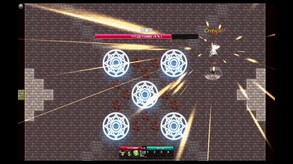
Phanotia: Interlude I-Aubzan Abbey is a compact action RPG developed and published by YUGKON UNION, offering a side story within the larger Phanotia universe. Released as a free-to-play title, it is closely connected to Phanotia I: Escavive and takes place roughly two years before events associated with that game. Instead of attempting to tell a massive standalone adventure, Aubzan Abbey concentrates on a specific mission involving Connecticut, Celine, and Allea while using their journey to reveal more about the political conflicts, social problems, and hidden organizations operating throughout its fantasy world.
The adventure begins while the mobile fortress Oslou is undergoing maintenance in the Fraensius Empire. During this period, Princess Biana sends Connecticut, Celine, and Allea on a foreign-aid mission to Aubzan Abbey. Their objective is to rescue imprisoned Vampir women who are being exploited for the benefit of influential nobles. What initially resembles a relatively straightforward intervention soon develops into a broader investigation, with the protagonists discovering indications that the abuse surrounding the abbey may be connected to a larger criminal network. This progression gives the story a sense of mystery beyond the immediate rescue operation.
Aubzan Abbey deals with considerably darker subject matter than its colorful pixel graphics might suggest. The background of the story includes references to forced prostitution and exploitation, although these subjects are treated as narrative circumstances rather than material intended for explicit presentation. Sexual acts and extreme violence are not directly depicted. This allows the game to address the cruelty surrounding its characters while keeping the actual presentation relatively restrained. The contrast between a traditional fantasy RPG appearance and a story involving corruption and abuse also gives the interlude a more serious atmosphere than players might initially expect.
Connecticut serves as the playable protagonist, accompanied by Celine and Allea. Their involvement helps connect this smaller adventure with the wider mythology of Phanotia. References to Princess Biana, the Fraensius Empire, the Vampir population, Oslou, and the political influence of the nobility suggest that YUGKON UNION has constructed a setting considerably larger than the locations explored during this particular installment. Players already familiar with the series are therefore likely to recognize more of the significance behind its characters and events, while newcomers can treat the game as an introduction to the setting.
Gameplay follows a pixel-based action RPG structure combining exploration, combat, adventure elements, and story progression. Its presentation is deliberately modest, so expectations should be adjusted accordingly. Aubzan Abbey is not trying to compete with large-scale commercial RPGs through elaborate 3D environments or enormous interconnected regions. Its appeal instead comes from concentrating its resources on straightforward action, level progression, narrative encounters, and character interactions. The relatively simple format can work well for an interlude because it keeps the experience focused on the mission rather than overwhelming it with unnecessary systems.
The character artwork is another notable aspect of the presentation. While normal gameplay relies heavily on pixel graphics, more detailed illustrations help establish the appearance and personalities of important characters. This combination gives the game an anime-influenced identity while allowing its environments and combat encounters to remain technically lightweight. The visual approach may not impress players searching for cutting-edge graphical technology, but it suits a small independent RPG and provides enough distinction to prevent the world from feeling completely generic.
One of the game's more significant disadvantages is its language accessibility. The Steam release supports Simplified Chinese for its interface and subtitles, while English is not officially supported. This matters more here than it would in an arcade-oriented action game because Aubzan Abbey places substantial importance on its characters, story, political background, and connections with the larger Phanotia universe. Players who cannot comfortably understand the supported language may miss much of the context surrounding the mission and its characters, substantially reducing the value of the narrative.
Its technical accessibility is considerably better. The game has very modest hardware requirements, including an older Intel i3-class processor, a small amount of memory, integrated graphics comparable to Intel HD 4000, and approximately 1 GB of storage. This makes Aubzan Abbey suitable for lower-end Windows computers and older systems. Such modest requirements are consistent with its pixel-art design and demonstrate that visual complexity is not the project's primary concern. It is also designed as a single-player experience, allowing the story and progression to remain entirely focused on the player's journey.
Being free-to-play makes the game easier to recommend to players curious about YUGKON UNION's work. There is little financial risk in trying it, and the interlude provides an opportunity to sample the developer's approach to combat, storytelling, character design, and world-building. The free format also makes sense for something positioned as a companion story rather than a huge independent chapter. Players interested in Phanotia can use Aubzan Abbey as another piece of its expanding fictional history, while newcomers can determine whether the broader setting appeals to them.
The strongest quality of Phanotia: Interlude I-Aubzan Abbey is ultimately its willingness to place a relatively serious story inside a small-scale indie action RPG. The rescue of exploited Vampir women, the involvement of powerful nobles, and the suggestion of an organized network behind the situation provide the narrative with greater stakes than a routine dungeon expedition. At the same time, references to empires, political figures, recurring characters, and mobile fortresses suggest that the events at Aubzan Abbey represent only one small incident within a much larger world.
Its limitations remain clear. The production is modest, the scope is relatively narrow, and the lack of official English support significantly restricts its accessibility. Players entering without any familiarity with Phanotia may also find some of its terminology and character relationships less meaningful than established followers will. Nevertheless, the free admission, lightweight system requirements, distinctive pixel presentation, character illustrations, action RPG framework, and surprisingly serious narrative make it an interesting companion piece for anyone willing to engage with its world.
Phanotia: Interlude I-Aubzan Abbey succeeds best as an expansion of YUGKON UNION's developing universe rather than as a grand standalone RPG. It offers a focused mission with darker themes, straightforward action, recognizable character artwork, and enough hints about the wider setting to encourage curiosity about other Phanotia stories. While its language barrier and modest scale prevent it from achieving broader appeal, its narrative ambition and accessible free-to-play format make it worthwhile for its intended audience.
Rating: 7/10