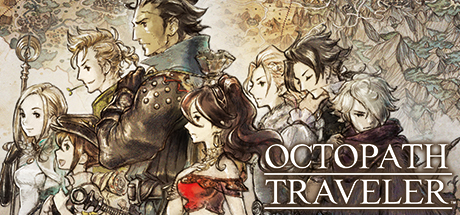
[h2]An incredible JRPG that excels through flexible progression, a masterful iteration of a Final Fantasy-esque job system, and fantastic combat mechanics. While its story and writing can be a bit lukewarm at times, it offers an amazing adventure and thoroughly challenging bosses.[/h2]
[h3]Story and Setting[/h3]
Octopath Traveler features a very unique story structure. Unlike most JRPGs, players choose one of eight titular Travelers to begin their adventure and can recruit the others in any order that they wish (or not at all). Each of the characters features four unique chapters to their own unique story before all culminate in a single postgame finale.
This story structure is a bit reminiscent of SaGa games and supports the general open structure of being able to tackle any story in the order that they wish, be that focusing on a single character to their conclusion or each simultaneously, though a byproduct is that each chapter feels a bit formulaic in the sense that they are all following the same build-up: Gathering information about the character’s current goal in a town, entering a dungeon, and defeating the chapter boss. This can be a bit tiresome, and each is short enough that it can be difficult at times to stay immersed in that specific story.
https://steamcommunity.com/sharedfiles/filedetails/?id=3755099931
Another aspect is that, of course, each character can be a bit hit or miss depending on whether the player is specifically interested in that story arc, as there are only hints of the overarching threat to the world until the very end of the game. For instance, I strongly enjoyed Primrose’s story, whom I happened to choose as my starting character but who has comparatively little involvement within the greater scheme than, for example, Cyrus. Primrose’s story is personal: it is one of personal growth through a thoroughly miserable life culminating in a question of whether revenge is truly worth it, whereas Cyrus’ story leads him into uncovering extremely strong hints and connections to the true final boss of the game. This can make OT a bit of a slog for long stretches at a time and invites some story skipping of segments the player may not be interested in to the detriment of story cohesion. The overall quality of each character’s writing is also hampered by the comparatively short chapters, which simply do not allow any single one to develop in a way that other JRPGs would allow.
Another venue of character development is party banter, occasional prompts for very brief conversations between characters that are currently in your party. Regrettably, mechanics like these are either very involved and typically tie into deeper systems, for example, Fire Emblem’s Support systems, or are woefully undercooked with only barely offering some flavorful dialogue during otherwise dry gameplay sections, and OT firmly falls into the latter category.
Overall what remains is a somewhat formulaic JRPG story, tackling interesting themes with solid character concepts but also stumbling constantly along the way. My enjoyment of the story stood and fell solely on whether I felt invested in the core themes of each character, but I ended up missing a feeling of party cohesion and didn’t feel invested in the True Ending story once I unlocked it because of a lack of proper build-up. This fundamentally means that OT is a game with very high highs superceded by equally low lows, with its story strongly tied to whether you are also invested in its gameplay systems to actively want to challenge yourself after the conclusion of each character arc.
[h3]Gameplay[/h3]
OT is a job- and turn-based JRPG, meaning that each character comes with a base “class” they are locked into. For example, Primrose is locked to the Dancer, a support role, as per her backstory, and then unlocks the ability to choose a secondary job as the game progresses, which you can freely assign. This is a system that is directly tied to Final Fantasy, from which Octopath Traveler takes a lot of inspiration, and which I am a great fan of, as it allows for incredibly in-depth character and team-building.
This also ties into character progression. You do not only earn EXP per battle but also JP (“Job Points”), which allow you to unlock active and passive abilities that can then be freely slotted per character. The fact that characters are locked to a main job felt actually very beneficial to the overall feeling of party progression, as it made me think more deeply as to which job synergizes best with the character I had in mind: do I move Primrose deeper into her support role by giving her another buff/debuff job, or maybe use her as a primary healer, for instance?
On top of the job system, there are also both Path actions and Boost Mode to consider. Path actions are social abilities unique to each character. Taking Primrose as another example, she comes with the ability "Allure", which lets her attempt to recruit NPCs in town. Either to solve quests or to use them as Summons during combat. Tressa, your Merchant, comes with the ability to access any NPC’s inventory to buy personalized items from them. And Olberic, your Warrior, can challenge NPCs to combat to unlock guarded houses. This means that you want to also diversify your active party for exploratory gameplay rather than just combat effectiveness.
https://steamcommunity.com/sharedfiles/filedetails/?id=3753947343
Boost Mode, on the other hand, felt similar to Bravely Default’s titular Brave and Default mechanics, wherein each character has an extra resource available to them that they gain once per turn and which allows them to buff their abilities to a maximum of +4 for strong effects and which can turn the tide of the battle immediately.
This is all incredibly well-designed and is near the top of my favorite combat systems in this sphere of Final Fantasy-adjacent titles. However, OT also struggles a bit with balancing itself decently well. The game is insanely grindy and has some notorious difficulty spikes that will inevitably feel a bit frustrating as you progress. In addition to this, the game’s True Ending is, as mentioned, locked to a notoriously difficult postgame boss, which is also a choice that can lead to a bit of a sour experience, both in terms of gameplay due to the rather high difficulty and narratively, as the game’s ending is very abrupt and disappointing if you don’t pursue the True Ending.
[h3]Graphics and Sound[/h3]
OT kickstarted the trend of HD-2D Square Enix games, attempting to emulate retro graphics of the early Final Fantasy era (specifically I through VI) while evolving its graphical presentation through incredible spritework and graphical depth. I am personally a huge fan of this style, and it absolutely does manage to capture this very nostalgic feeling while also impressing with detail, especially when it comes to environments and boss designs.
https://steamcommunity.com/sharedfiles/filedetails/?id=3754414049
The soundtrack is also among the best I have heard from Square Enix, as should be expected. From combat tracks like [i]They Who Govern Reason[/i] to environmental music such as [i]Victors Hollow, Jewel of the Forest[/i], OT is consistently a joy to listen to.
[h3]Final Thoughts[/h3]
Octopath Traveler is a fantastic experience. While its story cannot keep up with most other contemporary Square Enix RPGs, it is nevertheless a refreshing way to present a more traditional JRPG adventure. And even if the overall title may not wow you in the same way that XVI or Bravely Default may, OT will still feature stories that resonate with you and that manage to keep you engaged throughout its runtime. The selling point, however, is the combat, is the depth of its progression systems, and is the challenge even if you are already familiar with other titles in the genre.