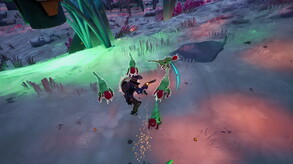
Grab your ragtag crew & take up the Nectar Raiding trade on a dangerous planet that’s become all the rage! In this PvPvE extraction game for 1-10 players, compete against enemy crews to harvest as much Nectar as possible before night falls. But watch out, you're not the only one roaming this planet!
Revenue comes from in-game items and microtransactions, which our price-based model doesn't estimate. The player count below is how many people own it, not what they spent.
About
Genres
Stats
Languages: English*, French*, Spanish - Latin America*languages with full audio support
Engagement
Reviews
Themes across 42 recent reviews and how positive each mention is. A keyword signal, not full sentiment analysis.
Reviews
it's not terrible, it's just... kinda boring. The enemies aren't particularly varied or interesting, the missions and maps are all just variations of the same idea, the weapons are basic and the gunplay doesn't feel very good, and overall the gameplay is just kinda... meh
Some games just suck
No Love Lost approaches the extraction genre with a lighter, more energetic personality than the grim military settings normally associated with this type of game. Developed and published by Ratloop Games Canada, it is a third-person PvPvE experience centered on short expeditions to the alien planet Drosera. Players compete for a valuable substance called Nectar while dealing with rival crews, dangerous wildlife, environmental threats, and the ever-present need to escape successfully. The concept is straightforward, but the colorful science-fiction setting, fast traversal, and relatively compact matches give the game an identity of its own. A major strength is the decision to structure expeditions around roughly fifteen-minute sessions. Extraction games can sometimes demand a considerable time investment before anything meaningful happens, whereas No Love Lost tries to get players into the action quickly. Once deployed, the objective is not simply to eliminate every opponent. Gathering Nectar, completing quests, surviving encounters, and determining when to retreat are equally important. This creates an enjoyable tension between greed and caution. Staying longer can produce better rewards, but every additional confrontation increases the possibility of losing progress. The PvPvE structure works particularly well when several dangers converge. Drosera is populated by hostile creatures, meaning another player is not necessarily the only threat during a firefight or objective. An encounter can quickly become unpredictable when alien wildlife enters the situation, forcing players to adapt rather than relying exclusively on conventional shooting tactics. Rival crews can also exploit these distractions, so situational awareness matters. The result is a game that can produce entertaining unscripted moments even when the basic objectives themselves are relatively simple. Traversal provides some of its most distinctive entertainment. Hoverboards and hoverbikes make moving across the alien landscapes considerably faster and more playful than simply running between objectives. The hoverboard in particular complements the game's arcade-like personality, turning transportation into an active part of the experience rather than empty travel time. Drosera's different biomes also benefit from this mobility because players can cover significant distances while searching for quests, resources, creatures, and rival teams. The colorful environments help reinforce the sense that this is an adventurous alien expedition rather than another bleak survival scenario. Nectar functions as an important component of the progression loop. Successful expeditions contribute toward improving and combining perks, encouraging players to experiment with different approaches rather than treating every match identically. There is still a meaningful penalty for failure because becoming stranded can temporarily remove acquired perks until a later successful extraction. It is a clever compromise between permanent progression and extraction-game risk. Failure matters, but it does not necessarily destroy hours of progress in a single disastrous encounter. Procedurally generated quest chains are intended to provide additional replay value. Changing objectives can alter where players travel and consequently influence which opponents or creatures they encounter. This works naturally with the competitive structure because different crews can become involved in the same areas for different reasons. However, procedural generation cannot entirely disguise repetition. After enough expeditions, the central rhythm of collecting Nectar, completing tasks, confronting enemies, and extracting becomes familiar. Players who require extensive narrative development or constant handcrafted surprises may find the long-term experience comparatively limited. Cosmetic customization adds another incentive for continued play. Nectar can contribute toward unlocking personalization options such as weapon and hoverboard appearances and emotes. These rewards suit the game's colorful presentation and allow progression to extend beyond purely functional perks. More importantly, cosmetic rewards do not undermine the central competitive concept by making success entirely dependent on purchasing or acquiring overwhelming statistical advantages. Multiplayer is where the design makes the most sense. Human opponents provide unpredictability that AI creatures alone cannot reproduce, while playing cooperatively adds communication and teamwork to objective completion. Deciding whether to engage another crew, avoid them, or wait for wildlife to weaken them first can be more interesting than simply winning through superior accuracy. Matches supporting up to ten players remain small enough that individual encounters can feel significant without turning every expedition into uncontrolled large-scale combat. The main weakness is that the individual systems are stronger collectively than they are separately. Shooting is functional, traversal is enjoyable, progression provides motivation, and the alien setting has personality, but none of these elements possesses exceptional depth on its own. The experience therefore depends heavily on the interactions between players and the unpredictable situations created during expeditions. When matches are active and chaotic, the design can be genuinely entertaining. When encounters are sparse or objectives become repetitive, its limitations are considerably more noticeable. Steam Deck compatibility should be approached with some caution. No Love Lost does not have a prominent official Steam Deck Verified designation to make handheld compatibility completely straightforward. Since it is a multiplayer-focused PC title, users may encounter compatibility, interface, performance, online-service, or control considerations depending on the current game build and Proton environment. It should therefore not be treated as a guaranteed plug-and-play Steam Deck experience. Players primarily intending to use Valve's handheld should verify the game's current compatibility status before expecting the same reliability as a formally Verified title. No Love Lost ultimately succeeds as a compact and unusually cheerful interpretation of extraction gameplay. Its alien world, short sessions, hoverboard mobility, Nectar economy, perk combinations, procedural objectives, hostile creatures, and competitive encounters provide a respectable foundation. Repetition and dependence on multiplayer activity limit its broader appeal, but players who enjoy quick PvPvE sessions may appreciate how much action is condensed into each expedition. It does not revolutionize extraction games, yet it offers enough distinctive ideas to be more than a generic imitation. Rating: 7/10
Media

Related
Related
Price dynamics, follower growth, revenue and sales trajectories with interactive tooltips
This and every other Pro feature is free until October 20, 2026. A free account is all it takes.
Hours played at review time, across 42 reviews with recorded playtime.
positive critical· bar length = how often the theme comes up
ХУ...А
It's fun and easy to pick up. Would play again.
The Cycle : Frontier didn't die for this
poorly made
bring back lemnis game, this game is chud. whats wrong with it? literally everything.
Bof
çoğu kişi beğenmemiş oyunu ama aslında biraz daha geliştirilirse güzel. birde oyuncu azlığından sanırım eşleştirme yapmıyor. bence denemeye değer. grafikler ve oyun mantığı hoş..
Players by region
Where this game's players are, estimated from review languages.
Related
| Game | Estimated lifetime revenue | Reviews | Review score | Price |
|---|---|---|---|---|
| $0 | 0 | — | Free | |
| $881.9K | 5.3K | 87% | $4.94 | |
| $2.2K | 7 | 43% | $9.99 | |
| $371 | 10 | 60% | $1.99 | |
| $208 | 2 | 100% | $4.99 | |
| $0 | 0 | — | Free |