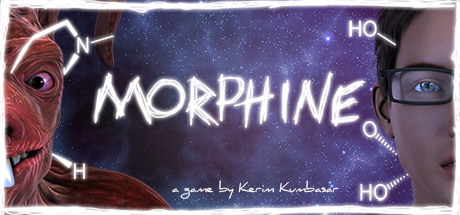
Morphine is an independent first-person adventure that places psychological storytelling ahead of conventional action, using surreal environments and disturbing memories to explore the troubled life of an eighteen-year-old student. Developed and published by Kerim Kumbasar, it is presented as a story-driven cinematic FPS, although anyone expecting a traditional shooter should adjust those expectations. Combat and first-person mechanics contribute to the experience, but the real emphasis is on exploration, atmosphere, emotional discomfort, and witnessing events that shaped the protagonist's damaged perception of the world.
The story centers on a young man who has spent much of his life feeling ignored, isolated, and bullied by others. Rather than simply explaining his experiences through lengthy exposition, the game takes the player into his past and gradually reveals the dramatic incidents that continue to affect him. His apparent retreat into a personal utopia becomes particularly important because reality, memory, and subconscious imagery begin to overlap. This gives the narrative an intentionally uncertain quality where environments can feel less like physical locations and more like representations of emotional states.
Its psychological approach is easily the most interesting part of the experience. The player is effectively being asked to observe events from the protagonist's perspective and develop some degree of empathy for his circumstances. Exploring an alternative subconscious world allows otherwise ordinary locations and situations to become unsettling because it is not always obvious whether something should be interpreted literally. Horror consequently comes more from unease, loneliness, strange imagery, and psychological instability than from relying exclusively on monsters or constant jump scares.
Gameplay itself is straightforward and comparatively modest. Movement through first-person environments forms the foundation, with scripted events and occasional action supporting the narrative progression. The FPS label is technically relevant, but shooting is not developed deeply enough to make the game worthwhile purely as an action experience. Instead, the mechanics function as tools for moving the story forward. Players who enjoy experimental walking simulators, obscure psychological adventures, and unusual independent horror projects are therefore much more likely to appreciate what is being attempted than those looking for sophisticated gunplay.
Presentation is where the game's small-scale origins become especially noticeable. Character animation, environmental construction, transitions, interactions, and general visual polish can feel crude by modern standards. Certain sequences have an almost amateurish quality, while some environments appear sparse or mechanically simple. Yet the rough presentation occasionally works in favor of the surreal atmosphere. The slightly unnatural appearance of the world can reinforce the impression that the player is exploring fragmented memories or an unstable subconscious rather than a perfectly coherent reality.
Narrative execution is similarly uneven. The themes involving bullying, social isolation, emotional trauma, and escapism provide potentially powerful material, but the writing does not always handle those ideas with sufficient subtlety. Some scenes can be confusing or abrupt, and the transition between realistic memories and symbolic material is not always communicated clearly. The game frequently seems more interested in making the player feel something strange or uncomfortable than providing an elegantly structured explanation. That ambiguity can be fascinating for players who enjoy interpreting unconventional stories, but frustrating for those who prefer tightly constructed plots and clearly answered questions.
There is also an unexpectedly eccentric side to the experience. Horror, drama, psychological imagery, action, and occasional humorous or bizarre moments coexist, producing tonal shifts that can make the adventure difficult to categorize. This inconsistency sometimes undermines its serious themes, yet it simultaneously prevents the journey from becoming predictable. It feels like a highly personal independent project rather than something designed around a standardized genre formula, and that individuality remains one of its more memorable qualities.
The Steam version is primarily a single-player experience and includes achievements and trading-card support. English and Turkish interfaces and subtitles are available, making the narrative accessible in either language. These supporting features are welcome, although there is little reason to approach the game as a progression-heavy or endlessly replayable title. Its value rests primarily in completing the unusual story and experiencing the strange sequence of memories and subconscious scenarios that surround its protagonist.
Steam Deck compatibility deserves some caution. There is no official Steam Deck Verified or Playable classification displayed on the Steam store page, and the game is distributed as a Windows title. Since it can potentially be run through Steam Play and Proton, Steam Deck owners may be able to get it working, but this should be considered unofficial compatibility rather than guaranteed Deck support. Controller behavior, interface usability, stability, and other aspects may require adjustment, so players specifically purchasing it for handheld play should be prepared for possible troubleshooting.
Ultimately, this is a flawed but distinctive psychological adventure whose ambitions are considerably larger than its production values. Its first-person mechanics are basic, its presentation has aged noticeably, and its storytelling occasionally struggles to communicate serious ideas effectively. Nevertheless, there is genuine personality underneath those shortcomings. The mixture of painful memories, surreal exploration, unsettling atmosphere, and unpredictable imagery gives the experience an identity of its own. Players interested in unconventional indie projects may find its imperfections easier to forgive because there is a sincere attempt to create something personal rather than merely reproduce familiar horror conventions.
As both developer and publisher, Kerim Kumbasar created a game that feels unmistakably individual, for better and worse. It lacks the mechanical refinement required to stand alongside stronger first-person adventures, but its unusual psychological perspective and willingness to experiment make it more interesting than its technical limitations initially suggest. It is best recommended to players who value strange atmosphere and experimental storytelling over polish, complex gameplay, or conventional horror thrills.
Rating: 7/10