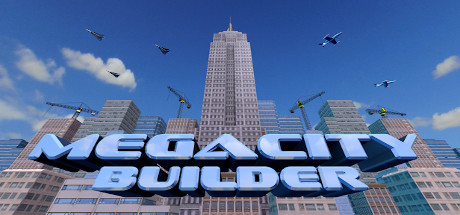
Megacity Builder takes the familiar concept of designing a city and expands it into something closer to managing an entire nation. Developed and published by Andrew Rowe, this single-player simulation combines urban planning with industrial production, trade, legislation, diplomacy, infrastructure, and broader economic management. Its presentation is relatively simple, but underneath that modest appearance is an ambitious collection of systems intended for players who enjoy experimenting with large-scale management rather than following a tightly structured campaign.
One of the more interesting aspects is that development is not restricted to a single city. The player can establish different settlements across multiple maps, allowing rural communities and the capital to serve different purposes. Smaller towns can contribute resources while the capital becomes a major center of population and manufacturing. This creates a sense that individual settlements are pieces of a larger national economy rather than isolated cities. With a very large amount of buildable territory available, there is plenty of space to experiment with layouts and gradually transform undeveloped land into a sprawling network of populated and productive areas.
Manufacturing gives the economy additional purpose. Factories can produce a surprisingly broad selection of goods, ranging from ordinary consumer products to highly advanced manufactured items. Researching products and eventually selling them through the world market provides objectives beyond simply increasing population numbers. There is satisfaction in watching a modest settlement evolve into an economy capable of supporting increasingly sophisticated industries, particularly when rural resource production and urban manufacturing begin working together.
Municipal management remains an important part of the experience despite the larger national focus. Players still have to consider infrastructure such as plumbing and subway networks while managing individual city budgets. Procedurally generated maps encourage experimentation because a fresh game does not necessarily present exactly the same development situation. Disasters can also disrupt otherwise orderly expansion, providing occasional complications that prevent the sandbox from becoming entirely predictable.
The political and international systems are what separate the game most clearly from a conventional city builder. Laws and national programs allow the player to influence the direction of the country, while diplomacy introduces neighboring nations into the simulation. Resources can be traded internationally, giving excess production an additional purpose and creating another connection between domestic industry and the larger strategic layer. Military options are available as well, meaning the player is not limited to peaceful commercial development.
Financial management is relatively forgiving compared with more demanding economic simulations. Money is deliberately generous, allowing players to spend more time constructing, testing ideas, and expanding instead of waiting for the treasury to recover. This works particularly well for anyone interested in sandbox creativity, although players who want every building decision to carry serious financial consequences may find the economy less demanding than expected. The emphasis is more on giving the player freedom to interact with numerous systems than creating a punishing survival-style economy.
Visually, Megacity Builder has a straightforward old-school appearance that prioritizes function over spectacle. The 2D isometric presentation communicates the necessary information without attempting to create the highly detailed streets, animated citizens, and elaborate environments associated with modern big-budget city simulations. This simplicity helps the game remain lightweight, but it also makes its age and independent origins immediately noticeable. Interface refinement and visual feedback are areas where the experience can feel considerably rougher than its underlying ideas deserve.
That same unevenness extends to some of its mechanics. The game tries to accommodate city planning, production, research, economics, transportation, politics, diplomacy, trade, disasters, and military elements within one package. The breadth is impressive, especially for a small-scale production, but individual systems are not always developed with the depth found in simulations devoted exclusively to one or two of those subjects. Players willing to tolerate rough edges can discover an unusually broad sandbox, while those expecting highly sophisticated economic modeling and polished modern presentation may be less impressed.
Steam Deck compatibility should be approached cautiously. Megacity Builder does not have a confirmed official Steam Deck compatibility rating, so it should be considered Unverified rather than guaranteed to provide a fully optimized handheld experience. Its modest technical requirements may make running the game feasible, but its interface and controls were designed primarily around traditional PC input. Using trackpads, custom controller mappings, or the touchscreen may therefore be preferable to relying exclusively on conventional gamepad controls.
Overall, Megacity Builder succeeds more through ambition and freedom than refinement. Its combination of multiple settlements, enormous construction space, factories, research, international commerce, laws, transportation, diplomacy, and national management gives players plenty of systems to explore. It lacks the presentation and mechanical polish of more expensive city-building productions, yet there is a distinctive charm in being able to progress from developing small rural communities to overseeing a massive industrialized nation. For players who appreciate old-school management games and can accept a rougher independent presentation, it offers an interesting sandbox with considerably more scope than its simple visuals initially suggest.
Rating: 5/10