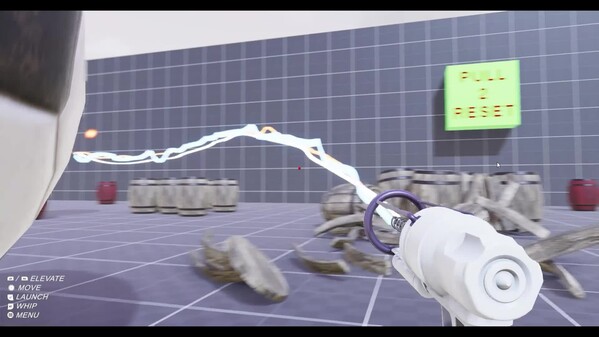
Mash Box is an experimental physics sandbox that feels more like an evolving collection of gameplay ideas than a traditional sports game built around a campaign or structured progression. Developed and published by Mash Games, the project uses its open-ended format to explore movement, vehicles, sporting activities, character physics, and other systems that could eventually contribute to future games from the studio. This experimental identity is essential to understanding the experience because Mash Box is deliberately designed around testing mechanics and having fun with them rather than completing a conventional sequence of missions.
The main attraction is the freedom to interact with several prototype activities. Mash Box combines sports and physics-based gameplay with vehicles such as mountain bikes and scooters, alongside additional experimental activities and a mini-game. Instead of focusing exclusively on one discipline and developing it into a detailed simulation, the game provides different ways of interacting with its underlying physics technology. This variety gives the sandbox an unpredictable quality, as changing from one activity to another can substantially alter how movement and momentum are approached.
Character movement is another major component of the experience. Physics are not merely visual decoration but an important part of how the player interacts with the world. Balance, momentum, positioning, environmental geometry, and the behavior of equipment can all contribute to what happens during play. This creates entertaining situations that sometimes emerge naturally rather than appearing to have been specifically scripted. Players who enjoy experimenting with physics systems may find considerable amusement in simply discovering what the mechanics allow them to accomplish.
This approach also produces some of Mash Box's biggest limitations. Individual activities do not necessarily possess the depth expected from games dedicated entirely to cycling, BMX, skateboarding, or another particular sport. There is less emphasis on long-term progression, extensive competitive structures, elaborate challenges, or a substantial narrative framework. Instead, the enjoyment comes from experimentation itself. Players who need constant rewards and clearly defined objectives may consequently lose interest faster than those who enjoy making their own entertainment inside sandbox environments.
The prototype nature of Mash Box also means that polish should not be judged in exactly the same way as it would be in a finished premium sports release. Experimental physics can produce entertaining results, but they can also expose awkward interactions or inconsistent behavior. Controls and movement systems built around physical simulation often require additional learning because players must understand momentum and positioning instead of relying entirely on predefined animations. This can make successful movement satisfying, but occasional roughness is difficult to avoid when so much of the experience revolves around systems that were created for experimentation.
Mash Games originally positioned Early Access as an opportunity to develop the project alongside its community. Feedback was intended to help determine which mechanics deserved further refinement and which ideas could become part of a larger and more cohesive experience. That development philosophy fits Mash Box particularly well because the game essentially operates as a public laboratory for the studio's technology. However, the current state of development should be considered separately from those ambitions. Steam warns that the developer has not posted an update for an extended period and that information concerning development plans may therefore be outdated. As a result, the game is better evaluated according to what it currently contains rather than what it might eventually become.
Visually and technically, Mash Box serves its sandbox concept more than it attempts to deliver an elaborate cinematic presentation. Environments and objects primarily exist to provide spaces where movement and physics can be explored. That functional design makes sense considering the project's purpose, although players expecting highly detailed locations and the presentation standards of a major commercial sports title may find it relatively modest. The more interesting visual moments often emerge from movement itself, particularly when vehicles, characters, terrain, and physics combine in unexpected ways.
The system requirements also reflect the experimental character of the software. The minimum specifications are relatively approachable, while the recommended hardware listed on Steam rises dramatically, including a very powerful graphics card. Such a large difference between minimum and recommended specifications is unusual and further suggests that Mash Box should be regarded as a technology-oriented experimental project rather than a carefully standardized final release. Fortunately, its relatively small storage requirement makes it easy to install and try without making a substantial commitment.
What makes Mash Box worthwhile is ultimately its willingness to remain playful and unconventional. There is a certain charm in receiving access to a collection of mechanics without being constantly directed toward the next objective. Players can experiment with movement, learn how different vehicles respond, interact with physics, and create amusing situations simply through repeated attempts. The game is particularly suited to people who enjoy mechanical experimentation and who are comfortable finding entertainment without requiring a formal campaign to provide motivation.
At the same time, its open-ended nature limits its broader appeal. Anyone expecting a deep sports simulator, expansive career mode, sophisticated multiplayer competition, or lengthy progression system should approach it cautiously. Mash Box is more successful as a playground than as a complete sports package. Its strongest qualities are freedom, experimentation, physics, and variety, while its weaker areas are depth, structure, refinement, and uncertainty surrounding continued development.
Overall, Mash Box is an intriguing demonstration of what Mash Games can accomplish with physics-based movement and sports mechanics. It provides enough unusual ideas to make experimentation enjoyable, particularly for players fascinated by sandbox technology and emerging gameplay systems. The lack of a conventional structure will be either refreshing or disappointing depending on personal preferences, and the uncertain development status prevents its original ambitions from carrying much weight in the final assessment. Judged purely as the experimental sandbox currently available, it remains an interesting curiosity with entertaining mechanics but considerable room for expansion and refinement.
Rating: 7/10