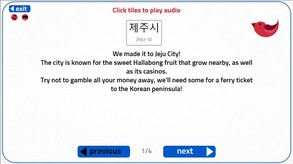
Study Hangul as you explore the Republic of Korea and learn about its culture, cuisine and history. Practice each new Hangul letter by playing fun mini-games.
Modeled estimate, not a reported figure. How we estimate →
Discounts
Every price cut of more than 20% we have observed, in each market that quoted one, with this game's chart position on either side of it. These are episodes, not a model: a sale is one event, and one event cannot tell you what the next one will do.
Reviews, worldwide (the counter carries no country): 0/day in the week to Jul 30 → 0.14/day in the week after.
For scale, across Steam · Top Sellers · Brazil over the last 30 days: the 25 chart moves that followed a price cut of more than 20% went a median of 10 places towards #1, and the 2,413 moves with no price cut behind them went 2 away. One store, one chart, one country — it is the only place we have enough observations to say even that.
Prices outside the United States have been collected since 6 August 2026 and chart positions since 19 July 2026, so a cut older than that has no market to compare and a market that joined later has no history yet. Nothing here is converted between currencies.
About
Stats
All-time low is the lowest price we've recorded for this game since we started tracking it.
Engagement
Reviews
Themes across 42 recent reviews and how positive each mention is. A keyword signal, not full sentiment analysis.
Reviews
한글 훈련에 좋다 나는 한국어를 사랑 ❤
very educational, took out a noona on a date and ordered a banana smoothie easily thank you very much cant wait for the next time i see her
I used this to learn Hangul and it was effective. It took me 5,2 hours of study - over a period of 15 days. I wanted to go very slowly and ensure that all the characters truly stuck in my brain. I made sure I achieved gold on all of the practise exercises, and I did each of them at least three times. I am now starting to study Korean directly with my textbooks, and having worked through this application has made that process far easier. I do not struggle to read Korean words and I'm able to study without romanisation at all - which I find immensely helpful for actually adapting to the Korean language. I would highly recommend this application to anyone looking to learn Hangul. It is effective if you take your time and reenforce what you learn with extra reading practise.
Media

Related
Related
Price dynamics, follower growth, revenue and sales trajectories with interactive tooltips
This and every other Pro feature is free until October 20, 2026. A free account is all it takes.
Languages: English, German, Spanish - Spain, Spanish - Latin America
Hours played at review time, across 42 reviews with recorded playtime.
positive critical· bar length = how often the theme comes up
https://www.youtube.com/watch?v=AXuUNSpMnWI&list=RDAXuUNSpMnWI&start_radio=1
This game is almost really good, but it has a few problems which make it worse than other free alternatives. It kept my wife and me entertained for 3 hours before we exhausted all of the lessons and activities. 1. In the match 3 activity, the cascading bejeweled effect in the blows out your speakers with simultaneous sound clips when multiple sets are aligned simultaneously. Sometimes the blinking visual effect also appears on cells which were not part of the combo. 2. In the slicer activity, identical characters can fall down where the first one does not match the target, but the second one does. I thought I was mistaken at first until two "a" characters were side by side and only the later one matched the "a" target. 3. The pronunciations do not help to distinguish similar sounds adequately. Duolingo struggles with this too, especially with "e" vs "ae" and "j" vs "jj" vs "ch" 4. An explanation for why some jamo appear differently in text boxes versus paragraphs would be helpful. Some consonants appear differently depending on the font being used, just like in English. I figured it out after some research but it would have been much better if the game showed how to write and recognize the jamo in all of their different writing or printing styles.
Buenísimo, aprendí mucho, está bastante bien explicada cada vocal, consonantes y sus combinaciones. 감사해요!
I found the app/game to be surprisingly effective. Overall, I'm glad this app/game exists for it has made the process of memorisation faster and less tedious. pros: - some explanations are incredibly helpful and let me memorised some letters fast (yayy! less effort for the rest); - games can be repeated immediately - a slow me needs it occasionally(?); - lessons consist of sounds, short stories, and letters themselves. To a total westie like me, all these stories set the mood. - dark mode. yes, even in 2025, it's still a pleasant surprise. cons: - some games aren't intuitive - and I praise myself to be quick with interfaces. - one letter seems to have only one type of a game - it's a waste, really.
Let's Learn Korean! Hangul, developed and published by Dr. Cyril Splutterworth, is an educational title on Steam designed with a very clear and focused goal: to teach players how to read the Korean writing system, Hangul, from the ground up. Rather than attempting to be a full language-learning suite, the game narrows its scope to literacy, guiding absolute beginners through the structure, sounds, and logic of Hangul in a way that is approachable, interactive, and surprisingly effective. Its design philosophy prioritizes clarity and retention over spectacle, making it feel more like a guided learning tool than a traditional video game, yet it still manages to remain engaging through thoughtful use of interactivity. The learning structure is carefully paced, beginning with the fundamentals of Hangul’s consonants and vowels before gradually introducing how these components combine into syllable blocks. Instead of overwhelming the player with information, the game breaks lessons into digestible segments, ensuring that each new concept builds naturally on the previous one. This step-by-step approach mirrors how Hangul is often taught in classrooms, but the interactive format allows players to actively participate rather than passively memorize. Seeing, hearing, and interacting with characters repeatedly helps reinforce recognition, and the game places strong emphasis on understanding the logic of Hangul’s design rather than treating it as an arbitrary set of symbols. A core strength of Let’s Learn Korean! Hangul lies in its use of mini-games to reinforce lessons. These activities range from matching characters with sounds to assembling syllables from individual letters, encouraging active recall rather than rote repetition. While the mini-games are simple, they are purposeful, designed to reinforce specific learning outcomes rather than pad out playtime. Some activities may feel easier or more intuitive than others, but this variation helps prevent the experience from becoming monotonous and allows different learning styles to benefit from different forms of interaction. The repetition is intentional and educational, reinforcing memory rather than testing reflexes or problem-solving skills. The game also makes a conscious effort to contextualize learning within a light cultural framework. Lessons are framed as part of a journey through Korea, with references to everyday objects, places, and cultural touchstones that subtly ground the alphabet in real-world usage. These elements are not deeply explored, but they add warmth and personality to what could otherwise feel like a sterile training program. By associating Hangul with familiar imagery and situations, the game helps demystify the script and makes it feel immediately usable rather than academic. Visually, the presentation is clean and unobtrusive, clearly designed to minimize distractions. The interface favors readability, with clear typography and simple layouts that keep attention focused on the characters being learned. Audio support plays an important role, providing pronunciation cues that help learners associate written forms with spoken sounds. While some users note that certain audio elements could be clearer or more consistently emphasized, the inclusion of spoken examples significantly enhances the learning process compared to text-only methods. The overall aesthetic supports the game’s educational purpose rather than competing with it. In terms of limitations, the game is very upfront about what it does and does not aim to teach. It does not cover grammar, sentence construction, or conversational Korean, and players hoping to speak or understand Korean fluently will need to use additional resources. However, this narrow focus is also one of the game’s strengths. By concentrating solely on Hangul literacy, it avoids the dilution that often affects broader language apps and delivers a more confident and effective introduction to reading Korean. For many learners, being able to read signs, menus, and simple words is a major psychological milestone, and the game excels at guiding players to that point. Community reception on Steam reflects this clarity of purpose. Many players praise the game for helping them learn Hangul faster than expected, often reporting noticeable progress within just a few hours. It is frequently recommended as a supplementary tool alongside textbooks or spaced-repetition apps, but many users also find it valuable as a standalone introduction. Criticism tends to focus on minor technical issues or the limited scope, rather than on the quality of instruction itself, suggesting that expectations are generally well-aligned with what the game offers. Taken as a whole, Let’s Learn Korean! Hangul succeeds by embracing its role as a focused educational experience rather than trying to masquerade as a traditional game. Its interactive lessons, thoughtful pacing, and learner-friendly design make it an excellent entry point for anyone curious about Korean writing. While it won’t replace comprehensive language study, it serves as a strong foundation, transforming Hangul from an intimidating script into a readable, logical system. For beginners, casual learners, or anyone looking to finally understand how Korean text works, it is a practical, accessible, and genuinely helpful tool that delivers exactly what it promises. Rating: 8/10

I love this game! The explanations were easy to follow, I had a lot of fun playing it. I even wrote down on flash cards, and have been practicing with the game. I learned fairly quickly, by playing the levels over and over again. Plus the little adventure and history made it more exciting. I'm happy this game was the first step to my learning Korean journey !
Very good. I would like more kinds of practice games but they do what they need. I would also prefer to have an option of taking the timer off of the final games. like maybe keeps going til you get one wrong instead of the timer since you often have to wait for a word to pop up before you can choose it which chew down the timer.
Selling now
See how fast this game is selling right now — estimated copies and revenue per day from recent review growth.
Players by region
Where this game's players are, estimated from review languages.
Related
| Game | Estimated lifetime revenue | Reviews | Review score | Price |
|---|---|---|---|---|
| $7.5M | 27K | 91% | $9.99 | |
| $582.8K | 1.6K | 99% | $9.99 | |
| $5.5K | 194 | 95% | $0.99 | |
| $52.4K | 90 | 98% | $22.99 | |
| $49.7K | 212 | 98% | $11.99 | |
| $21.1K | 137 | 80% | $14.99 |
Related
| Game | Estimated lifetime revenue | Reviews | Review score | Price |
|---|---|---|---|---|
| $1.3K | 55 | 60% | $1.49 | |
| $1.3K | 69 | 57% | $0.99 | |
| $1.3K | 69 | 77% | $0.99 | |
| $1.3K | 92 | 66% | $0.74 | |
| $1.3K | 56 | 38% | $0.79 | |
| $1.3K | 59 | 54% | $0.99 |