
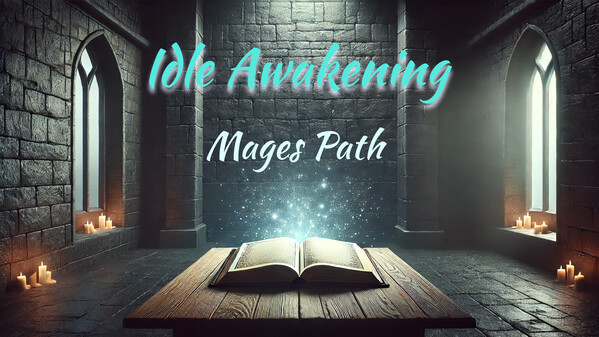
Embark on a journey of a fledgling mage. Start with nothing. Improve yourself, develop your skills through a vast tree, unlock upgrades, learn spells, gather resources, and craft unique items. Your progress never stops – it continues even while you're offline.
Modeled estimate, not a reported figure. How we estimate →
About
Start your path as a simple human — and build your own story of becoming a true mage. Plan your daily routines, manage carefully crafted lists of actions, and steadily improve every aspect of your magical life.
Explore a rich and expanding world full of opportunities. Unlock new actions, resources, and systems at your own pace — and discover how much there is to unfold. Every hour brings something new: a potion to brew, an upgrade to earn, a choice that shapes your next step.
Design your workflow by combining manual tasks and automated sequences. Experiment with dozens of magical materials, learn powerful spells, and customize your home with furniture that provides meaningful bonuses.
Whether you play actively or prefer passive growth, your journey continues — even while you're away.
Smart Progression
Start with just a handful of basic actions — and gradually unlock a vast network of upgrades, abilities, systems, and tools to manage them.
Action & List System
Plan, combine and automate your daily routines through a modular system of reusable action lists. Min-max or just let it flow.
Crafting & Alchemy
Craft dozens of materials, potions and unique accessories to improve your long-term growth.
Procedural Map Exploration
Explore an ever-changing map to discover rare herbs, treasure fragments and one-of-a-kind items with permanent effects.
Magic
Learn and upgrade your own arsenal of spells — from passive effects to direct magical actions.
No Prestige System
Your progress is permanent. No forced resets or repetitive loops — only forward momentum.
Flexible Skill Tree
Specialize your mage with a vast skill tree that adapts to your current needs — you can reassign skills during your journey to suit different strategies.
Customizable Home
Build and upgrade your private space with furniture that boosts your actions, automation, and progression efficiency.
This is not just a game about numbers going up — it’s about unfolding systems, planning, discovery, and magical self-growth.
And there's always more waiting to be revealed. Your journey awaits!
Genres
Stats
All-time low is the lowest price we've recorded for this game since we started tracking it.
Languages: English**languages with full audio support
Engagement
Reviews
Themes across 56 recent reviews and how positive each mention is. A keyword signal, not full sentiment analysis.
Reviews
The game is probably abandoned. Dev is working on other projects. Even if it wasn't, this wouldn't be worth your time if you're new or experienced with incremental games. The early game is fun and the writing is quirky, and also ignorable if you don't care. The unlocks are frequent and progression is up to player choice. The game borrows a lot of ideas from other good games and they work for awhile. As you reach the midgame and things slow down, you might think "alright time to grind, power up, and break the wall", but that break moment never comes. You'll notice your scaling slows down a lot, so you grit your teeth and let it idle to get through the wall the hard way - and then you find out there's nothing on the other side. It's just wall after wall with next to nothing to push you through it. I sat through this until I finally got to another actual unlock and found out for the umpteenth time that the unlocks, once again, don't make a meaningful difference in your progression. They take too long to accumulate too so it's not even exciting or interesting. Look at my hours. The first day was fun, the second and third days were alright. I let it sit for 10 more days practically spinning my wheels. It doesn't get better. Also AI has had it's hands on this. I wouldn't care as long as the game was good, but I know it will upset some people, so I'll mention it here.
Media

Related
Related
Price dynamics, follower growth, revenue and sales trajectories with interactive tooltips
This and every other Pro feature is free until October 20, 2026. A free account is all it takes.
Hours played at review time, across 56 reviews with recorded playtime.
positive critical· bar length = how often the theme comes up
I really wanted to like this game. It has an attractive UI and very nice automation features. Unfortunately it falls flat with the theme. This game is called Idle Awakening MAGES PATH, but it should be called Idle Awakening INDUSTRIAL REVOLUTION. There is very little magic to be had. You spend almost all your time doing pushups, mining coal, and running a printing press.
The game is fun for a couple of days. Then it turns into a faceless and sluggish routine. You may grind for many hours to just reveal another ability that makes your routine less sluggish by 10-20%. The are no bright steps that raise the game into a different level, there are no even any particular aims, just logarithmically described grind. Dunno whether its worthy five bucks. Maybe. But no more.
There is no Magic Path.
While i like the skill unlocking and getting better at them aspect... this game is incredibly boring. The UI is not great, the skill tree is about bland % uprades and while there is a ton of different activities (too many too fast in my opinion) it all feels inconsequential like... yawn. The demo was promising butthe gamet ended up very disapointing.
Idle Awakening: Mages Path, developed and published by Strange Matter Gaming, is an incremental RPG that tries to push beyond the usual “set it and forget it” formula by giving players a surprising amount of control over how their progression unfolds. While it still operates within the familiar framework of idle games—numbers increasing over time, resources accumulating, and systems gradually unlocking—it distinguishes itself through a more hands-on approach to automation and long-term planning. Instead of simply waiting for progress to happen, players are encouraged to actively design how their character develops, turning what could have been a passive experience into something more deliberate and strategic. At the center of this design is a flexible action queue system that allows players to script their character’s behavior. This mechanic becomes the backbone of the entire experience, as it enables the creation of increasingly complex routines involving training, gathering, crafting, and spellcasting. Early on, the process feels straightforward, but as more systems unlock, it evolves into a layered network of interdependent actions that require careful thought to optimize. The satisfaction comes not from constant interaction, but from refining these systems—tweaking priorities, adjusting sequences, and finding more efficient ways to progress. It gives the game a distinct identity within the genre, as it rewards planning just as much as patience. Progression itself is structured around gradual expansion. What begins as simple stat-building and resource collection steadily grows into something far more intricate, incorporating crafting chains, magical abilities, and exploration mechanics that feed back into the core loop. Each new layer adds complexity, often recontextualizing earlier decisions and encouraging players to revisit and improve their setups. The absence of a traditional reset or prestige system reinforces a sense of continuous growth, making advancement feel permanent rather than cyclical. This design choice can be refreshing, as it avoids the repetitive loops common in many idle games, but it also means that progress can feel slower and more demanding over time. The game’s pacing is where its strengths and weaknesses intersect. On one hand, the slow, methodical progression aligns well with its focus on long-term optimization, giving players time to experiment and refine their strategies. On the other hand, certain stages can feel excessively drawn out, with noticeable slowdowns that test patience more than skill. These moments can make the experience feel less like a puzzle to solve and more like a waiting game, particularly when progress hinges on incremental gains that take hours to accumulate. Players who enjoy gradual, steady advancement will likely find this appealing, but those looking for a more dynamic or fast-paced experience may struggle to stay engaged. Exploration and discovery play an important supporting role, adding variety to the otherwise system-driven gameplay. Venturing into new areas introduces opportunities to acquire rare materials, unlock upgrades, and expand the scope of what is possible. These elements help break up the monotony and provide a sense of forward momentum, even when the core progression slows. However, they remain secondary to the game’s primary focus on optimization and automation, serving more as enhancements than as central pillars of the experience. Visually, the game adopts a clean and functional interface that prioritizes clarity over style. Given the number of systems players must manage, this approach is both practical and necessary. Menus are dense but readable, and information is presented in a way that supports efficient decision-making. While the overall aesthetic is relatively simple and lacks the polish of larger productions, it aligns with the game’s focus on mechanics rather than presentation. Sound design is minimal and unobtrusive, reinforcing the idea that the game is meant to run alongside other activities rather than demand constant attention. As an ongoing project, the game shows clear signs of growth but also areas that need refinement. Balance issues, particularly in mid-to-late progression, can disrupt the flow and create uneven difficulty spikes. Some systems are not fully explained, leaving players to rely on experimentation or external resources to fully understand them. At the same time, the foundation is strong, and the developer’s continued updates suggest that these issues are being actively addressed. The game already offers a substantial amount of content, and its evolving nature hints at even greater depth in the future. In the end, Idle Awakening: Mages Path is a thoughtful and somewhat demanding take on the idle RPG formula, one that trades accessibility for depth and immediacy for long-term satisfaction. It is best suited for players who enjoy dissecting systems, optimizing workflows, and watching carefully planned strategies unfold over time. While its pacing and complexity may limit its appeal to a broader audience, it provides a rewarding experience for those willing to engage with its intricacies. It may not redefine the genre, but it offers a distinct and compelling variation that stands out through its emphasis on control and progression. Rating: 7/10
It's interesting for a day or two until the unlocks stop coming in and you're stuck waiting for a bunch of milestones that don't do anything to actually change how you play. For a game with "Mage's path" in its title, the game certainly feels a lot more like the path of the town's drunken craftsman for an obscenely long time. Some of the scenes mention you casting magic, but it's magic that the player can't cast because the game only gives you illusion and restoration, so it feels like the game is saying "congratulations, you can make a shadow that looks like a pot. You've awakened as a mage. That's it, there's no more mechanics to learn on this path. Enjoy six stories about blowing papers around with wind before we stop talking about it." And even after you are successful enough (Usually as a carpenter or something) to own a massive plot of land with multiple buildings on it, it feels like every story scene is still about you ♥♥♥♥♥♥♥ up somehow and learning the wrong lesson. The automation looks daunting when you get to it, but it's unlocked pretty early and generally quite useful if a bit dumb, but it's often difficult to say when something should be automated. Some are easy: "Drink a physical learning potion when doing an action with the physical tag" but there's so many actions that have no level cap and no purpose other than to provide small amounts of stats that trying to find the optimal automation for them feels like a chore. I do know there's still some mechanics I haven't reached yet due to seeing automation options for mechanics I haven't unlocked, but that makes it feel like there's only like two truly new mechanics waiting for me if I continue. Not to mention I've nearly touched all corners of the "skill tree" already (which is just a configuration of buffs, not skills). It feels like the game doesn't really have anything else for me to do and I'm just waiting for my skills to grind themselves out.
This would be a decent idle game, plenty of different things to do and the mechanics are fairly in-depth. However, constant crashes and freezes (at least ten of each in the total playtime) have ruined any interest I have in continuing the grind. Would be a recommend once stability improves.
AI slop
Horribly slow, easily months / years to complete Very bad UI Plenty of mechanics, but they are all shallow small multipliers
Selling now
See how fast this game is selling right now — estimated copies and revenue per day from recent review growth.
Active players
Estimated daily and monthly active players (DAU/MAU) modeled from peak concurrency.
Players by region
Where this game's players are, estimated from review languages.
Players also reviewed
The games this title's players most often review too — audience affinity.
Related
| Game | Estimated lifetime revenue | Reviews | Review score | Price |
|---|---|---|---|---|
| $6.7K | 87 | 77% | $1.99 | |
| — | 0 | — | — | |
| $423.7K | 1.6K | 87% | $5.59 | |
| $88K | 205 | 70% | $9.99 | |
| $87.8K | 249 | 67% | $8.99 | |
| $42.5K | 260 | 66% | $4.99 |
Related
| Game | Estimated lifetime revenue | Reviews | Review score | Price |
|---|---|---|---|---|
| $36.3K | 93 | 88% | $19.99 | |
| $36.3K | 161 | 86% | $9.99 | |
| $36.3K | 1.8K | 93% | $0.99 | |
| $36.3K | 202 | 98% | $9.99 | |
| $36.3K | 59 | 85% | $19.99 | |
| $36.3K | 98 | 56% | $19.99 |