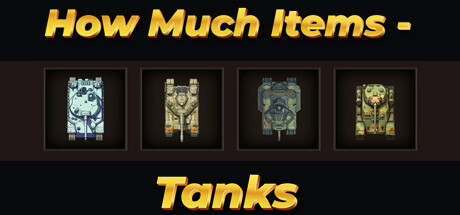
How Much Items – Tanks, developed and published by Hede, is a minimalist counting and observation game that builds its entire identity around a deceptively simple concept: look at a scene filled with tanks and determine exactly how many are present. Rather than offering combat mechanics, strategic depth, or simulation systems one might expect from a game centered on military hardware, it strips the theme down to its visual components and transforms it into a focused test of attention and precision. The result is a compact, highly specific experience that appeals primarily to players who enjoy short, skill-based visual challenges.
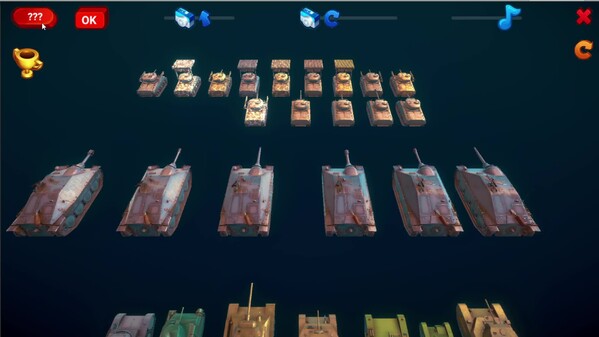
At its core, the gameplay loop is straightforward. Each level presents a static scene populated with numerous tank models arranged in varying densities and formations. The player’s objective is to carefully scan the environment, count every visible tank, and input the correct number. If the answer is wrong, the level resets with a new arrangement or altered quantity, forcing players to approach the task again with renewed focus. This mechanic introduces a subtle tension between speed and accuracy. Rushing increases the risk of miscounting, while taking too long can feel inefficient, particularly for players chasing leaderboard positions or achievement milestones. The simplicity of the premise makes it instantly accessible, but mastery demands concentration and systematic visual tracking.
Visually, the game adopts a clean and functional presentation. The tank models are clearly defined, ensuring that they are recognizable even when clustered closely together. Backgrounds are typically neutral or stylized in a way that provides context without overwhelming the player’s ability to distinguish individual objects. The design philosophy prioritizes clarity over spectacle. There are no elaborate particle effects or cinematic flourishes—everything exists to support the counting mechanic. Despite this utilitarian approach, there is a certain charm in the dense arrangements of tanks, especially when they are layered or partially obscured in ways that challenge the player’s ability to track duplicates or overlapping shapes.
One of the more interesting aspects of How Much Items – Tanks is how it turns a mundane activity into a surprisingly engaging mental exercise. Counting objects in a cluttered environment requires pattern recognition, spatial awareness, and short-term memory retention. Players often develop personal counting strategies, such as grouping tanks into clusters or scanning the scene in a grid-like pattern to avoid double-counting. This self-directed approach adds a subtle layer of strategy to what might otherwise seem like a purely mechanical task. The satisfaction of entering the correct number after carefully verifying each object provides a small but tangible reward, reinforcing the loop and encouraging repeated attempts.
However, the game’s narrow focus can also be its greatest limitation. There is no narrative framework, no progression system beyond repeated scenarios, and no evolving mechanics that dramatically alter the experience. While the increasing density of tanks or slight variations in layout introduce incremental challenge, the fundamental activity remains unchanged from beginning to end. For some players, this purity of design is appealing—it knows exactly what it wants to be and never strays from it. For others, the lack of variety may lead to fatigue once the novelty of the counting challenge wears off.
Replay value largely depends on a player’s tolerance for repetition and interest in self-improvement. Achievements and leaderboard rankings provide additional motivation for those who enjoy optimizing their performance. Trying to reduce counting time without sacrificing accuracy can feel like a personal challenge, almost akin to solving a timed puzzle repeatedly to shave off seconds. Still, without additional modes, thematic expansions, or layered objectives, the experience remains tightly contained within its original concept.
Ultimately, How Much Items – Tanks is a niche title that transforms a basic observational task into its sole gameplay mechanic. It does not attempt to simulate tank warfare or deliver an expansive strategy experience. Instead, it offers a focused mental workout centered on precision and patience. For players who enjoy hidden-object games, counting challenges, or short, skill-based sessions that test attention to detail, it provides a straightforward and oddly compelling diversion. For those seeking narrative depth or mechanical complexity, however, its minimalist design may feel too limited. In embracing simplicity so completely, the game delivers exactly what it promises—no more and no less.
Rating: 6/10