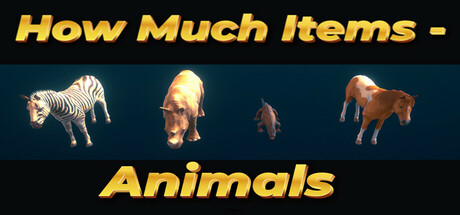
How Much Items – Animals is a minimalist hidden-object puzzle game developed and published by Hede that builds its entire identity around a single deceptively simple mechanic: counting. Instead of asking players to merely locate specific objects within cluttered environments, the game challenges them to determine exactly how many instances of a particular animal appear in each scene. This twist transforms what could have been a straightforward hidden-object experience into a focused test of observation, patience, and visual accuracy.
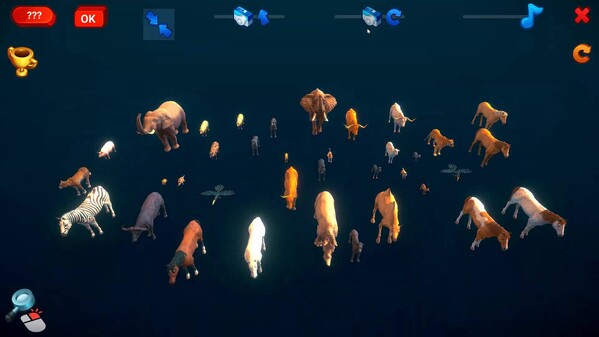
Each level presents a densely packed image filled with various items and repeated animal figures scattered across the map. The objective is not just to find one or two cleverly hidden creatures, but to carefully scan the entire environment and calculate the precise number present. Once confident, players input their answer into a dedicated field. If the count is incorrect, the level resets and the objects are rearranged, preventing brute-force guessing and reinforcing the importance of careful analysis. This mechanic establishes a feedback loop that emphasizes precision over speed, though improving speed naturally becomes part of mastery.
The visual design supports this core concept effectively. While the artwork does not aim for high-end realism or intricate animation, it serves its functional purpose well. Objects are arranged to create visual noise, forcing players to sift through clutter and develop efficient scanning strategies. Some animals blend subtly into the background, while others hide among similar shapes, testing pattern recognition skills. The scenes often feel chaotic at first glance, but repeated play reveals structure and recurring patterns that reward attentive players.
Replayability is subtly integrated through achievements and leaderboard tracking. Completing levels more quickly or without errors adds a competitive edge, encouraging players to refine their visual scanning techniques. The satisfaction does not come from narrative progression or unlocking new mechanics, but from personal improvement. Each correct count feels earned, and shaving seconds off completion times provides a small but meaningful sense of accomplishment.
However, the game’s focused design also limits its scope. There are no complex systems layered on top of the counting mechanic, no branching modes, and no narrative framing. The entire experience revolves around observation and numerical accuracy. For players seeking story-driven puzzles or evolving mechanics, the simplicity may feel repetitive over extended sessions. Yet for those who enjoy concentrated, skill-based challenges, the narrow focus becomes its strength rather than a weakness.
Accessibility is another positive aspect. The game’s interface is straightforward and intuitive, making it easy to jump in without lengthy tutorials. Because the objective is visually based rather than text-heavy, it transcends language barriers effectively. Its short, self-contained levels make it suitable for quick play sessions, appealing to players looking for casual engagement without significant time investment.
Ultimately, How Much Items – Animals succeeds by fully committing to its singular idea. It does not attempt to reinvent the hidden-object genre through elaborate storytelling or layered systems. Instead, it refines a specific challenge—accurate counting within cluttered environments—and delivers it consistently. The result is a focused puzzle experience that rewards patience, attention to detail, and incremental improvement. For players who appreciate quiet concentration and skill-based progression, it offers a simple yet surprisingly absorbing test of observational acuity.
Rating: 6/10