Grim Horde is a dark-fantasy action roguelite that puts players in the unusual position of becoming the menace that ordinary heroes would normally be expected to defeat. Developed and published by Red Koi Box, the game casts the player as a Darklord attempting to conquer the mortal world by summoning monsters, destroying settlements, collecting souls, and steadily expanding an evil army. This reversal of the traditional fantasy formula is its most immediately appealing quality, giving a familiar roguelite structure a different personality without making the basic mechanics difficult to understand.
Rather than relying entirely on direct attacks, much of the Darklord’s strength comes from summoned minions. Portal towers allow different creatures to enter the battlefield, gradually transforming a vulnerable beginning into a chaotic invasion. Managing this growing force is an important part of the experience because the creatures effectively become extensions of the player’s offensive capabilities. There is considerable satisfaction in watching a small group develop into a destructive horde capable of overwhelming opposition, and this army-oriented approach helps distinguish the game from survival roguelites centered almost exclusively on upgrading a single character’s weapons.
Conquering villages is closely connected to character development. Destroying mortal settlements allows the Darklord to acquire souls, which can then contribute to improving abilities and strengthening the army. This creates a simple cycle in which destruction leads to resources, resources provide greater power, and greater power makes further conquest possible. The mechanics are intentionally straightforward, making Grim Horde easy to enter without requiring extensive preparation. Beneath that accessibility, however, players can still consider which minions and improvements are most useful for their current approach.
Death naturally plays a major role in the roguelite design. Losing a run does not mean that everything accomplished was meaningless, since the Darklord returns and can benefit from progression that influences future attempts. This persistent development gives failure a productive purpose and encourages experimentation. The technology tree adds another layer to progression, while the Minionpedia provides information concerning the creatures available to the player. Endless Mode further emphasizes the game’s focus on replayability, allowing its central systems to continue beyond a more conventional objective-based structure.
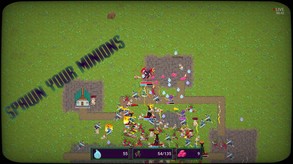
Visually, Grim Horde adopts pixel graphics that fit both its independent production scale and its arcade-inspired gameplay. The top-down viewpoint provides a useful perspective over the battlefield, particularly when numerous minions and enemies begin occupying the screen simultaneously. Its presentation does not attempt elaborate realism, instead using a stylized fantasy aesthetic that keeps the destruction playful and readable. This approach suits the premise because the player can enjoy behaving like an exaggerated fantasy villain without the atmosphere becoming excessively grim or serious.
The most entertaining moments emerge when the Darklord’s forces reach sufficient strength to make the battlefield feel genuinely dominated by an expanding monster army. There is an effective sense of progression between the comparatively modest beginning of an attempt and the later stages where numerous servants are participating in the destruction. Choosing improvements and discovering useful combinations adds some strategic consideration to what might otherwise have been a purely arcade experience. Grim Horde consequently works particularly well in shorter sessions where the player can enjoy building momentum without expecting an enormous role-playing campaign.
Its weaknesses become more noticeable over extended play. The fundamental loop of summoning creatures, attacking settlements, collecting souls, purchasing improvements, dying, and beginning another attempt can eventually become repetitive. A roguelite built around commanding monsters has enormous potential for radically different army compositions and strategies, but Grim Horde does not always provide enough variety to make every new attempt feel dramatically different. More substantial differences between minion combinations, encounters, environments, enemies, and progression choices would have strengthened the replay value considerably.
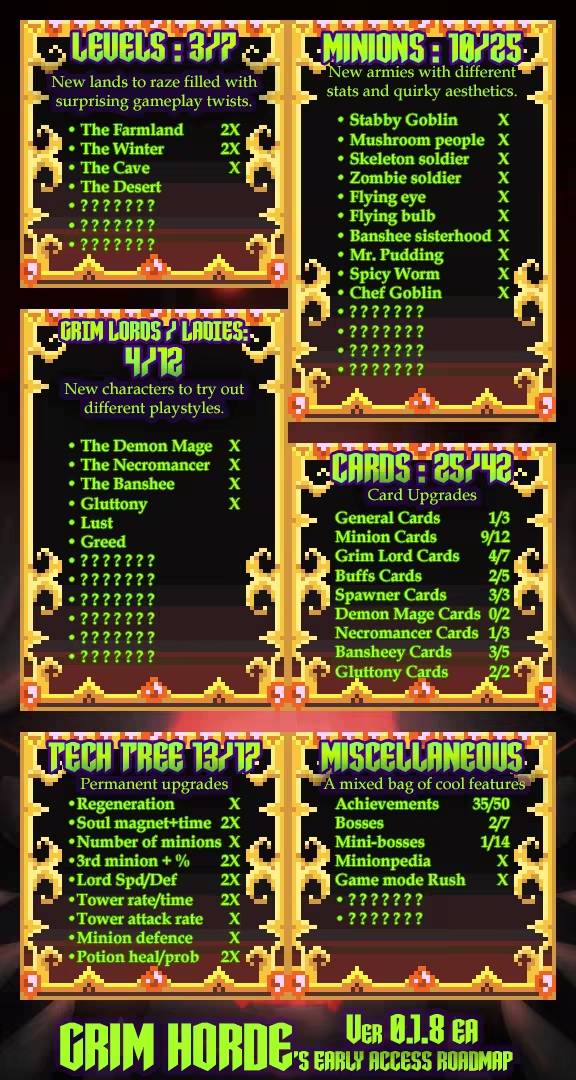
The game’s Early Access status is another important consideration. Red Koi Box originally outlined ambitions for additional Darklords, creatures, abilities, attributes, challenges, exploration elements, quality-of-life improvements, and a broader open-ended structure. Such additions could have greatly expanded the foundation already present. However, the project has remained in Early Access far longer than its initial development expectations suggested, so the existing game should be judged primarily on what it currently offers rather than on features that were once planned. This makes the limited breadth of its present content more significant.
Despite those shortcomings, the underlying concept remains appealing. Playing a Darklord who grows stronger by harvesting souls and unleashing increasingly dangerous creatures creates an entertaining alternative to the usual fantasy hero narrative. The summoning mechanics are particularly important because they make the player feel like the commander of an invasion rather than simply another lone warrior surrounded by enemies. When a horde begins functioning effectively, the resulting spectacle delivers exactly the kind of villainous power fantasy promised by the premise.
Grim Horde ultimately feels like a promising framework that never completely develops into the larger experience its ideas could support. Red Koi Box established a compelling central loop, approachable mechanics, suitable pixel presentation, persistent progression, and an enjoyable emphasis on commanding minions. The limited variety and uncertain state of its Early Access development keep it from reaching its full potential, but there is still entertainment available for players attracted to compact action roguelites and unconventional fantasy perspectives. Its strongest accomplishment is making the process of creating and unleashing a monster army immediately satisfying, even if the surrounding systems eventually reveal their limitations. Taking its creative premise, enjoyable horde mechanics, accessible progression, replay value, content limitations, and unfinished potential into account.
Rating: 5/10