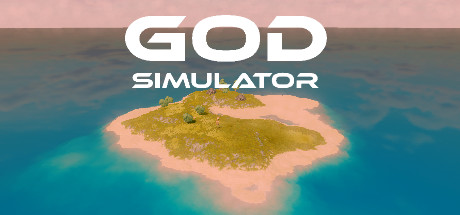
God Simulator is a small-scale indie sandbox simulation developed and published by Mateusz Kulis that sets out to explore one of gaming’s most enduring fantasies: shaping a world as an all-powerful deity. Rather than framing this power through structured objectives or narrative arcs, the game adopts a minimalist, open-ended approach, placing experimentation and observation at the center of the experience. From the start, it is clear that God Simulator is less concerned with guiding the player through a designed journey and more interested in offering a set of basic tools with which to tinker, observe, and reflect on cause and effect.
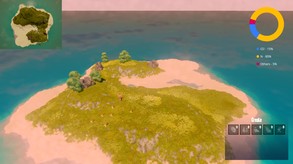
Gameplay takes place from a top-down perspective over a modest island environment inhabited by small populations and influenced by environmental factors. Players are given control over terrain and basic world parameters, allowing them to raise or lower land, influence the environment, and shape the island’s physical layout. These actions are meant to ripple outward, subtly affecting how the world behaves and how its inhabitants exist within it. The interface is straightforward, and the learning curve is gentle, making it easy to begin experimenting almost immediately. There is no tutorial-heavy onboarding or layered progression system; instead, players are encouraged to explore the tools organically and discover their effects through trial and observation.
The core issue — and defining characteristic — of God Simulator is its simplicity. While the idea of manipulating a living world is compelling, the simulation itself remains shallow. Environmental changes largely produce visual or surface-level effects rather than complex systemic responses. Population behavior, while present, lacks the depth and unpredictability that give stronger god games their sense of life and emergent storytelling. As a result, the world often feels static, responding to player input in predictable ways without evolving meaningfully over time. This limits the sense of long-term impact that many players expect when stepping into a godlike role.
There is also no overarching progression or victory condition to anchor the experience. Players are not working toward technological eras, divine milestones, or narrative endpoints. Instead, the game functions more like a digital sandbox or interactive toy, where satisfaction is derived from momentary experimentation rather than cumulative achievement. This design can feel freeing for players who enjoy meditative tinkering, but it also means that motivation relies almost entirely on personal curiosity. Once the novelty of shaping terrain and observing limited reactions wears off, the game offers little incentive to continue.
Visually, God Simulator is functional but unremarkable. The graphics clearly communicate terrain and objects, which supports usability, but the aesthetic lacks personality or atmospheric depth. Updates over time have attempted to improve lighting and presentation, yet these changes do little to disguise the fundamental simplicity of the world itself. The sound design follows a similar pattern, providing ambient feedback without contributing significantly to immersion or emotional tone. Together, the audiovisual elements serve their purpose but do not elevate the experience beyond its mechanical foundation.
Pacing is slow and contemplative, whether by design or limitation. Changes unfold gradually, and there are few dramatic moments or sudden shifts to keep players engaged. This makes the game suitable for brief, low-pressure sessions where the goal is simply to relax and experiment. However, for players seeking dynamic systems, escalating challenges, or emergent narratives driven by complex interactions, this pace can feel stagnant rather than soothing.
Community reception reflects these contrasts sharply. Many players express disappointment, citing expectations of a deeper, more reactive simulation that the game does not deliver. Criticism often focuses on the lack of meaningful mechanics, limited world behavior, and the feeling that the game resembles an unfinished prototype more than a fully realized god simulation. At the same time, a smaller subset of players appreciate its simplicity, viewing it as a lightweight sandbox that allows for casual experimentation without cognitive overload.
Ultimately, God Simulator stands as an earnest but limited indie project. Its ambition — granting players godlike control over a living world — is clear, but the execution does not fully support that fantasy. It functions best as a short-lived sandbox curiosity, offering a glimpse into environmental manipulation without the depth required for sustained engagement. For players curious about minimalist simulation experiments or those looking for a quiet, no-pressure sandbox to explore briefly, it can provide mild entertainment. For fans of rich god games filled with emergent systems, meaningful feedback, and long-term progression, God Simulator is likely to feel shallow and incomplete.
Rating: 5/10