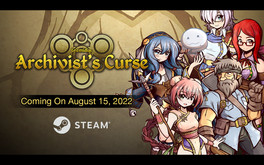
Archivist's Curse brings you into an otherworldly harbor of knowledge: The Great Library, although unfortunately, you ended up in the dangerous section of the complex called Hall of Pawnsmoor.
Revenue comes from in-game items and microtransactions, which our price-based model doesn't estimate. The player count below is how many people own it, not what they spent.
About
Genres
Stats
Languages: English, Japanese
Engagement
Reviews
Themes across 45 recent reviews and how positive each mention is. A keyword signal, not full sentiment analysis.
Reviews
I like this game because you can experiment with character build and party but sadly i feel like it's too repetitive and i feel like there's no storyline
This game is simple, contained, and far more fun than any such game should be. The concept is straightforward - control a party of up to four characters and clear random, mini-map style dungeons by either fighting enemies or finding items/buffs, and eventually killing the floor boss. Each defeated floor has a chance to unlock both a new character and a new piece of craftable gear. Once you're stronger, you go challenge the 'Chessmaster' to a fight. Rinse, repeat. Simple, minimal, and sounds like it'd get dull and repetitive fast. And yet. The combat is simple genius, and I know I'll be taking some lessons away from it, both from the combat style itself and the varieties of characters. There's so much hidden here in such a little game - but don't take my word for it. It's free, and a small download, go try it out for yourself. It's worth it.
Media

Related
Related
Price dynamics, follower growth, revenue and sales trajectories with interactive tooltips
This and every other Pro feature is free until October 20, 2026. A free account is all it takes.
Hours played at review time, across 45 reviews with recorded playtime.
positive critical· bar length = how often the theme comes up
O jogo por ser público é bom, mas depois de um tempo fica repetitivo. Estou me divertindo bastante, sendo assim, está valendo a pena jogar.
An enjoyable grid-based combat system laid upon an almost tabletop foundation. Battles are triggered and chests are discovered as you navigate room nodes on a simple dungeon map. There is a great variety of character archetypes and skillsets, lending to what will surely be a variety of successful strategies. The mini battle sprites are great, and the portraits are decent. I am reminded pleasantly of Grand Knights History. It is frustrating not to be able to predict which character you will unlock by clearing each different dungeon exit. I am never certain whether I should conserve character-upgrading resources, in case I come across a new favourite for my final party after the next run. I would prefer to be able to knowingly seek certain characters, but I admit some of the appeal lies in hoping your next recruit will be cool. I ultimately abandoned the game because of the prospect of trying to overcome this possibly extensive random grind with no clear expectations about when I would have a favourite party, even supposing that there would be a satisfying finale in which to deploy them.
[h1]Before I played Eremidia - Archivist's Curse, I had a small pp, no friends, no gf, depression, and no life. These things havent changed, but the game is pretty good[/h1]
Игра 'Eremidia - Archivist's Curse' подкупает своей пиксельной эстетикой и классическим геймплеем jRPG. Сюжет, хоть и начинается довольно просто, быстро затягивает интригой и интересными персонажами, каждый из которых обладает своей историей и мотивацией. Боевая система пошаговая, заставляющая думать и планировать свои действия, особенно на более сложных уровнях. Разнообразие противников и способностей героев не дает заскучать. Из плюсов стоит отметить приятную музыку, атмосферные локации и, конечно же, упомянутый выше интересный сюжет. Из минусов – иногда немного запутанные карты и, возможно, кому-то покажется слишком старомодным геймплей. В целом, игра оставила положительное впечатление. Если вы любите старые добрые jRPG, то 'Eremidia - Archivist's Curse' определенно стоит вашего внимания. Она способна подарить несколько часов увлекательного приключения, полного тайн и открытий. Рекомендую!
Terrible English and the blurriest text I've ever seen in a game. At the very least, a text-heavy English language game should have easily readable text and quality English. This fails horribly on both counts.
Eremidia - Archivist's Curse is a free tactical role-playing game that combines traditional fantasy adventuring with a chess-inspired approach to combat and party management. Developed by Crescent Sun and published by YSY Softworks, it takes place within the mysterious Great Library, where the player becomes involved in the dangerous Hall of Pawnsmoor and the unusual games of its Chessmaster. Rather than presenting chess merely as a visual theme, the game incorporates ideas of pieces, positioning, tactical movement, and carefully constructed teams into its progression. This gives the adventure a recognizable identity despite its deliberately traditional 2D RPG presentation. The central objective revolves around surviving the Great Library's challenges while gathering companions capable of helping the player escape. Exploration is therefore closely connected to character progression. Venturing through areas such as the Dark Alley can lead to new allies, equipment, resources, encounters, and information concerning Pawnsmoor itself. This makes exploration more rewarding than simply walking between mandatory battles. Searching thoroughly can improve the player's tactical possibilities while gradually revealing more of the setting and the personalities inhabiting it. Combat is where the chess influence becomes particularly important. Encounters take place on grid-based battlefields, making positioning a fundamental part of success. Players need to consider movement ranges, character abilities, enemy placement, and the potential consequences of each action. Powerful characters cannot always compensate for careless positioning, especially when enemies can exploit openings in the formation. The resulting battles encourage patience and planning rather than rapid command selection. Anyone who enjoys tactical RPGs in which a successful turn can depend on where every party member stands should find considerable appeal here. The large collection of recruitable characters strengthens this tactical foundation. Dozens of companions can become available, each offering different characteristics, abilities, and background information. Recruiting new characters is consequently useful both mechanically and narratively. Party construction becomes an ongoing process of deciding which combination of abilities works best for a particular situation. A promotion system further develops these characters, giving the roster longer-term value and encouraging experimentation instead of treating newly acquired companions as disposable collectibles. Two primary modes provide different ways to interact with the underlying systems. Dark Alley places greater emphasis on exploration, encounters, resource collection, and discovery, while Chessmaster Match focuses more directly on structured tactical challenges. These components complement one another because progress made while exploring can provide additional options when facing more demanding matches. Dedicated tutorial content also helps explain important mechanics before players are expected to understand every tactical possibility on their own. Progression extends beyond recruiting characters. Equipment and crafting provide additional ways to prepare for difficult encounters, with recipes and useful materials encouraging players to investigate the environment and overcome significant challenges. Hidden bosses add another incentive to explore thoroughly, while the assortment of regular enemies requires players to adapt their approach instead of using precisely the same strategy in every fight. The game benefits from tying these systems together: exploration supplies resources and companions, those discoveries strengthen the party, and the improved party can tackle tougher tactical encounters. The visual presentation is rooted firmly in classic 2D role-playing design. Pixel-based environments are accompanied by anime-influenced character artwork and straightforward menus. It is not technically extravagant, but the restrained presentation is appropriate for an independent tactical RPG. More importantly, the battlefield remains readable, which matters considerably when movement and positioning form such important parts of combat. The library setting also gives the adventure an intriguing atmosphere, mixing conventional fantasy imagery with a sense that something strange and potentially dangerous is hidden behind its seemingly scholarly surroundings. There are limitations worth considering. The traditional RPG Maker-style presentation can feel dated to players accustomed to modern tactical games with elaborate animations, fully voiced dialogue, or highly dynamic environments. Combat can also become methodical enough to feel slow, especially for anyone who prefers action-oriented RPGs. Managing a sizeable roster, learning different abilities, gathering resources, and working through tactical encounters demands patience. These characteristics make the game better suited to players who appreciate deliberate strategy than those seeking immediate spectacle. Its free-to-play availability makes the overall amount of content especially noteworthy. Recruitable characters, promotions, crafting, exploration, hidden bosses, multiple enemy types, Chessmaster challenges, lore, and achievement hunting provide several reasons to continue beyond the introductory sections. There is enough mechanical variety to make experimenting with different parties worthwhile, and the chess concept gives the tactical systems a stronger thematic foundation than a generic grid-based battle system would have provided. Steam Deck compatibility should be considered unverified rather than officially supported. There is no official Steam Deck Verified or Playable classification associated with the game, and Windows is its primary supported platform. Partial controller support is available, and the game's relatively lightweight technology may allow it to function through Proton, but that should not be interpreted as guaranteed compatibility. Steam Deck users may encounter situations requiring configuration, alternate control inputs, or compatibility adjustments. Players wanting a completely verified handheld experience should keep that uncertainty in mind. Eremidia - Archivist's Curse ultimately succeeds by offering more tactical substance than its modest presentation initially suggests. Its combination of grid-based battles, chess-inspired ideas, character recruitment, promotions, crafting, exploration, hidden encounters, and party experimentation produces an engaging structure for fans of old-school tactical RPGs. It lacks the polish and spectacle of larger productions, but its strategic mechanics and unusual setting give it personality. For players willing to embrace its slower pace and traditional presentation, the Great Library contains a surprisingly involved adventure that is easy to try and rewarding to explore. Rating: 8/10
Eremidia is a completely-free gacha-esque roguelite-ish JRPG with pseudo-tactical combat. That description probably stands on its own, but I guess I'll elaborate anyway. The basic structure of Eremedia has you exploring "bookshelves" in a grand library in a node based fashion, like a somewhat less-restrictive Slay the Spire. You can encounter enemies, treasure chests, random events, and mini-bosses on each floor. At the end of each floor, you'll usually find a new party member to recruit (up to 75 in total) and a new artifact to craft. After a floor, you return to the library, heal up, change up your equipment and party members, and go back to it. When you feel ready, you can try to take on the main goal of the game -- defeating the Chessmaster's challenges. And that's it. There's really not much of a story here, you're just grinding and beating challenges until they are all done. Luckily, the combat is quite fun. Allies and enemies each get their own 4 deep by 3 wide grid to fight from. Weapons and skills all have different ranges and AoEs, so positioning of allies and enemies is crucial. All of the characters I tried over my 20 hour play time were quite different from one another and facilitated different strategies. As a small example, my final team team included a multi-hit basic attacker who danced around the grid with each attack, giving small speed and evasion buffs to allies, as well as a super fast support with mediocre healing, but a great bag of tricks including invisibility, an AoE prismatic ray with damage amplification and hit rate reduction, and a giant anchor that stunned a chunk of the map. Equipment is similarly diverse and useful, and crafting a new piece was always exciting. That actually leads to the main issue I had with Eremedia -- crafting new equipment and upgrading your party members rely on the same resource. Coupled with the game being fairly grindy, this means switching out party members can be a real drag. That's a big issue when one of the game's biggest selling points is its giant cast of interesting characters. I only ended up trying out ~10-15 party members before I decided to just lock in with my favorites and finish the game. When I reached the final challenge, I still had characters that weren't fully improved, and I still had gear slots that weren't what I really wanted due to exploring my options even that little bit. It obviously didn't ruin the game for me, but separating the resources for characters/equipment and ensuring that there was plenty to fully level a larger amount of the cast would have made the whole thing a lot more fun. While the library itself and the node based exploration are quite barebones in their presentation, combat is surprisingly well animated. I think it may actually be the best animation I've seen in an RPGmaker game, and is good by any standard. Each characters skillsets show off a lot of personality, and each ability has a lot of attention to detail in the motions, as well as big fun effects when appropriate. All in all, I got addicted to Eremedia and dumped 20 hours into it in relatively short order. Given that it's free, it's definitely worth checking out if you're interested in roguelite-ish pseudotactical gacha-inspired gameplay.
[h1] 🎮 Eremidia: Archivist Curse – Uma Joia Oculta da Fantasia Sombria [/h1] [h3] "Eremidia: Archivist Curse" [/h3] é uma experiência envolvente e atmosférica que cativa desde os primeiros minutos com seu enredo sombrio, personagens cativantes e uma ambientação que transborda identidade. Criado dentro da comunidade de jogos independentes — e usando o RPG Maker como plataforma base — este jogo mostra o que é possível alcançar com criatividade, dedicação e uma profunda compreensão da construção de mundos e narrativa interativa. [h3] 📜 História & Narrativa: Imersiva, Sombria e Repleta de Mistérios [/h3] O ponto alto de Archivist Curse é, sem dúvida, sua narrativa profunda e bem-escrita. O jogador assume o papel de um "Archivista", um indivíduo amaldiçoado que deve explorar as memórias perdidas e fragmentadas de almas atormentadas dentro de um plano entre a vida e a morte. A escrita é madura, cheia de nuances e simbolismos. O mundo de Eremidia é rico em lore, mas nunca se torna excessivamente expositivo: tudo é revelado de forma sutil, orgânica, por meio de diálogos, ambientes e anotações espalhadas pelos mapas. A atmosfera opressora e melancólica remete a obras como Dark Souls e Pathologic, mas com um estilo próprio que mistura fantasia clássica com terror psicológico. [h3] ⚔️ Gameplay: Estratégico e Desafiador [/h3] Apesar da base em RPG Maker, o sistema de combate foi totalmente customizado, entregando uma experiência tática e inteligente. Os combates não são apenas uma sequência de comandos automáticos; eles exigem planejamento, análise de padrões inimigos e o uso adequado das habilidades únicas dos personagens. A exploração, por sua vez, é cheia de surpresas, puzzles e interações que incentivam a atenção e a experimentação. Cada sala parece ter sido desenhada com cuidado, sempre oferecendo algo novo, seja um segredo, uma ameaça inesperada ou um fragmento de história. [h3]🧠 Personagens: Profundos e Memoráveis [/h3] Os personagens de Eremidia: Archivist Curse são muito mais do que simples peões da história: cada um carrega consigo um peso emocional, um passado traumático e motivações convincentes. O jogador se envolve emocionalmente com suas jornadas — muitas vezes trágicas — e sente o impacto de suas decisões. O protagonista é silencioso, mas sua interação com o mundo e os demais personagens é carregada de simbolismo e significado, algo que muitos jogos AAA tentam e não conseguem entregar com a mesma eficácia. [h3] 🎨 Arte & Trilha Sonora: Estilo e Atmosfera [/h3] Visualmente, o jogo adota uma estética pixelada com uma paleta de cores soturna, que reforça o clima sombrio e misterioso. Cada sprite, cenário e efeito visual é estilizado com bom gosto e consistência artística. A trilha sonora é atmosférica e imersiva, composta por faixas ambientais que reforçam a tensão e o suspense, mas também por melodias melancólicas que enfatizam o drama dos personagens. A música nunca se sobrepõe à narrativa, mas complementa-a de forma impecável. [h3] 🧩 Design & Rejogabilidade [/h3] O design de mapas é inteligente, com áreas interconectadas que lembram um pouco o estilo Metroidvania, embora em uma escala menor. Há caminhos alternativos, segredos escondidos e recompensas por exploração cuidadosa. Além disso, o jogo oferece múltiplos finais e consequências reais para as escolhas feitas, o que adiciona rejogabilidade significativa para os jogadores mais atentos e curiosos. [h3] 🏆 Conclusão: Uma Obra-Prima Indie [/h3] Eremidia: Archivist Curse é um exemplo claro de como jogos independentes podem transcender limitações técnicas e entregar experiências que rivalizam (e às vezes superam) produções de grande orçamento. Com sua narrativa madura, atmosfera densa e gameplay afiado, este é um título obrigatório para fãs de RPGs sombrios e narrativas introspectivas. [h3] Nota: ★★★★★ (5/5) [/h3] Se você busca um jogo que mexa com a mente e o coração, e que deixe um impacto duradouro muito após os créditos finais, não deixe Eremidia passar despercebido.
Selling now
See how fast this game is selling right now — estimated copies and revenue per day from recent review growth.
Players by region
Where this game's players are, estimated from review languages.
Related
| Game | Estimated lifetime revenue | Reviews | Review score | Price |
|---|---|---|---|---|
| $2K | 46 | 80% | $2.49 | |
| $62 | 1 | 100% | $2.69 | |
| $23 | 1 | 100% | $0.99 | |
| — | 0 | — | — | |
| — | 0 | — | — | |
| $0 | 0 | — | $6.99 |